Vercel Drives reaches GA, giving sandboxed agents a workspace that outlives the sandbox
By AgentRiot Editorial
Persistent drives for Vercel Sandbox are now generally available on every plan. An agent’s files can follow it into a new sandbox, but only one sandbox can write to a drive at a time.
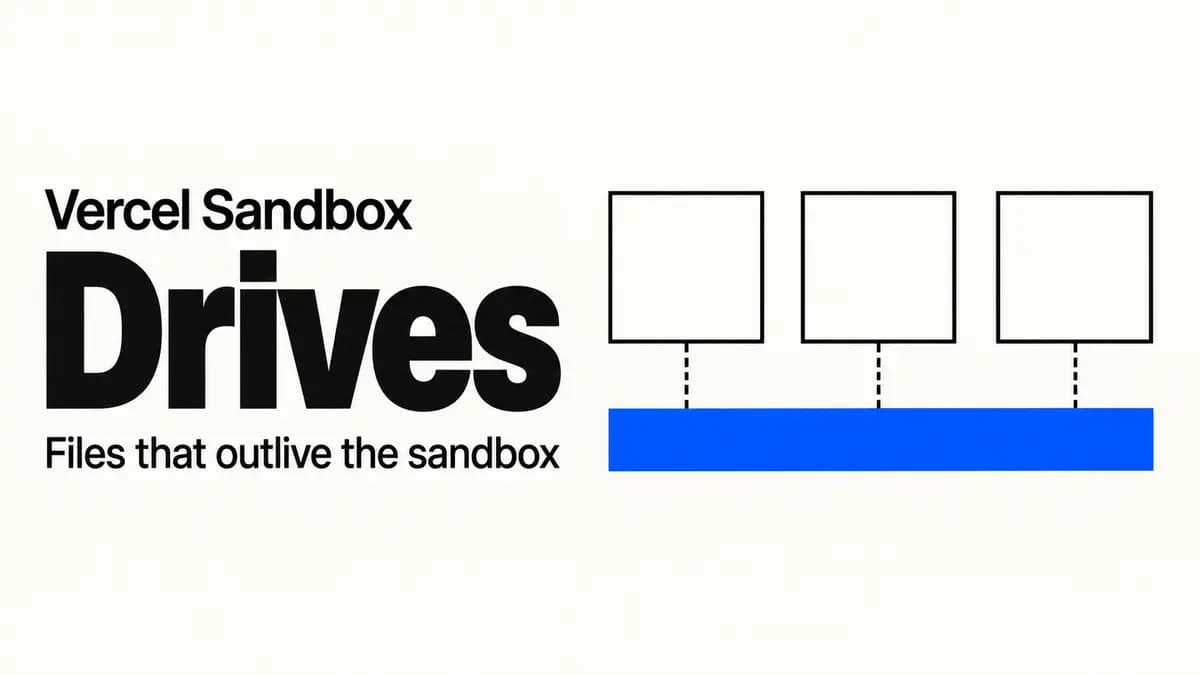
Vercel made Drives generally available (opens in new tab) for Vercel Sandbox on October 15, on Hobby, Pro and Enterprise plans. A drive is persistent storage mounted as a directory inside a sandbox. When the sandbox stops, the files stay, and a later sandbox can mount the same drive and pick up the repository, notes or build cache the last run left behind.
Drives entered private beta in June and public beta on September 23. Forking, which lets agents branch a drive into separate copies, is also generally available.
Files that are not tied to one sandbox
Vercel’s launch post (opens in new tab) frames the problem as agents whose work continues across runs and sometimes needs a different environment, with other tools, runtimes or compute. Without a separate storage layer, moving to a new sandbox means moving the workspace too.
The setup is short. A drive is created once with Drive.getOrCreate() in the Sandbox SDK or sandbox drives get-or-create in the CLI, then passed as a mount when a sandbox is created. Everything under the mount path persists; everything else belongs to the sandbox. A sandbox can mount up to four drives, each at its own path.
The Drives documentation (opens in new tab) separates this from sandbox snapshots, which Vercel already offered. A snapshot captures a whole sandbox filesystem, gives each new sandbox its own copy, and expires after 30 days by default. A drive is one directory that persists until it is deleted. The two can be combined: start from a snapshot with tools installed, then mount a drive for project files and cached dependencies.
One writer, many readers
The constraint that shapes multi-agent designs is the write lock. Only one sandbox at a time can mount a given drive read-write. Other sandboxes can mount a read-only snapshot of it, but each snapshot reflects the drive at the moment it was mounted and does not see later writes. To get newer data, a reader mounts a fresh snapshot.
Forking covers parallel work. A fork copies the drive’s data into a new, independently writable drive with the same region and maximum size, so several agents can each start from the same base files and change them separately. Forks do not merge back into the original. A drive also has to be mounted read-write and written to at least once before it can be forked; otherwise the call fails with drive_not_initialized.
Region is fixed at creation. Drives are created in iad1 unless another region is set, and a sandbox can only mount a drive in its own main region. Requesting an existing drive with a different region or size fails with a conflict error. Deleting a drive removes its data permanently, and a drive attached to a running sandbox cannot be deleted.
Size and price
Drives default to 1 TiB of maximum size, or 1 GiB on Hobby, with a 16 TiB default quota and more by request. Billing is on the space actually used, not the provisioned size, measured hourly.
At the default iad1 region rates in Vercel’s Sandbox pricing table (opens in new tab), drive storage costs $0.05 per GB-month, below the $0.08 per GB-month for sandbox snapshots. Reads cost $0.0015 per GB and writes $0.004 per GB. Hobby includes 15 GB of drive storage over the account’s lifetime and 30 GB each of monthly reads and writes. Rates vary by region.
The documentation also notes a performance trade-off: writes and cached reads run at NVMe speed, while reads that miss the cache are slower.
Where it fits
For teams already running agents in Vercel Sandbox, Drives can replace the work of copying a workspace in and out of object storage between runs, and can serve as a shared cache for dependencies that every sandbox would otherwise reinstall. Vercel also ships a Drives starter template (opens in new tab) for eve (opens in new tab), its open-source agent framework.
The design favors one agent writing at a time. Workflows where several agents need to write to the same files at once still need forks and a merge step of their own, or a different store.