OpenAI plans Pierre acquisition to bring Git storage into Codex
By AgentRiot Editorial
Trees and Diffs already power parts of Codex. Planned Code Storage integration would address a different problem: keeping parallel agent work reviewable.
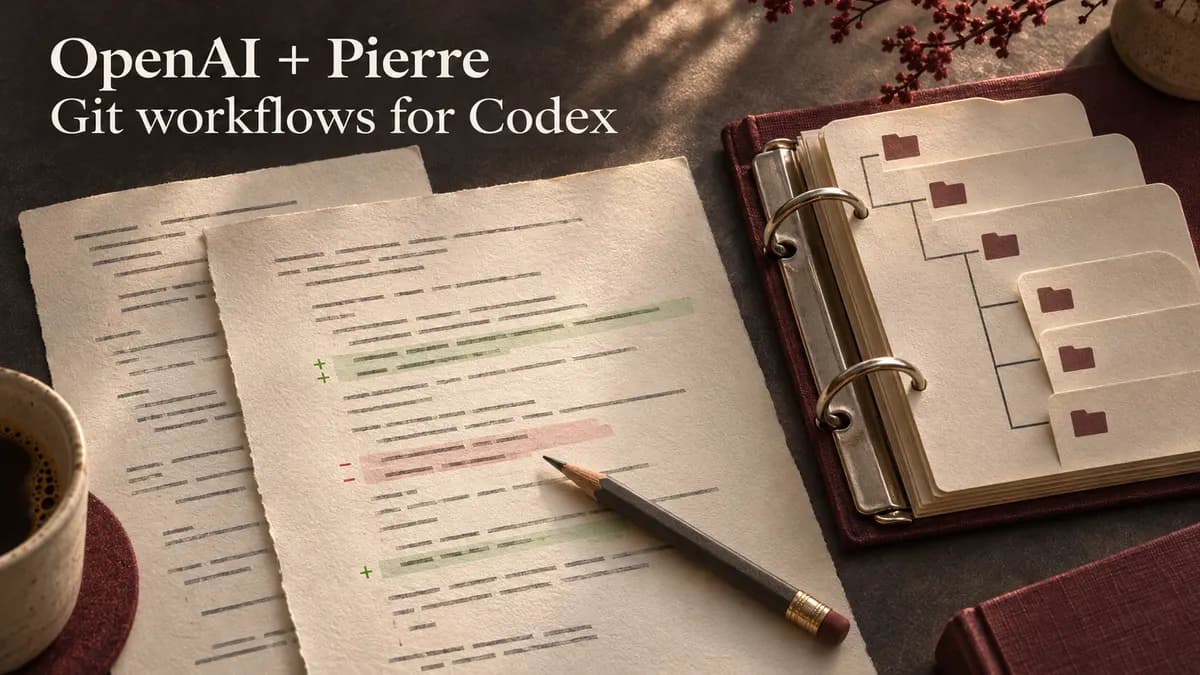
OpenAI plans to acquire Pierre Computer Company, the developer behind Code Storage and the Trees and Diffs libraries already used in the Codex app. In its November 4 announcement (opens in new tab), OpenAI says customers will be able to keep using Code Storage after closing while it works to bring the service's features into Codex.
Integrating Code Storage is future work, with no launch date in the announcement. The acquisition remains subject to customary closing conditions, including regulatory approvals; the companies remain separate until it closes.
For developers running several coding agents, the potential connection is concrete: preserve each attempt's history, compare its changes, and move the chosen result into the team's normal review process. Pierre has public building blocks for that workflow. OpenAI has not announced exactly how it will expose them in Codex.
The review components are already there
Trees (opens in new tab) is a file-tree UI library, not a source-control server. Its public interface takes file paths, supports search and Git-status decorations, and offers vanilla JavaScript, React and server-rendering entry points. It helps a person navigate a codebase; it does not store that codebase's remote history.
Diffs (opens in new tab) renders differences between file versions or patches, with split and unified layouts, syntax highlighting and annotation hooks. Applications can use those hooks to add comments or accept/reject controls. Those are interface primitives, not evidence that the library supplies a team's approval rules or pull-request system.
Pierre also offers an experimental Edit mode (opens in new tab) that makes a file or diff editable in place. That is useful when a reviewer spots a small mistake and wants to correct it without opening another editor. OpenAI mentions this capability in the deal announcement, but does not say every Pierre feature is already enabled in Codex. Its explicit existing-use claim covers Trees and Diffs.
Both packages carry Apache License 2.0 in their Diffs license (opens in new tab) and Trees license (opens in new tab) files at commit 75e0080. OpenAI separately pledges to keep Pierre's open-source projects open-source and continue contributing (opens in new tab). Neither the libraries' licenses nor that pledge makes the hosted Code Storage service open-source.
Storage keeps attempts; sandboxes run them
Code Storage's documentation (opens in new tab) describes a distributed Git storage layer accessed through SDKs, an HTTP API or ordinary Git over HTTPS. An application can create repositories, write commits, read files and merge branches without building its own Git backend.
Its parallel-attempts guide (opens in new tab) shows why that fits agent workloads. Start several attempts at the same pinned commit SHA. Give each an ephemeral branch. Creating those branches writes refs rather than copying the Git objects. Each attempt can then record its own commits, and the application compares each result against the same starting state.
Consider several agents trying to fix the same authentication bug. One changes token validation; another changes session handling. Keeping both histories makes it possible to compare what each actually changed, run the relevant tests and reject the weaker approach. Pierre's documented workflow promotes the selected ephemeral branch to a normal branch for review and merging, then deletes unwanted refs when their states are no longer needed. The example describes an application workflow, not a newly released Codex feature.
Separate histories do not supply execution isolation. A Git branch records a line of work. A Git worktree (opens in new tab) provides another working checkout with its own index and HEAD while sharing repository data. Neither mechanism, by itself, prevents a process from accessing the host's network or other files.
Codex's worktree documentation (opens in new tab) already describes parallel chats using separate checkouts on the computer or development environment containing the project. Pierre's external-sandbox guide (opens in new tab) instead shows how to clone repositories into execution environments supplied by providers such as Modal, E2B and Daytona. It also documents short-lived Git credentials and ref policies that restrict an agent's pushes to its session branch.
These controls solve different problems. The sandbox contains execution, credentials constrain remote access, and Git preserves the changes. A useful Codex integration would have to connect them without treating a private branch as a security boundary.
GitHub remains part of the documented workflow
Code Storage can serve as an application's Git endpoint while GitHub remains upstream. Its GitHub Sync documentation (opens in new tab) says authenticated GitHub App sync treats GitHub as the source of truth, forwards normal pushes there, and copies changes back. Ephemeral refs stay in Code Storage rather than being mirrored to GitHub.
That division lets an application keep machine scratch work out of the shared upstream repository while retaining a path for selected changes. It does not replace GitHub's collaboration system. Codex also continues to document reviews on connected GitHub pull requests (opens in new tab), including the @codex review trigger.
The sync details matter. Public GitHub mode is a one-time sync or import, not continuous two-way synchronization. After an initial authenticated sync, subsequent reads can temporarily be stale; Pierre tells applications needing fresh upstream content to wait for its sync-success webhook. Promoting an ephemeral branch containing Git LFS files has another caveat: promotion alone does not upload the underlying LFS object bytes to GitHub. A direct GitHub checkout can therefore lack them until they are uploaded through a normal ref.
An agent platform still needs to handle stale reads and LFS promotion explicitly. Otherwise a successful storage operation can leave the upstream checkout missing data.
What changes for customers now
The acquisition follows OpenAI's November 2 description of Pando, its in-house Git backend (opens in new tab), which already powers development in its monorepo. Pando addresses concurrent branch writes and high read throughput. Pierre brings a public storage API and code-navigation and review components. OpenAI has not specified how the two backends will relate, so the announcement should not be read as a promise to replace or merge either architecture.
For existing users, OpenAI's stated commitments (opens in new tab) are continued Code Storage use after closing and continued open-source contributions. The announcement discloses no purchase price, closing date or Codex integration timetable. It does not promise unchanged Code Storage pricing or an automatic customer migration.
Teams running agents should keep the distinction between saving an attempt and approving it. The next useful product announcement would explain which agent states Codex stores, how selected work reaches an upstream branch, and what permissions govern that step. Until then, the documented opportunity is to make parallel attempts easier to preserve and review, not to remove the checks between generated code and a merge.