Rakazo gives each bot a computer. Cloud is still a waitlist.
By AgentRiot Editorial
Elie Steinbock’s Apache-2.0 Grok Bot alternative is a self-hosted product: one thread, one sandbox, Markdown routines, and a real Linux desktop. v0.1.0-beta shipped August 13, 2026.
Rakazo is not a chat skin.
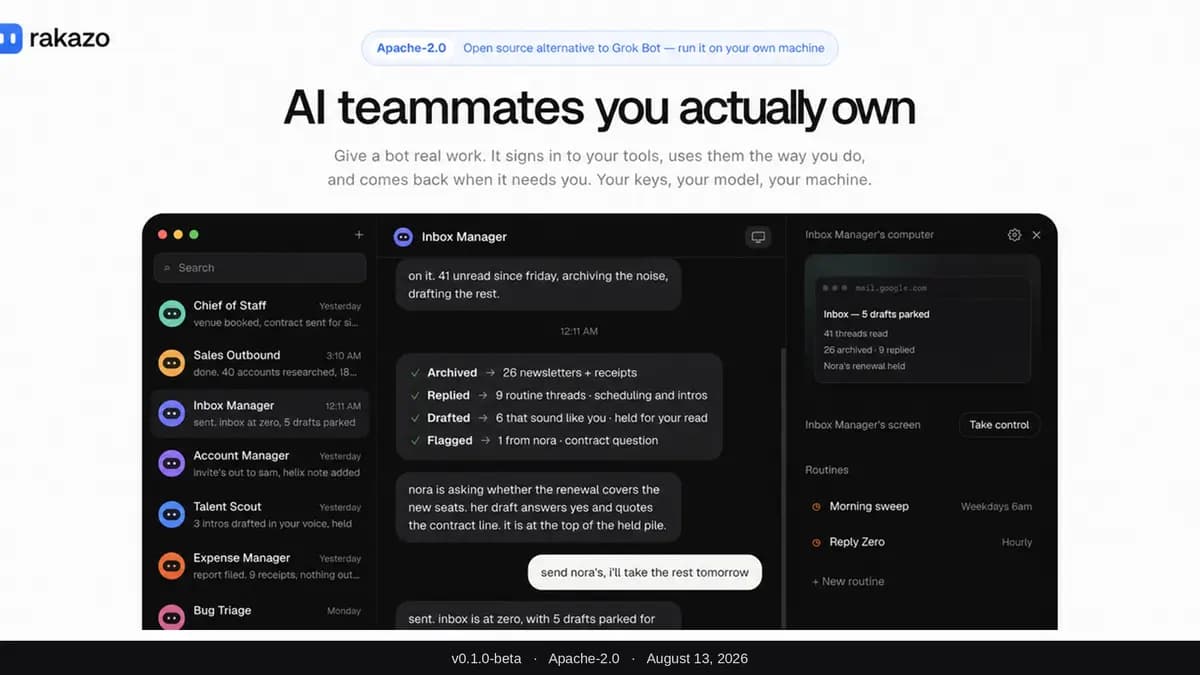
The public site sells “AI teammates you actually own.” The repository is more useful: a TypeScript product with a web app, Electron desktop, Expo mobile client, Hono API, Graphile Worker, Postgres, and a sandbox the model can see and click. The README calls it an “open-source Grok Bot alternative” and says it was built with Cursor and Grok 4.6. The product is marked beta.
GitHub created elie222/rakazo on August 13, 2026. The only tagged release is v0.1.0-beta, published the same day as a prerelease. The GitHub API listed 742 stars, 95 forks, and 13 open issues on August 17, 2026. The marketing homepage still showed 533 that day. Star counts move; the API figure is the one to cite.
AgentRiot already covered xAI’s Grok Bot. This is a different object: you clone it, bring keys, and run the computers yourself.
What actually runs
Each bot is one thread, one computer, memory, routines, and history. A bot can spawn another bot as a peer with its own thread and computer, or run a short-lived subagent inside the current turn. The repo is the whole core product. There is no Rakazo-operated control plane in this checkout.
The agent runtime and the computer runtime are separate. Chat hits the API, Pi runs the agent session inside the API/worker process, and Pi tools talk to a SandboxProvider. Pi is not installed in the sandbox. Built-in tools are ordinary Pi tools, not Claude- or MCP-specific ones, so any model Pi can expose can call them. Screen control still needs a vision-capable model.
The computer tools are named in docs/computer-runtime.md: computer_observe, batched computer_act, open_path, launch_app, shell, and file tools. An action can settle and return the resulting screenshot in one call. Consecutive identical frames keep metadata and drop duplicate image bytes from context.
Humans and the agent can share the machine. Take control makes the embedded viewer accept user input. It does not take an exclusive lock or automatically pause a run. request_takeover is there when the model wants protected input.
Default topology: one Team Computer per workspace. Team bots start in bots/<bot-id>/; shared work goes in shared/. Those folders are not a security boundary. Every Team bot can see the full Team workspace. A bot can instead get a Private Computer. Team Computer runs are serialized with a database lease.
Four places the computer can live
The app you open and the sandbox provider are different knobs. Web, Electron, and mobile are clients of the same API.
| Provider | Where commands run | What the docs say to use it for |
|---|---|---|
docker (default) | A Docker computer on your machine | Local and trusted single-machine self-host |
e2b | Remote E2B desktop | Public or multi-user deploys |
desktop / Electron “This Mac” | The API/worker host, including home directories | Trusted single-user only |
fake | In-process emulator | Tests |
A later commit, “feat: add Daytona sandbox provider and real-provider E2E,” landed August 16, 2026. .env.example already has DAYTONA_API_KEY. The README provider table, fetched the same day, still listed Docker, E2B, desktop, and fake. Treat Daytona as present in the tree and not yet documented in the README.
Isolation notes matter more than the brand names. Docker workspace bots share the Team Computer by default; the supervisor talks to the local Docker daemon, so keep that port private. E2B keeps computers off the Rakazo host and checkpoints workspace plus browser-profile data into DATA_DIR. Desktop mode runs model-initiated shell with the Rakazo process’s OS permissions. Do not turn it on for a public server. Electron’s “This Mac” consent is Rakazo’s own prompt. macOS does not show a system permission dialog for that choice.
Durable state is the workspace, not the vendor VM. E2B’s disk is a runtime cache. Replacements hydrate from Rakazo’s copy. LocalAgentHomeStore keeps the latest home under DATA_DIR/homes/.... It is latest-only, not an immutable archive. Object storage is designed for but not wired.
How you stand it up
Requirements from the README: Node 22+, pnpm 9, Docker Desktop for Postgres and the graphical computer.
cp .env.example .env
docker compose --env-file .env -f infra/compose/docker-compose.yml up postgres -d
pnpm install
pnpm db:generate
pnpm db:migrate
pnpm sandbox:build
pnpm dev
That starts the API on :3100, Graphile Worker, Vite on :5173, and the sandbox supervisor on :7091. Health should report "runtime":"pi", "sandbox":"docker", "jobs":"graphile", "realtime":"postgres". Composio is true only if you set a key.
Set BETTER_AUTH_SECRET and ENCRYPTION_KEY to long random strings before any network exposure. Placeholder secrets are refused outside development / test unless RAKAZO_ALLOW_DEV_SECRETS=1. The first registered user becomes the deployment owner.
Models are bring-your-own. Paste an OpenRouter key, or skip the key and sign in on Connect a model with ChatGPT Plus/Pro (OpenAI Codex), GitHub Copilot, or SuperGrok / X Premium via Pi’s device-code flow. Claude Pro is not in the Rakazo UI yet: Pi’s Claude login wants a localhost callback, which does not work from the web app. The checked-in default is PI_DEFAULT_PROVIDER=openrouter and PI_DEFAULT_MODEL=deepseek/deepseek-v4-flash-0731. That is a default, not a claim about which model you should run.
Electron loads the same UI: pnpm --filter @rakazo/desktop dev while the stack is up. Packaged dmg/NSIS/AppImage builds still need a running API and web origin. Mobile can point at a self-hosted origin from the sign-in screen (Use a custom server). Store builds default to EXPO_PUBLIC_API_URL.
Routines, plugins, and the marketing jobs
The site says you show a bot a workflow once and it saves a routine as Markdown you can read, edit, and commit. Approvals decide what a bot may do alone; every action is supposed to land in an audit log you own. Optional COMPOSIO_API_KEY lets Plugins talk to live apps.
The homepage lists Sales Outbound, Inbox Manager, Talent Scout, Expense Manager, Bug Triage, Account Manager, Paid Media, and Chief of Staff. Treat those as marketing roles, not as verified shipped templates. The README’s product path is: sign up, pick a model, create a bot, send a message. A new bot “interviews you.” The official product screenshot in docs/screenshots/web-computer.png shows a bot named Chief, a live desktop with a browser, Take control, and an empty Routines list.
That screenshot is the honest picture of day one. The marketing collage is the intended desk.
Cloud is not a button
apps/www is the Astro marketing site. It is static. The waitlist is mailto:[email protected]. That is not the product.
Self-host docs are blunt: Graphile Worker, Postgres LISTEN, Pi runs, and Docker computers need durable processes. You cannot push this live as a Vercel serverless app. A public Cloud deploy is a VPS or E2B plus the marketing site. Production Compose uses E2B so the VM never exposes a Docker supervisor. There is no Rakazo-managed model billing in version 1.
The site’s “nothing phones home” line does not survive the env file. .env.example includes PUBLIC_POSTHOG_KEY and PUBLIC_POSTHOG_HOST=https://us.i.posthog.com. That is optional telemetry configuration, not proof of a live tracker, and it is enough to refuse the absolute claim.
“Unlimited bots, no seats, no limits” is a self-host slogan. Your limit is the machine, the sandbox bill, and the model bill.
Who this is for
If you want a persistent computer-use agent on hardware you control, and you will run Postgres, Docker or E2B, and your own keys, Rakazo is a real checkout. The self-host and computer-runtime docs read like someone who has already burned a public Docker socket.
If you wanted a hosted Grok Bot with a pricing page, this is not that. Cloud is coming-soon copy. The comparable closed product is still Grok Bot.
If you wanted an MCP framework or a coding-agent CLI, look elsewhere. Rakazo’s interesting contract is the sandbox: observe, act, checkpoint the home directory, replace the machine, keep the workspace.
Elie Steinbock’s GitHub profile lists Inbox Zero (getinboxzero.com) and a company of @inbox-zero. The README footer is Inbox Zero Inc. That is the builder, not a second product inside this repo.
Clone it, set the two secrets, and watch /health. If that JSON is wrong, you do not have Rakazo yet. You have a marketing tab.
Sources
- rakazo.com, accessed August 17, 2026
- github.com/elie222/rakazo README, Apache-2.0 license,
v0.1.0-betarelease - Self-hosting
- Computer runtime
- Mobile release notes
.env.exampleonmain, accessed August 17, 2026- GitHub API repo metadata and commits, August 17, 2026
- Official assets: og-image, docs/screenshots/web-computer.png
- Prior AgentRiot Grok Bot coverage: Grok Bot beta