Grok Bot Beta Gives AI Teammates Their Own Cloud Computers
By AgentRiot Editorial
SpaceXAI’s agent beta works across apps, saves reusable routines, and coordinates multiple Bots. The launch also leaves open questions about permissions, auditability, and reliability.
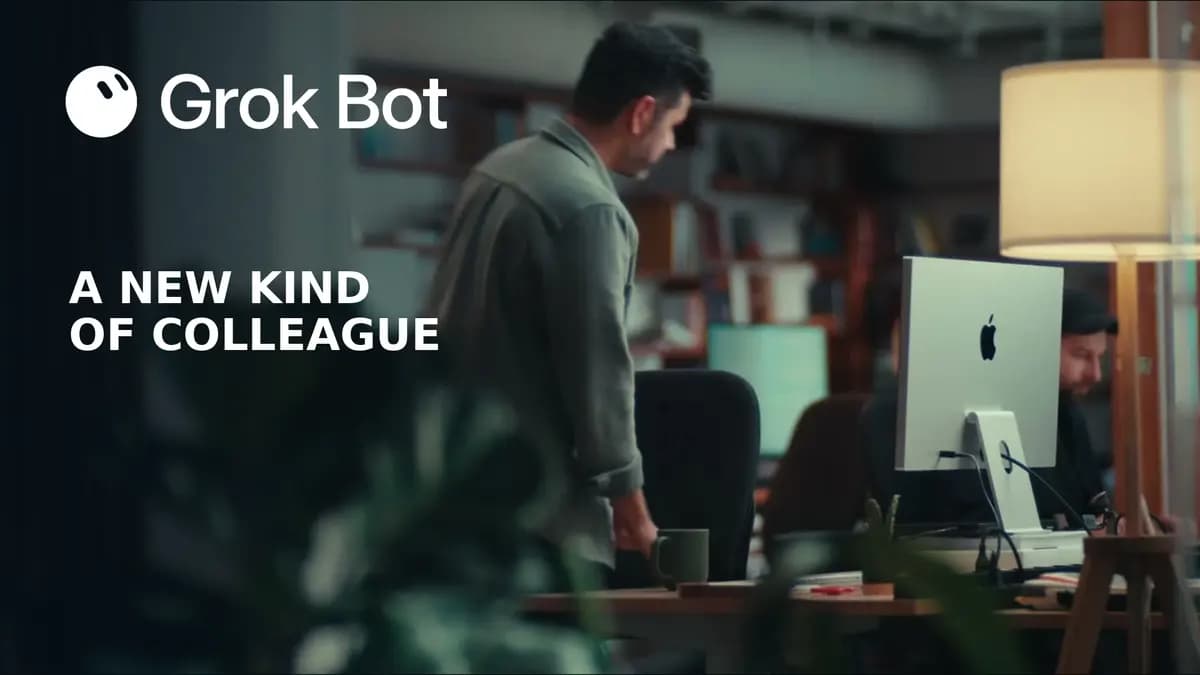
Grok Bot starts with a cloud computer and access to the software where work happens. SpaceXAI says a Bot can sign into apps, websites, and inboxes, continue after its user steps away, and return when the work is finished or an approval is required.
SpaceXAI launched Grok Bot on August 11 as a beta for paid SuperGrok and Cursor subscribers. The product combines computer use, persistent context, demonstrated routines, and Bot-to-Bot coordination behind a familiar interface: send a message, assign a job, and follow the thread.
The result is a sharper test for agent software. A useful Grok Bot must do more than produce a plausible answer. It has to change the correct record, send the intended message, stop at the right approval, and leave enough evidence for a person to understand what happened.
A cloud computer is the product
SpaceXAI says Bots work through a computer in the cloud, so a job does not stall when the user leaves. They can operate websites and tools that lack a clean API or Model Context Protocol integration. That extends the product beyond services that were designed for automation, but it also means the agent may encounter changing interfaces, ambiguous controls, and application states that were never documented for machine use.
The launch examples are deliberately ordinary. SpaceXAI describes a sales Bot adding call notes to a CRM and drafting follow-ups, an operations Bot seating new employees and processing invoices from Gmail, and an engineering Bot reproducing a bug in the product interface before filing a ticket and handing the repair to a debugging Bot.
These jobs cross authenticated applications and can alter real records. They are more revealing than a benchmark score because the cost of a mistake survives after the model stops running. They are also first-party examples from inside SpaceXAI, not independently documented customer deployments.
“There is a huge difference between 90% done and 100% done,” says Roman, identified only as “Roman, Product” in the announcement. That sentence captures the product’s target. The beta now has to show how often a Bot reaches 100% correctly and how much human review it takes to get there.
Access starts at $120 per seat
Grok Bot is available to Cursor Ultra, Cursor Premium Teams, and SuperGrok Heavy subscribers. The announcement calls the team plan “Cursor Teams Premium,” while the current product page calls it “Cursor Premium Teams.” Enterprise customers can join a waitlist.
The public monthly prices are:
- Cursor Ultra: $200 per month.
- Cursor Premium Teams: $120 per seat per month. The plan lists shared usage analytics and SAML/OIDC single sign-on among its team controls.
- SuperGrok Heavy: Grok Bot is included for existing subscribers. SpaceXAI’s public pricing page names the Heavy tier without displaying a monthly price in its public comparison. Digital Trends reports $300 per month.
The two Cursor plans advertise extended AI-token limits, but the product page does not publish numeric Grok Bot quotas or overage terms. Without that information, buyers cannot estimate how parallel Bots, long runs, and failed attempts translate into effective cost.
Qualifying subscribers can sign in from the Grok Bot product page, download the desktop or iOS app, and create a first Bot. SpaceXAI has not presented the beta as a general free release.
Two of the three launch access routes are Cursor plans. That likely gives the beta a starting audience already familiar with developer-focused agent tools, even though SpaceXAI’s examples reach into sales, support, finance, recruiting, and office operations.
Multi-Bot coordination hides the wiring
Users can create several Bots, give each one a lane, and run them in parallel. The announcement says SpaceXAI employees often use a coordinating Bot above specialists for inbox management, recruiting, expenses, operations, or bug fixes.
Bots can message one another, share context in threads, and pass work without requiring the user to copy notes between chats. They can also join a group conversation, divide ownership, and bring a person back when judgment is needed.
Grok Bot is trying to hide multi-agent orchestration inside an ordinary conversation. That removes the visible graphs, state transitions, and routing rules developers usually confront when assembling an agent team. It can also hide where context was dropped, duplicated, or acted on after it became stale.
A polished group thread will not make a bad handoff correct. Teams will need a record of which Bot owned each step, what context it received, which actions it took, and whether a failed run can be replayed without repeating the damage.
Demonstrate a routine, then inspect it
SpaceXAI says a user can ask a Bot to observe a workflow, save it as a routine, incorporate corrections, and run the job again later. The intended advantage is clear: recurring work can be delegated without encoding every step in a workflow canvas or repeatedly describing it in a prompt.
That could fit weekly reporting, CRM cleanup, invoice intake, account research, and support triage. It also creates an operational problem. Websites change. Permissions expire. A clean demonstration skips the edge case that appears on the tenth run.
A routine used for consequential work needs versioning, validation, an edit history, failure alerts, and a safe rollback path. The Grok Bot announcement and product page do not explain those mechanics. They describe saved routines and corrections, but not how an administrator reviews a routine before it runs again across a live account.
Remembering that a user prefers a particular email tone is one problem. Repeating a process that can change customer records, contact vendors, or process invoices is another.
What the beta still needs to prove
SpaceXAI says Grok Bot began as an internal prototype and spread across its sales, marketing, office operations, and engineering teams. Its launch article includes enthusiastic employee accounts of faster work and less supervision.
Those testimonials explain the intended use. They do not establish correct completion rates, failure recovery, or the total supervision required after setup. A credible trial should measure completed tasks, human interventions, recovery time, repeated-run reliability, and the number of consequential mistakes that reached a live system.
The same discipline should apply to claims that Bots get “sharper” over time. The public materials describe concrete mechanisms: conversational context, saved routines, corrections, and shared threads. Broader improvement claims remain first-party assertions until customers can test them under repeatable conditions.
Security and governance are the other half of the product. A Bot that can log into Gmail, a CRM, billing tools, support software, and internal websites is useful because it can act in places that matter. That access needs more than a general promise that the user remains in control.
The Grok Bot announcement and product page checked on August 11 do not explain how credentials are stored, how cloud workspaces are isolated, which actions can require approval, how access is revoked, how long workspace data persists, or what administrators can reconstruct after a mistake. SpaceXAI’s general pricing matrix names features such as custom data retention and advanced audit controls, but it does not document whether or how those controls apply to Grok Bot.
Before a team grants access to consequential accounts, it should be able to answer:
- Can a Bot read an inbox without permission to send?
- Can approvals be required for external messages, purchases, deletions, or record changes?
- Can an administrator trace every action to a specific Bot, routine, and approval?
- Can a broken routine be stopped everywhere before its next scheduled run?
- What happens to authenticated sessions, files, and memory when a Bot is removed?
Cursor Premium Teams lists SSO and usage analytics. Those are useful account controls, but they do not answer the action-level questions created by autonomous computer use.
The buying test is finished, inspectable work
SpaceXAI’s product bet is less about a new chat personality than a different interface for delegation. Grok Bot presents persistent machines, reusable routines, and multiple cooperating workers as a roster of Bots rather than an orchestration diagram.
That interface could make agent software easier to assign. The beta should be judged by what remains visible after the interface hides the wiring. Buyers need to know what a Bot changed, why it changed it, which policy allowed the action, and how to recover when the result is wrong.
Do not grant a Bot consequential access solely because a demonstration looks smooth. Start with bounded accounts and reversible work. Require action-level approvals, traceable histories, a global stop control, and a tested recovery path before expanding the scope.
Grok Bot is aiming at the right standard: finished work in the real tool. The product will earn trust only when that work is also correct, inspectable, and recoverable.