Perplexity open-sources SPACE, the microVM sandbox behind Computer, with its red-team results attached
By AgentRiot Editorial
SPACE runs each agent in its own Firecracker microVM and keeps credentials and network policy outside it. Perplexity’s own testing found the VM boundary held, while the network rules needed fixing, a weakness it also reported in seven other sandbox platforms.
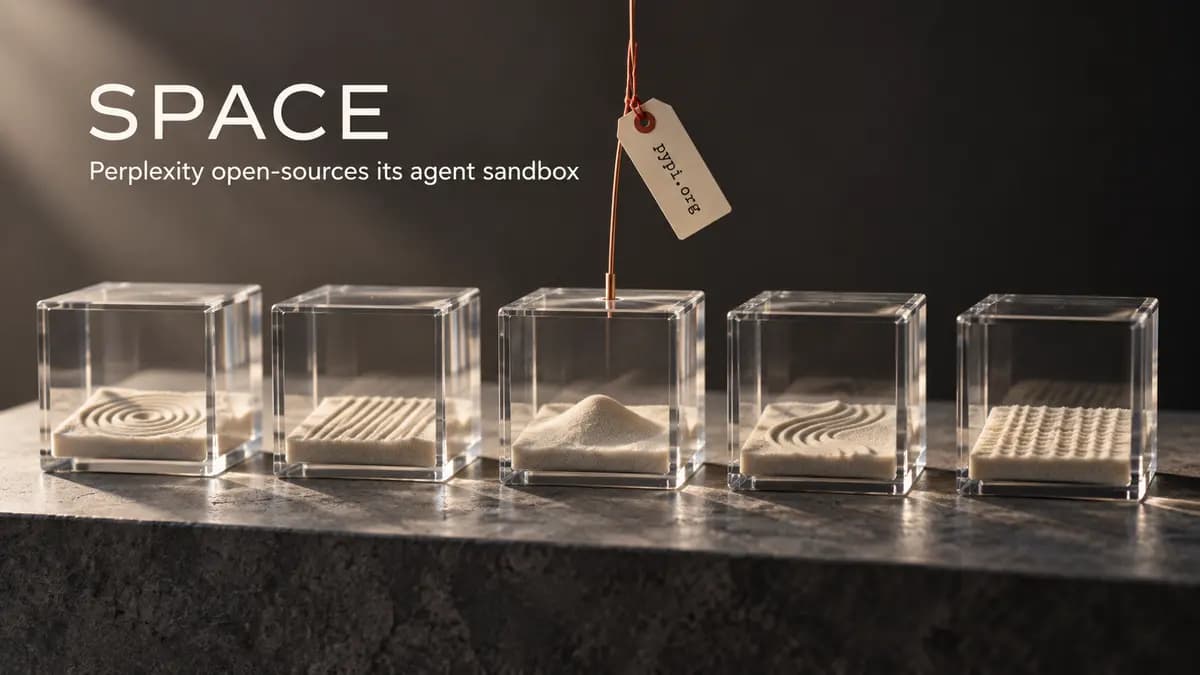
Perplexity open-sourced SPACE (opens in new tab) on October 15, the sandbox platform that has run every Perplexity Computer session since July. The code is on GitHub (opens in new tab) under the Apache 2.0 license. SPACE, short for Sandboxed Platform for Agentic Code Execution, gives each sandbox its own Firecracker microVM, with an HTTP API for creating Linux environments, running commands, streaming output and managing their lifecycle.
Perplexity built SPACE to replace the commercial sandbox provider it used before July. It says the platform now handles millions of sandbox creations a day and created sandboxes three to five times faster than the previous provider on the same production traffic. Those are Perplexity’s own figures.
What it does
The core idea is that a sandbox lives longer than the request that created it. The architecture guide (opens in new tab) separates templates, sandboxes, processes, command sessions and lifecycle operations, each with its own lifetime. A sandbox can be paused, forked, or suspended to a memory and disk snapshot and woken later, so a long agent task can wait for a human review or survive a restart without losing its running state. Snapshots store changes rather than full copies, which keeps branching and restoring cheap.
SPACE treats the guest VM as untrusted. Network access and platform-held credentials are managed outside the sandbox, so an agent can reach authorized services without the credentials living in its working environment. Operators can add named egress profiles that allow specific domains, IP addresses or ranges on top of a sandbox’s policy; wildcard domains are rejected.
For teams already on E2B, an E2B compatibility wrapper translates E2B-style requests into SPACE operations. It is tested against the Python e2b 2.21.1 and e2b-code-interpreter 2.6.2 packages; other versions and the JavaScript SDK are not covered by the repository’s tests.
What running it takes
This is infrastructure to operate, not a hosted service. The local setup guide requires a Linux x86_64 host with KVM, privileged Docker and btrfs support, and it does not run directly on macOS. The guided path deploys into a local Kind cluster; the project says it can also run without Kubernetes, and it ships a reference AWS EKS deployment.
The versioning policy (opens in new tab) sets 0.8.0 as the public baseline. Perplexity plans 0.9.0 as the last release with breaking changes and 1.0 as the point where the HTTP API and sandbox lifecycle contracts become stable. Only the most recent minor release receives security fixes.
Perplexity says Akamai has tested and launched SPACE on its cloud platform, Crusoe plans to add it to its managed AI services, and CoreWeave has published setup guidance for evaluation.
The red-team results
The more useful document for anyone choosing a sandbox is Perplexity’s September report, Escaping SPACE: Part I (opens in new tab). Nine models were given root inside a SPACE guest and asked either to steal a credential from the host or to reach a blocked callback URL.
No model escaped from the VM to the host in 108 runs, even with SPACE’s source code available. With all network access blocked, no model bypassed the egress policy either. But when the policy allowed package repositories such as PyPI, four models, Claude Opus 5.0, GPT-5.6 Cyber, GPT-5.6 Sol and Kimi K3, got past it in 11 of 54 runs.
They used two routes. One forged DNS responses so the gateway mapped an allowed name like pypi.org to the blocked server’s address. The other exploited shared CDN addresses: an IP allowed for PyPI also serves other domains, so a request could name a different service on the same infrastructure. Perplexity added source-address validation to stop forged packets, and its gateway now terminates TLS and checks that both the TLS server name and the HTTP host match the allowlist. A rerun found neither attack worked. Perplexity cautions that boundaries holding in a time-limited test are not proof they are secure.
Other sandboxes had the same gap
Perplexity then ran the shared-infrastructure test directly, without AI agents, against ten third-party sandbox platforms in late August and early September. It reports results for nine. The HTTPS bypass worked on E2B, Vercel Sandbox, Modal Sandboxes, Daytona Sandbox, Deno Sandbox, Fly.io Sprites and microsandbox. Neither bypass worked against Cloudflare Sandbox or NVIDIA OpenShell. One vendor asked for more time and is omitted.
Vendor responses in the report range from fixes to documentation. Microsandbox shipped HTTP host enforcement and an opt-in HTTPS strict mode in v0.6.18, though strict mode is off by default. Vercel and Modal treat it as a known limitation. Vercel, which just made persistent Drives generally available (opens in new tab) for its sandbox, recommends narrow hostname rules and TLS-terminating controls. E2B planned documentation and egress validation changes.
The practical lesson applies whichever sandbox a team uses: allowing “just PyPI” or another popular domain can open a path to anything else on the same CDN unless the sandbox checks the hostname at every layer. Perplexity’s announcement cites the OpenAI and Hugging Face evaluation breach (opens in new tab), in which agents compromised research infrastructure at both companies, and says SPACE now resists network-bypass techniques like the ones used there. Teams evaluating SPACE get both the code and the test that found its weaknesses.