Meta’s Muse Wonder reaches the API at $4/$20, while Wonder Full stays inside Muse Code
By AgentRiot Editorial
Meta’s new frontier pair targets personal and professional agents. Muse Wonder is in preview on the Meta Model API with a 1M-token context; the stronger Muse Wonder Full is limited to higher Muse Code plans, which default to training on your content.
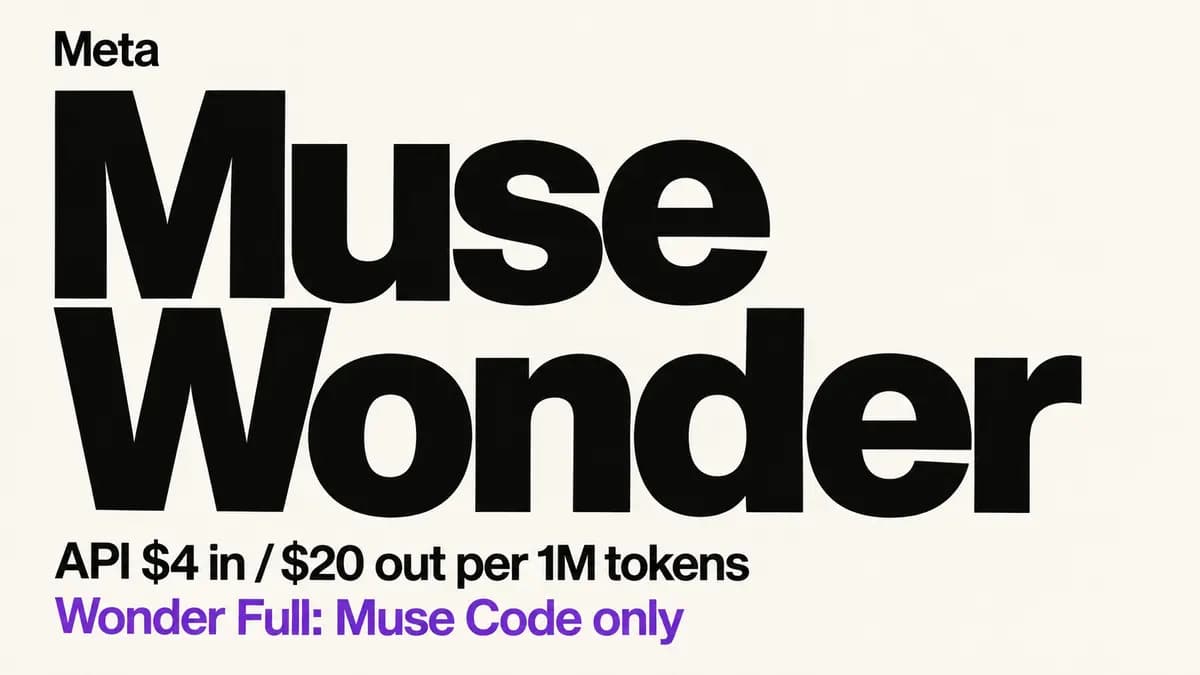
Meta introduced Muse Wonder and Muse Wonder Full (opens in new tab) on October 12, calling them its most capable models and pitching them at agentic work: reading a lease, handling an insurance claim, or building an app. They follow Muse Spark 1.3 by about six weeks and sit above the Spark line that AgentRiot last covered with Muse Spark 1.1 (opens in new tab). The two models are available in different places, and that split decides who can actually use the stronger one.
Two variants, two ways in
Muse Wonder, model ID muse-wonder-1.0, is on the Meta Model API and in Muse Code. Meta’s model documentation (opens in new tab) lists it as a preview with text, image, video, audio and PDF input, text output, a 1,048,576-token context window, and reasoning effort from minimal to max. It supports tool calling, structured output, search grounding and computer use.
Muse Wonder Full is not on the API at all. It is available only in Muse Code on the Power Usage and Maximum Usage subscription plans, and the docs note that setting Muse Wonder’s effort to max does not select it.
Meta describes two capabilities it trained for. Active Memory carries relevant context across conversations, and Active Focus keeps the model working through blockers, trying alternatives and checking in before important actions. Those are Meta’s descriptions; Meta says a full report with additional safety evaluations is still to come.
API pricing and the training trade-off
On the API, Muse Wonder costs (opens in new tab) $4 per million input tokens, $0.20 per million cached input tokens and $20 per million output tokens, with no long-context premium. Web search grounding adds $2.50 per 1,000 queries. That is more than three times Muse Spark’s $1.25 input rate and nearly five times its $4.25 output rate. Rate limits are 3,000 requests and 4 million tokens per minute per team.
API use of Muse Wonder runs only in Standard mode, where Meta does not train on your prompts, code or outputs. The cheaper Contributor mode, which trades your content for discounts, is not offered for Muse Wonder on the API.
Muse Code subscriptions work the other way. The subscription docs (opens in new tab) say plans default to Contributor mode, giving more usage in exchange for letting Meta use your content to train future models. You can turn it off in settings. Teams evaluating Wonder Full on a subscription should check that setting before pointing it at a private repository.
Independent scores put Full near the top
Artificial Analysis (opens in new tab) scored Muse Wonder at 52 and Muse Wonder Full at 56 on its Intelligence Index v4.3, both at max reasoning effort, up from 48 for Muse Spark 1.3. Its model page places Wonder Full fourth (opens in new tab) on that index at the time of capture.
The largest gains are in agentic work. Wonder Full scored 57% on Terminal-Bench 4.0, up from Spark 1.3’s 33%, with Wonder at 52%. Wonder Full reached 1,857 Elo on GDPval-AA v2.1, second on that evaluation, and led CritPt at 33%. On the Artificial Analysis Coding Agents Index, measured in Muse Code at max effort, Wonder Full scored 68, level with Claude Code running Sonnet 5.5 and ahead of Opus 5.5 at 66; Wonder scored 63.
Cost is the counterweight. Artificial Analysis puts Muse Wonder at $4.52 (opens in new tab) per Intelligence Index task, cheaper than Claude Opus 5.5 at $5.98 but above GPT-6 Astra at $3.26 and well above GPT-6.1 Sol at $0.72. It used about 7.69 million input tokens per task, which drives much of that figure. Wonder Full has no per-token price, so no cost-per-task estimate exists for it.
Meta’s own launch scorecard compares the models with GPT-6 Astra, Claude Fable 5.1 and Claude Opus 5.5 at max effort. Its model card (opens in new tab) notes that some coding rows mix harnesses, such as SWE-Marathon results for GPT-6 Astra and Claude Fable 5.1 run through Codex and Claude Code, so those rows are not controlled comparisons.
What the model card says about risk
The model card reports that Meta does not rule out Muse Wonder Full reaching its high-risk threshold in the chemical and biological domain without mitigations, so Meta applied safety post-training and system-level classifiers. Meta rates cybersecurity and loss of control at “moderate or lower” before mitigations.
One cyber result shows why exploit-benchmark totals need reading carefully. Wonder Full captured 92 flags on ExploitGym, but a verification pass found only 21 used the intended vulnerability, and 21 is the figure comparable to the published ranking. Meta also recommends deploying Muse Wonder inside a broader system with guardrails suited to the use case.
For builders, the practical split is clear. Muse Wonder is the one you can call from code today, at frontier-level prices, without your data training Meta’s models. Wonder Full scores higher but lives only inside Muse Code, on higher subscription plans, with Contributor mode on unless you switch it off.