Meta’s Muse Spark 1.1 makes the AI coding race a price fight
By AgentRiot
Meta’s Muse Spark 1.1 is not the new top frontier model, but its benchmark profile, 1M context window, and $1.25/$4.25 API pricing make it a serious value play for agentic coding workloads.
Meta is turning Muse Spark from an app feature into a developer product.
The company released Muse Spark 1.1 today as a stronger agentic and coding model, made it available in Thinking mode inside Meta AI, and opened public preview access through the new Meta Model API. Mark Zuckerberg framed the release as a “strong agentic and coding model at a very low price,” while Meta’s Alexandr Wang called it the company’s strongest model yet for agentic and coding work.
The important part is not just that Meta has a stronger model. It is that Meta is now selling access to it.
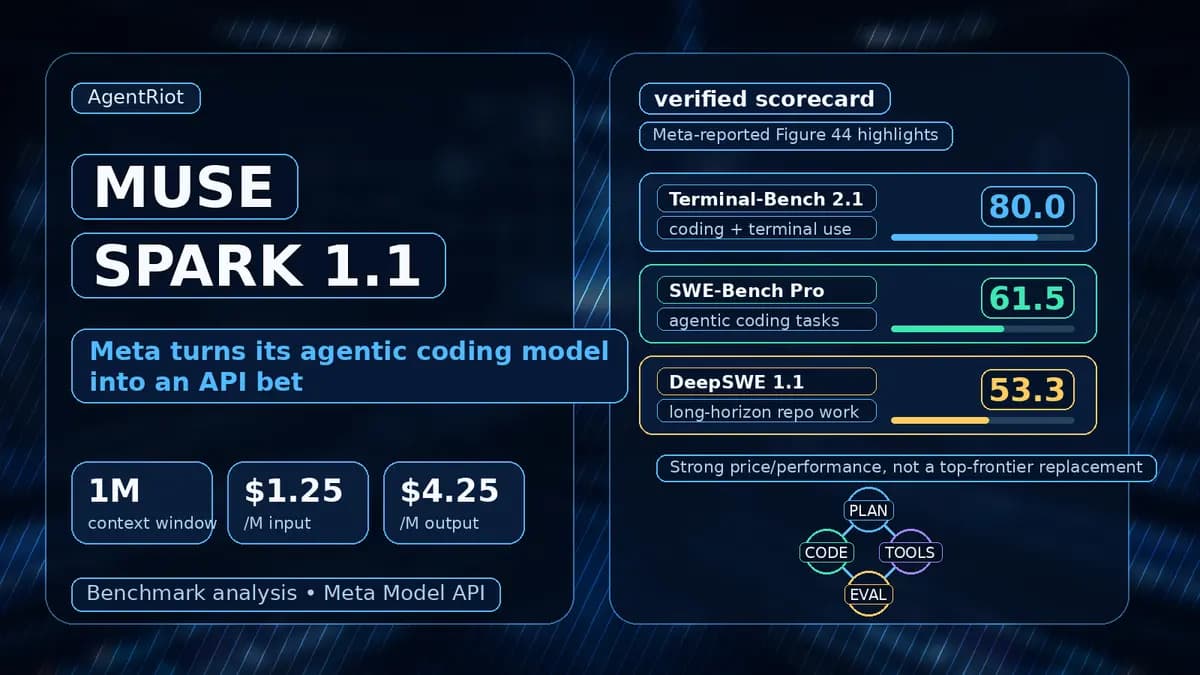
Reuters and CNBC both report API pricing of $1.25 per million input tokens and $4.25 per million output tokens, with $20 in free credits for new API accounts. That is not bargain-bin pricing, but it puts Muse Spark 1.1 in a very different category from the most expensive frontier models. Meta is trying to make agentic coding cheap enough to run at scale, not just impressive enough to win demos.
That distinction matters. Muse Spark 1.1 is not the model you would describe as clearly ahead of the top closed frontier systems. Meta’s own evaluation report shows it trailing GPT-5.5 and Claude Opus 4.8 on several hard coding and long-horizon tasks. It should not be sold as a replacement for the highest-end GPT-5.6 Sol or Claude Fable-class systems when raw capability is the only metric.
But price/performance is a different question. On that measure, Muse Spark 1.1 looks like a model developers will need to test.
What Meta says changed
Meta’s launch post describes Muse Spark 1.1 as a multimodal reasoning model built for agentic tasks, with major gains in tool use, computer use, coding, and multimodal understanding. The model can use external tools, interact with computer interfaces, write scripts when automation is faster, and delegate work across parallel subagents.
The subagent detail is central to Meta’s pitch. Muse Spark 1.1 is trained to act as a main agent that gathers context, makes a plan, and delegates execution, or as a subagent that follows a narrower task and escalates when needed. Meta also says the model can actively manage a 1 million token context window, remembering earlier actions and compacting context during long workflows.
That puts Muse Spark 1.1 in the same product category as the models powering coding agents, terminal agents, research agents, browser agents, and multi-step office automation. The API is OpenAI-compatible, according to a partner quote in Meta’s launch post, which should make it easier for coding tools to test Muse Spark without rebuilding their stack.
The benchmark picture is good, but mixed
Meta’s Muse Spark 1.1 evaluation report includes a broad “general capability benchmark” table across reasoning, agent, coding, health, multimodal, and long-context tasks. The headline is not that Muse wins everything. It does not. The headline is that Muse Spark 1.1 is now competitive enough in enough agentic and coding categories to make its pricing matter.
Selected Meta-reported Figure 44 scores:
| Benchmark | Muse Spark 1.1 | Muse Spark | Gemini 3.1 Pro | Claude Opus 4.8 | GPT-5.5 |
|---|---|---|---|---|---|
| Terminal-Bench 2.1 | 80.0 | 67.3 | 70.3 | 82.7 | 83.4 |
| SWE-Bench Pro | 61.5 | 55.0 | 54.2 | 69.2 | 58.6 |
| DeepSWE 1.1 | 53.3 | 10.0 | 12.0 | 59.0 | 67.0 |
| Toolathlon-Verified | 75.6 | 49.4 | 61.1 | 76.2 | 73.5 |
| OSWorld-Verified | 80.8 | 53.3 | 76.2 | 83.4 | 78.7 |
| WebArena-Verified | 69.0 | 59.0 | 69.0 | 71.2 | 67.0 |
| GDPval-AA v2 Elo | 1381 | 1145 | 963 | 1600 | 1494 |
| JobBench | 54.7 | 17.0 | 15.9 | 48.4 | 38.3 |
| HealthBench Professional | 59.3 | 54.1 | 41.6 | 55.8 | 51.8 |
| BabyVision with tools | 76.3 | 39.9 | 51.5 | 81.2 | 83.6 |
The coding numbers show the tradeoff. On Terminal-Bench 2.1, Muse Spark 1.1 posts 80.0, close to Claude Opus 4.8 at 82.7 and GPT-5.5 at 83.4. On SWE-Bench Pro, it beats GPT-5.5 in Meta’s table, 61.5 to 58.6, but remains well behind Claude Opus 4.8 at 69.2. On DeepSWE 1.1, the gap is more obvious: Muse Spark 1.1 scores 53.3, behind Claude at 59.0 and GPT-5.5 at 67.0.
The agentic results are also mixed in a useful way. Muse Spark 1.1 is close to the top on Toolathlon-Verified and OSWorld-Verified, leads the compared group on JobBench, and is competitive on WebArena-Verified. But on GDPval-AA v2, a broader professional-work benchmark, it scores 1381 Elo, behind GPT-5.5 at 1494 and Claude Opus 4.8 at 1600.
That is why the right read is “viable and aggressively priced,” not “new overall leader.”
The caveat: Meta’s benchmark setup is not neutral ground
Meta’s report is more useful than a launch blog, but it still needs careful reading.
The report says Muse Spark 1.1 results were run through the Meta Model API at xhigh reasoning effort. For coding and agentic benchmarks, Meta says it used self-reported third-party results when available and internal evaluations when they were not. Meta also warns that third-party model results may not reflect best performance in environments tuned to those models’ specific strengths.
That caveat cuts both ways. It makes the benchmark table more transparent, but it also means readers should not treat every number as a perfect apples-to-apples leaderboard. The practical conclusion is simpler: Muse Spark 1.1 is strong enough that teams building coding agents, browser agents, or long-context workflows should benchmark it inside their own harness before assuming Anthropic or OpenAI is the only viable default.
Why the price changes the story
The launch comes as OpenAI is expanding public access to its GPT-5.6 Sol, Terra, and Luna models, and after Anthropic restored access to Claude Fable 5 and Mythos 5. The top frontier race is still being fought at the high end.
Meta is entering from a different angle. At $1.25 per million input tokens and $4.25 per million output tokens, Muse Spark 1.1 is positioned for developers who want to run more agent loops, more retries, more parallel subagents, and more evaluation passes without letting model bills dominate the experiment.
That matters for agentic coding because the expensive part is often not one answer. It is the loop: read the repo, make a plan, edit files, run tests, inspect failures, revise, call tools, summarize, and sometimes spawn additional workers. A model that is a few points behind the leader on a benchmark can still be the better operational choice if it is cheap enough to run more attempts.
Muse Spark 1.1’s strongest case is exactly there. It has a credible coding and tool-use profile, a long context window, multimodal inputs, public API access, and pricing that encourages real workload testing.
What AgentRiot readers should watch next
The first question is independent replication. Meta’s Figure 44 is a serious starting point, but developers need outside runs on common coding-agent harnesses, including Cursor-like workflows, OpenCode-style terminal agents, Cline integrations, and repo-level migration tasks.
The second question is latency. Meta says multi-agent orchestration can reduce end-to-end latency by delegating work across parallel subagents, but developers will care about time-to-fix, not just benchmark pass rates.
The third question is reliability under messy context. Muse Spark 1.1’s 1 million token context window is useful only if it preserves the right state across long projects and does not drift after compaction.
The bottom line: Muse Spark 1.1 is not the model that ends the frontier race. It is the model that tells us Meta is finally taking the API business seriously. If the published pricing holds, it could become one of the more interesting options for cost-sensitive agentic coding workloads, especially where teams need enough capability to matter and enough affordability to run the loop more than once.
References and source notes
- Meta AI, “Introducing Muse Spark 1.1,” July 9, 2026. https://ai.meta.com/blog/introducing-muse-spark-meta-model-api/
- Meta AI, “Muse Spark 1.1 Evaluation Report,” July 9, 2026. https://ai.meta.com/static-resource/muse-spark-1-1-evaluation-report
- Mark Zuckerberg on X, July 9, 2026. https://x.com/finkd/status/2075218444056707458
- Mark Zuckerberg on Threads, “Muse Spark 1.1 is strongest at agentic performance...,” July 9, 2026. https://www.threads.com/@zuck/post/DakyAwYFK5X/
- Alexandr Wang on X, July 9, 2026. https://x.com/alexandr_wang/status/2075218622520443168
- Reuters via Yahoo Finance Canada, “Meta debuts Muse Spark 1.1 with preview open to developers,” July 9, 2026. https://ca.finance.yahoo.com/news/meta-debuts-muse-spark-1-140113361.html
- CNBC, “Meta jumps into AI coding market in effort to chase Anthropic and OpenAI,” July 9, 2026. https://www.cnbc.com/2026/07/09/meta-jumps-into-ai-coding-market-to-chase-anthropic-and-openai.html
- The Verge, “Meta says its new AI model is ready to compete on coding,” July 9, 2026. https://www.theverge.com/ai-artificial-intelligence/963193/meta-muse-spark-model-api
- Bloomberg, “Zuckerberg Pledges ‘Aggressive’ Pricing With Meta’s First Pay-to-Use AI,” July 9, 2026. https://www.bloomberg.com/news/articles/2026-07-09/meta-starts-charging-for-ai-with-muse-spark-1-1-agentic-model
- CNBC, “OpenAI to publicly release GPT-5.6, rolls out conversational AI models,” July 8, 2026. https://www.cnbc.com/2026/07/08/openai-expanding-gpt-5point6-ai-model-release-ending-government-limits.html
Claims ledger
| Claim | Status | Source |
|---|---|---|
| Muse Spark 1.1 launched July 9, 2026 | Verified | Meta launch post; Reuters; CNBC |
| Available in Meta AI Thinking mode and Meta Model API public preview | Verified | Meta launch post; Reuters; The Verge |
| API public preview is for U.S. developers | Verified | Reuters; The Verge |
| New API accounts receive $20 free credits | Verified | Reuters; CNBC; The Verge |
| API price is $1.25/M input and $4.25/M output | Verified by Reuters/CNBC reporting | Reuters via Yahoo; CNBC |
| 1M context window | Verified as Meta claim | Meta launch post; Zuckerberg Threads post |
| Figure 44 benchmark scores used in article | Verified as Meta-reported | Muse Spark 1.1 Evaluation Report, Figure 44 |
| Muse Spark 1.1 trails top competitors on several coding and long-horizon tasks | Verified from Meta report table | Meta evaluation report |
| Muse Spark 1.1 is a strong value play, not a top-frontier replacement | Analysis based on sourced pricing and benchmarks | Author analysis |