Claude Haiku 5.5 brings cheaper tokens and adjustable effort to subagents
By AgentRiot Editorial
Anthropic’s small model adds a million-token context and adjustable effort. The cheapest rates stop at 100,000 prompt tokens, and its strongest benchmark scores do not represent the default setting.
Anthropic released Claude Haiku 5.5 on October 7 (opens in new tab), pricing short requests at $0.10 per million input tokens and $0.50 per million output tokens. Those rates are one-tenth of Haiku 4.5’s, making repetitive summaries, document extraction and narrowly scoped subagent jobs cheaper to attempt.
The upgrade also changes how teams should budget that work. Haiku now has adjustable effort, adaptive thinking on by default and a one-million-token context window. But prompts over 100,000 tokens enter a five-times-higher price tier. A larger context window is useful capacity, not a promise of the lowest price throughout it.
Anthropic is also halving Sonnet 5.5’s cache-read price and introducing monthly API credits for Max and Team subscribers. For builders already using several Claude models, the announcement changes the economics of both the supporting workers and the larger model coordinating them.
The price cut has a prompt-length boundary
Anthropic’s API pricing documentation (opens in new tab) separates Haiku 5.5 requests by prompt length. All figures below are dollars per million tokens; the first price applies up to 100,000 prompt tokens, the second above that threshold:
- Uncached input: $0.10 / $0.50.
- Output: $0.50 / $2.50.
- Cache reads: $0.01 / $0.05.
- Five-minute cache writes: $0.125 / $0.625.
- One-hour cache writes: $0.20 / $1.00.
The Batch API halves input and output rates, to $0.05/$0.25 for shorter prompts and $0.25/$1.25 for longer ones. Tool charges and regional processing modifiers can still apply. These are Claude API prices, not a guarantee that every cloud provider bills identically.
For a hypothetical workload totaling one million uncached input tokens and 100,000 billed output tokens across individually short requests, Haiku 5.5 costs $0.15. The same token counts cost $1.50 on Haiku 4.5 and $3 on Sonnet 5.5. That illustration excludes caching, batch discounts, tools, regional premiums, tax and retries; it does not establish equivalent task quality or token consumption.
The distinction matters because Anthropic’s migration guide (opens in new tab) says the same input text produces approximately 30% more tokens than on Haiku 4.5, depending on content. Recount prompts and output budgets before carrying over an old cost forecast. Anthropic’s separate estimate of around 75% lower average workload cost accounts for request sizes and changed token usage; it is not a guaranteed saving on your traffic.
Higher scores require higher effort
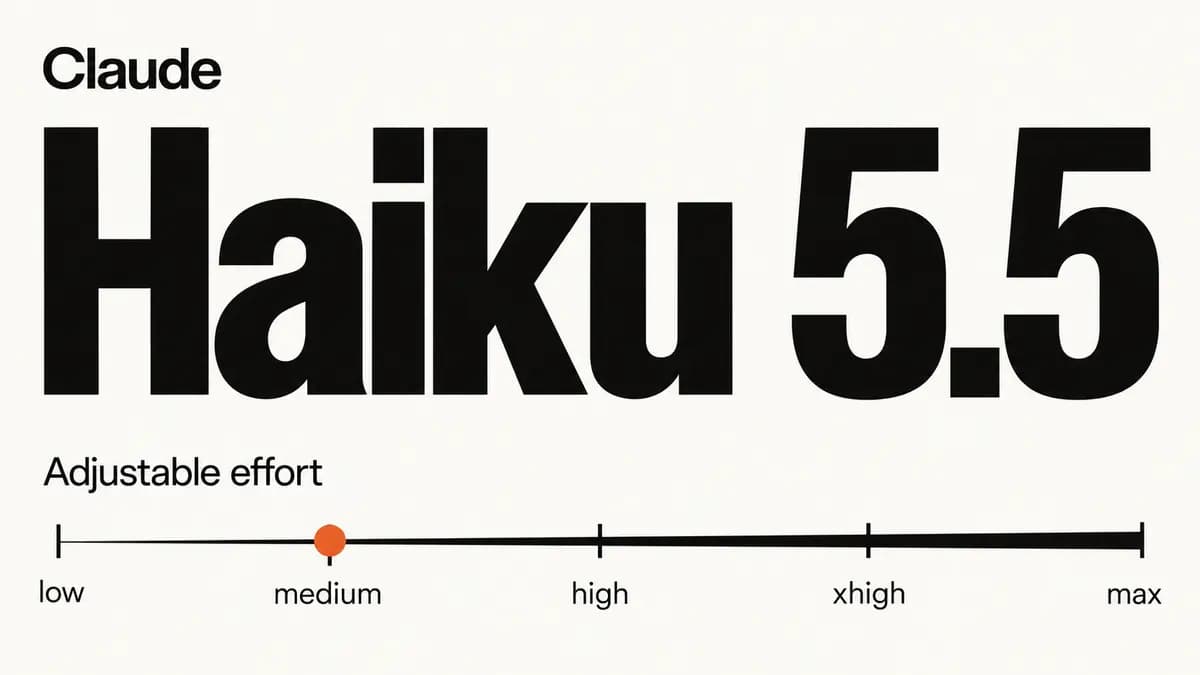
Haiku 5.5 supports low, medium, high, xhigh and max effort through output_config.effort. Medium is the API default (opens in new tab). Effort influences thinking, visible text and tool calls; it is a behavioral control, not a strict token budget.
The launch comparison (opens in new tab) shows substantial gains over Haiku 4.5, but its headline Haiku results generally use maximum effort. On Terminal-Bench 4.0, Anthropic reports 39.2%, compared with Haiku 4.5’s 0.0%, GPT-6 Luna’s 16.4% and Sonnet 5.5’s 70.6%. In Anthropic’s cost chart, Haiku’s default medium setting reaches 20.3% at $0.68 per attempt; max reaches 39.2% at $2.64.
That chart also explains why the cheapest token rate need not produce the cheapest successful coding run. Sonnet at medium scores 28.8% at the same $0.68 per attempt. At high, Sonnet scores 43.0% at $1.46, exceeding Haiku’s max score at a lower attempt cost. Those are benchmark-specific figures from Anthropic, not general production tariffs.
Computer use needs an equally careful reading. The launch lists 72.4% on OSWorld 2.1’s offline subset, against 15.7% for Haiku 4.5, 48.9% for Luna and 83.9% for Sonnet. The system card (opens in new tab) identifies that as partial credit on 82 tasks, not the share completed perfectly. Haiku’s strict pass rate is 37.1%; Sonnet’s is 48.8%.
On knowledge work, the launch lists 1,620 Elo on GDPval-AA v2.1 and 1,578 on AA-Briefcase v1.1. Sonnet remains ahead at 1,840 and 1,824; Luna is at 1,437 and 1,336. The system card attributes these evaluations to independent Artificial Analysis runs. Haiku’s default medium results are lower: 1,277 and 1,372 respectively.
The remaining launch results show the same tradeoff. Haiku scores 45.9% on Humanity’s Last Exam without tools and 57.4% with tools, versus Sonnet’s 56.9% and 64.5%; Luna has no result supplied there. FrontierCode 1.1 Main reaches 46.4%, above Luna’s 42.4% but below Sonnet’s best 52.1% at xhigh. Chartography without tools reaches 46.4%, above Haiku 4.5’s 6.4% and Luna’s 29.1%, below Sonnet’s 61.6%.
Separately, Artificial Analysis’s high-effort listing (opens in new tab) records 38 on Intelligence Index v4.3.2 and a weighted $0.08 per index task. Its configuration is labeled “High, Default Fallback”; that label and effort setting should stay attached to the result. It is neither a replication of every launch-table score nor a prediction for medium-effort production traffic.
A migration involves more than the model ID
The model documentation (opens in new tab) lists claude-haiku-5-5 on the Claude API, a one-million-token context and up to 128,000 output tokens. Anthropic also lists availability through AWS, Google Cloud and Microsoft Foundry. Text and images go in; text comes out.
The migration guide identifies breaking changes. Replace manually budgeted extended thinking with adaptive thinking, omit temperature, top_p and top_k, and remove final assistant prefills. Select returned content blocks by type, not position: a response can begin with thinking rather than answer text. Thinking also consumes max_tokens, so an old small limit can stop the response before any visible answer.
For computer use on the Claude API and Google Cloud, the old computer_20250124 declaration must become computer_toolset_20260801. Browser use is newly supported there through browser_toolset_20260801. Neither is permission to let an agent act without application-level controls.
Handle stop_reason: "refusal" explicitly. Haiku 5.5’s safeguards have no server-side fallback, and the system card reports that flagged Terminal-Bench trials stopped and failed. Anthropic’s standard cyber safeguards still block penetration testing. A stronger browser benchmark does not remove the need for restricted tools, confirmation before consequential actions and a manual-review route.
Sonnet savings and API credits are separate changes
Sonnet 5.5 cache reads now cost $0.10 per million tokens, down from $0.20 (opens in new tab). Anthropic estimates roughly 20% lower cost on most agentic work. Your saving depends on the fraction of the bill coming from cache reads; input and output rates remain $2 and $10.
The monthly API-credit terms (opens in new tab) provide $100 for Max 5x and $200 for Max 20x. Team gets $20 per Standard seat and $100 per Premium seat, pooled and capped at $500. The rollout takes several days; new subscribers must have an eligible plan for seven days and link a Console organization. Credits expire each billing cycle and do not cover interactive Claude Code or partner-cloud usage.
Haiku’s best starting job is a bounded one: extract a field, summarize a document or complete a small assignment for a larger agent. Test low and medium effort first, track prompts near the price threshold, and count retries and escalations. Keep complex coding on the larger model when it achieves a better reviewed result for less total spend.