Meta’s Muse Spark Open puts an 816B agent model in public weights, with strings attached
By AgentRiot Editorial
Meta released downloadable weights for Muse Spark Open, a 42B-active mixture-of-experts model with a 1M-token context. Artificial Analysis scores it as the strongest US open-weight model it has tested, but behind the leading Chinese open-weight models, and the license adds attribution and a revenue threshold for API providers.
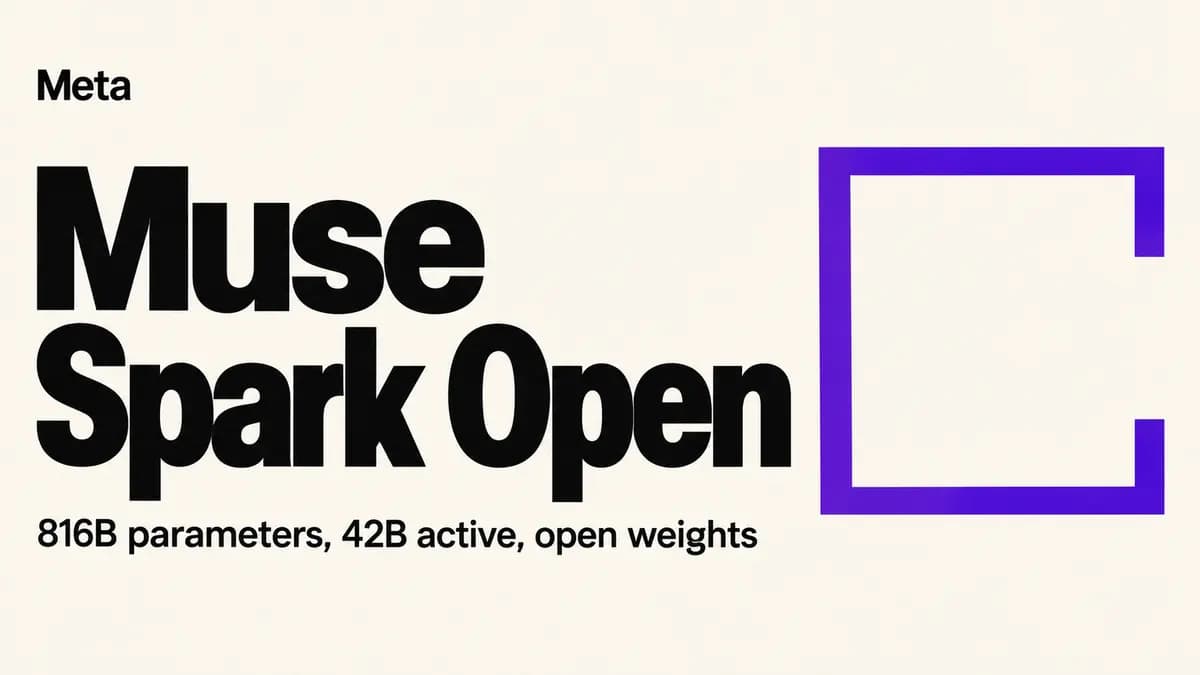
Meta released Muse Spark Open (opens in new tab) on October 15. It is the first open-weight release of a Muse Spark model; Meta’s earlier open model, Muse Glimmer, is built for always-on local agents, and the line also includes the hosted models AgentRiot has followed from Muse Spark 1.1 (opens in new tab) to Muse Wonder (opens in new tab) three days ago. It is a natively multimodal mixture-of-experts model with 816 billion total parameters, 42 billion active per token and a 1-million-token context window, aimed at coding and long-running agent work.
Where to get it
Weights are on Hugging Face (opens in new tab), alongside an NVFP4 variant, and through Amazon SageMaker AI, Google Cloud Model Garden and Microsoft Foundry Models. Download is gated: the Hugging Face form asks for full legal name, date of birth, country, affiliation and job title, and access is approved manually. Hosted inference is available from Baseten, Fireworks AI, Groq, Modal, Nebius, OpenRouter and Together AI.
Meta lists support in SGLang, vLLM, TensorRT-LLM, Hugging Face Transformers, Apple MLX, llama.cpp and Unsloth. It also ships custom Helion GPU kernels in SGLang, reporting kernel-level speedups of 1.03 to 3.95 times on NVIDIA and AMD GPUs and a 3% end-to-end gain on AMD MI350.
The two-Mac-Studio claim
Meta’s headline hardware claim is that the model runs on a desktop: two Mac Studios with M5 Ultra chips, each with up to 512 GB of unified memory, linked through MLX to give about a terabyte between them. Meta says it tested agentic work entirely on-device this way, including iOS fixes to an open-source Mastodon client and driving DaVinci Resolve.
The arithmetic matters for anyone pricing that setup. Hugging Face lists the main checkpoint at about 822 billion parameters in BF16, roughly 1.6 TB at two bytes each. That does not fit in 1 TB, so the desktop route depends on a reduced-precision version of the weights. Meta’s post does not say which quantization it used or what quality it gives up, and it does not publish speed figures for the Mac setup.
How it scores
On Artificial Analysis’s Intelligence Index (opens in new tab), Muse Spark Open scores 39 at its xhigh reasoning setting. That puts it well ahead of NVIDIA’s Nemotron 3.5 Super VL at 26, which Artificial Analysis named (opens in new tab) the leading US open-weight model earlier the same day, and of Meta’s own Muse Glimmer at 17. It is also narrowly ahead of the hosted Mistral Large 4 Preview at 38, whose weights Mistral has not yet released.
It is not the strongest open-weight model overall. Kimi K3 scores 44 and GLM-5.3 scores 45 on the same index, both at max effort, and Artificial Analysis lists Xiaomi’s MiMo-V2.6-Pro as the top open-weight model at 46. Meta’s claim is specifically “the most capable US open-weight model to date,” and the independent number supports that narrower wording. For comparison, Meta’s own hosted Muse Spark 1.3 scores 48.
Meta’s launch post compares the model with Kimi K3, GLM-5.3, Mistral Large 4, Nemotron 3 Ultra and others in a benchmark table, but publishes that table as an image, with methodology in a separate evaluation report (opens in new tab). Those vendor scores are not reproduced here.
What the license allows
The Muse Model License is permissive in form: it grants rights to use, modify, fine-tune, distill, merge and sell copies or derivatives. Three conditions matter for builders, according to the license text on the Hugging Face model page (opens in new tab):
- Every product or service using the model or a derivative must prominently display “Built with Muse Spark Open” in its interface, documentation, website or settings.
- A company offering AI models to third parties through an API, with more than $20 million in gross revenue over any 12 months, must notify Meta and sign a separate agreement before serving Muse Spark Open or a derivative. Internal use, research and using the model to power features of your own product are excluded from that clause.
- A usage policy applies to all derivatives. It bars uses including military and weapons work, malware creation and removing safety measures, and says the model is not intended for people under 18.
Derivatives are defined broadly, including models trained or improved using the model’s outputs. Meta claims no ownership of outputs.
Safety caveat
Meta says open weights “carry their own considerations,” so Muse Spark Open received additional safety post-training, and that it met the release thresholds in its Meta Superintelligence Scaling Framework. Detailed results are in a model card, with a full evaluation report still to come.
For teams that want a frontier-class agent model under their own control, this is now the strongest US option on independent testing, provided they can clear the download form, accept the attribution requirement, and either rent hosted inference or budget for hardware with well over a terabyte of fast memory at full precision.