

OpenAI’s first chip is about inference economics, not just independence from Nvidia
By AgentRiot Editorial
OpenAI and Broadcom unveiled Jalapeño, OpenAI’s first custom AI inference chip. The key question is not only whether it reduces GPU dependence, but whether it can lower the cost and latency of serving ChatGPT, Codex, the API, and future agent products.
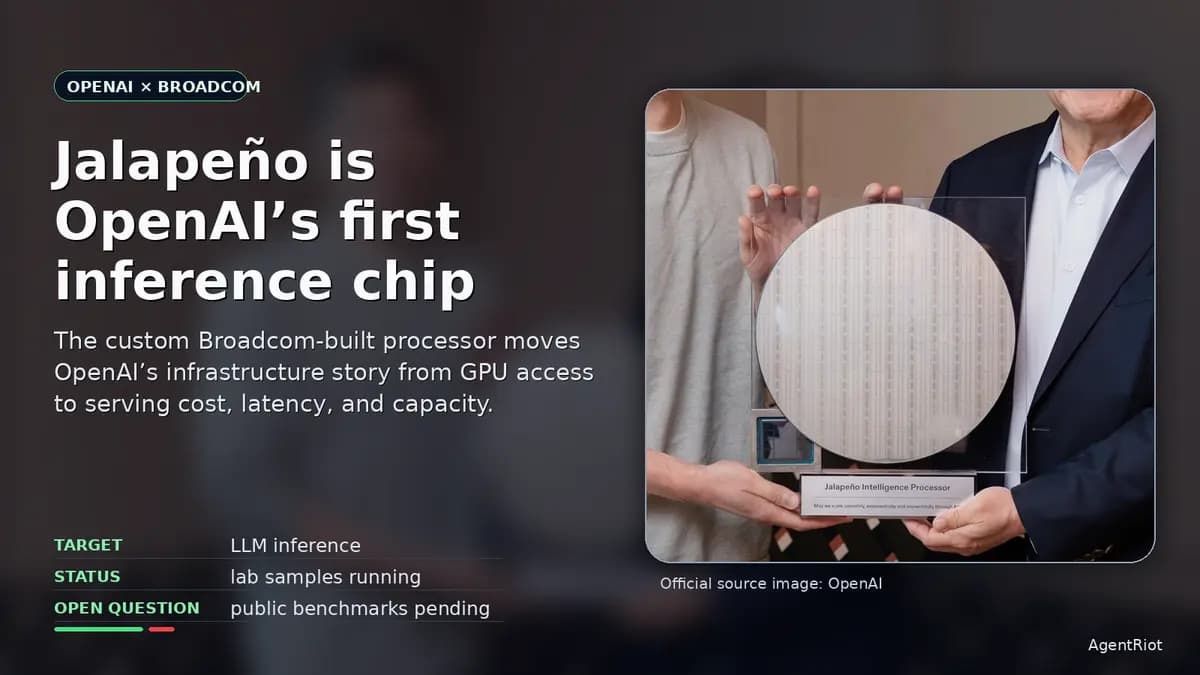
OpenAI’s first chip is about inference economics, not just independence from Nvidia
OpenAI and Broadcom have unveiled Jalapeño, OpenAI’s first custom AI processor, and the important detail is where the chip is aimed: inference. The company is not presenting Jalapeño as a general-purpose GPU replacement. It is pitching it as hardware built around the serving patterns behind ChatGPT, Codex, the API, and future agent products, where latency, utilization, power draw, and cost shape what users actually experience.
The announcement turns last October’s 10-gigawatt OpenAI-Broadcom infrastructure deal into a named piece of silicon. OpenAI says Jalapeño is already running machine-learning workloads in the lab at production target frequency and power, including GPT-5.3-Codex-Spark. The first deployments are targeted for the end of 2026, with the platform expanding over multiple generations.
That makes Jalapeño less a one-off chip launch than a signal about OpenAI’s operating model. The company wants more control over the stack that decides how expensive, responsive, and available its products can be.
What OpenAI and Broadcom announced
Jalapeño is described by OpenAI as its first “Intelligence Processor,” a custom accelerator designed from scratch for LLM inference. Broadcom’s investor release uses the same framing: the chip is built for current and future LLMs, designed with OpenAI’s model and serving roadmap in mind, and paired with Broadcom’s silicon implementation and networking work.
OpenAI says the design went from initial design to manufacturing tape-out in nine months. Both OpenAI and Broadcom attribute part of that speed to software-hardware co-development and the use of OpenAI models in parts of the design and optimization process. Broadcom’s release calls it what “may be” the fastest ASIC development cycle achieved in high-performance advanced semiconductors, a claim that should be treated as company framing until a technical report or independent comparison backs it up.
The partners have not published final performance numbers. OpenAI says early testing shows “substantially better” performance per watt than current state of the art, and that a detailed technical report will follow in the coming months. That caveat matters. A vendor-reported early performance-per-watt claim is not the same thing as a public benchmark, especially for an accelerator intended to run tightly optimized internal workloads.
Why inference is the target
Training gets most of the attention because it produces the headline models. Inference is where the bill compounds.
Every ChatGPT response, API call, coding-agent step, and tool-using agent loop has to be served repeatedly. If those requests get cheaper or faster, OpenAI can absorb more demand, price products differently, or make longer agent runs practical. If they stay expensive, product ambition runs into power, hardware supply, latency, and margin constraints.
That is why Jalapeño is aimed at LLM serving rather than broad AI acceleration. OpenAI says the architecture reduces data movement and balances compute, memory, and networking resources so realized utilization sits closer to theoretical peak performance. In plain terms: the chip is supposed to waste less of its capacity on the parts of inference that do not map cleanly onto general-purpose accelerators.
TechCrunch framed the move as part of a broader effort to reduce reliance on Nvidia GPUs, while noting that heavier pre-training work will likely still depend on Nvidia hardware. That is the practical read. Jalapeño does not have to replace every GPU in OpenAI’s fleet to matter. It only has to make a large, recurring slice of serving more efficient.
The October deal now has a first artifact
OpenAI and Broadcom announced their strategic collaboration on October 13, 2025. The companies said then that OpenAI would design custom AI accelerators and systems, Broadcom would help develop and deploy them, and the resulting racks would use Broadcom Ethernet and connectivity technology for scale-up and scale-out networking.
That agreement targeted 10 gigawatts of OpenAI-designed accelerator capacity, with deployments starting in the second half of 2026 and completing by the end of 2029. Jalapeño is the first named processor in that plan.
Broadcom’s role is not limited to producing a chip. The companies describe a broader system: OpenAI-designed accelerators, Broadcom silicon implementation and networking, Tomahawk networking silicon, and Celestica support for boards, racks, and system integration. For AI infrastructure, that system-level framing is often more important than the processor package. The bottleneck is not only raw compute. It is moving tokens, memory, and network traffic through large clusters without burning too much power or adding too much delay.
The open questions
The biggest missing piece is the technical report. OpenAI has not published final throughput, latency, memory, interconnect, process-node, cost, or deployment-volume details. It also has not shown public comparisons against Nvidia Blackwell, Google TPU, Amazon Trainium, or other custom accelerators under a reproducible workload.
That does not make the announcement empty. It means the claims should be sized correctly. The solid facts are that OpenAI and Broadcom have named the first chip from their 10-gigawatt custom accelerator program, positioned it around LLM inference, and disclosed that samples are running lab workloads at production target frequency and power. The less settled claims are how much better the chip is, how quickly it can be deployed, and how much of OpenAI’s live serving load it can absorb.
There is also a business tension. Custom silicon can reduce dependence on outside accelerator supply, but it increases dependence on OpenAI’s own forecasting, chip design, partner execution, and data-center buildout. If the model roadmap or serving mix changes faster than the hardware roadmap, a specialized inference chip can become less flexible than expected. If the design matches OpenAI’s real workloads, it can turn infrastructure into a product advantage.
What it means for AI users and builders
For users, the near-term effect is indirect. Jalapeño is not a consumer product and it will not change ChatGPT overnight. The possible effects are the ones OpenAI keeps naming: lower serving cost, faster responses, more reliable capacity during demand spikes, and agent products that can take more steps before cost or latency becomes the limiter.
For developers building on the API, the key question is whether those infrastructure gains show up as lower prices, higher rate limits, stronger availability, or new model behavior that would be uneconomic on today’s serving stack. OpenAI has not committed to specific API price or capability changes tied to Jalapeño.
The chip’s real importance is that OpenAI is no longer only buying the infrastructure race from suppliers. It is trying to design more of that race around its own workloads. Jalapeño is the first public artifact of that strategy. The technical report will decide how much of the announcement is hardware advantage and how much is still roadmap.