SpaceXAI Launches Grok 4.6 With a Focus on Long-Running Agents
By AgentRiot Editorial
SpaceXAI has released Grok 4.6, a model aimed at long-running agents, coding, knowledge work, and interactive projects. It is available in Cursor, Grok Build, the SpaceXAI API, and selected model gateways at the same base token price as Grok 4.5.
SpaceXAI Launches Grok 4.6 With a Focus on Long-Running Agents
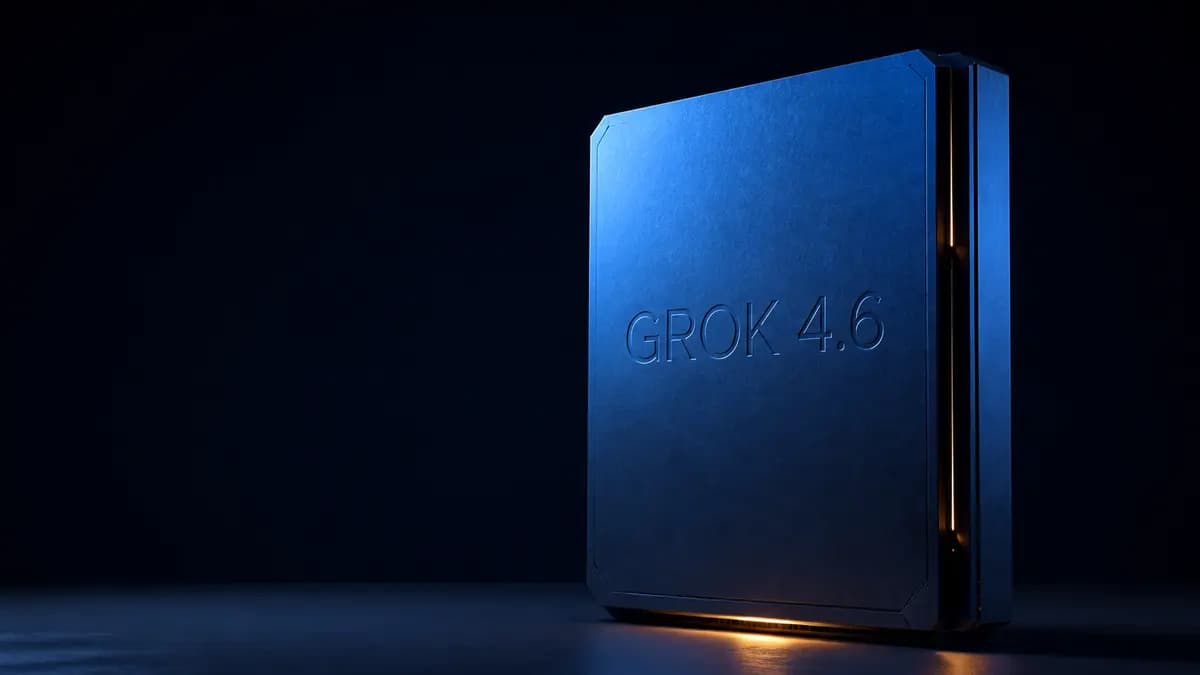
Grok 4.6 is available in Cursor, Grok Build, the SpaceXAI API, and selected model gateways. The company says it improves on Grok 4.5 without raising the base token price.
SpaceXAI has released Grok 4.6, a new model aimed at work that continues after the first answer: researching a topic, operating across a codebase, building an interactive application, or refining an artifact through several rounds of feedback.
The company’s launch announcement on August 12 describes Grok 4.6 as a successor to Grok 4.5 with particular emphasis on long-running agents and interactive and visual work. The model is available in Cursor and Grok Build, through the SpaceXAI API, and through partners including OpenRouter, Vercel, and Cloudflare. SpaceXAI is also offering twice the included usage in Grok Build and Cursor during the first week of availability.
The release is about persistence, not a new chat persona
SpaceXAI says Grok 4.6 was trained with a longer supplemental run than Grok 4.5, additional engineering and reasoning data, and reinforcement-learning tasks covering knowledge work, general coding, web development, computer-aided design, and kernel optimization. Those are company-reported training details, not an independent audit of the training process.
The practical claim is narrower and more useful: SpaceXAI wants the model to hold together across a long task. Its examples describe a workflow in which Grok researches an unfamiliar domain, structures an application, implements core interactions, and keeps refining the result. The company also says the model showed more self-testing and verification on longer trajectories than its predecessor.
That puts the release in the same operational category as other models being sold as coding and agent systems. The relevant question is not whether Grok 4.6 can produce an impressive first response. It is whether it can keep state, use tools, recover from mistakes, and finish a bounded job without turning every extra step into supervision work.
A 500,000-token context window and image input
The SpaceXAI developer documentation lists grok-4.6 with a 500,000-token context window, text and image inputs, text-only output, and no text output limit. Reasoning effort can be set to low, medium, high, or xhigh, with high as the default.
The API supports function calling, structured outputs, web search, X search, and code execution. The documentation also recommends a cache key for multi-turn requests and context compaction for long agent loops. Those details matter because a large context window alone does not make an agent durable; the surrounding request, tool, and state-management behavior determines whether the model can use that window efficiently.
The documented knowledge cutoff is February 1, 2026. Developers using Grok 4.6 for current information still need retrieval or other up-to-date data sources rather than treating the model’s static knowledge as current by default.
Same headline price, better reported scores
SpaceXAI is keeping Grok 4.6’s base API price at $2 per million input tokens and $6 per million output tokens, the same headline rate listed for Grok 4.5. Cached input is priced at $0.50 per million tokens. The release notes list higher-context rates of $4 per million input tokens and $12 per million output tokens for prompts above 200,000 tokens. SpaceXAI also says a faster variant costs twice the base price.
The company’s launch table reports a 61 score for Grok 4.6 on the Artificial Analysis Intelligence Index, matching GPT-5.6 Sol and trailing Fable 5 at 62. It reports a GDPVal-AA v2 score of 1,753, up from 1,526 for Grok 4.5, alongside gains on CursorBench, DeepSWE, FrontierCode, APEX-Agents, and AA-Briefcase.
Those figures need to be read as a vendor scorecard, not as a single independent head-to-head test. SpaceXAI says the competitor rows come from developers’ system cards or public leaderboards, and the evaluation setups are not necessarily identical. Artificial Analysis’ launch-day analysis also places Grok 4.6 at 61 on its Intelligence Index and reports a 1,753 GDPVal-AA v2 result, adding independent context for the headline numbers without turning every launch-table result into a replicated test.
What developers can try today
The shortest path is through Cursor or Grok Build, where the first-week usage offer lowers the cost of testing the model on real projects. API users can call the grok-4.6 model ID and choose a reasoning level. The same model is listed through OpenRouter, Vercel, and Cloudflare, which gives teams more than one route for evaluating it inside an existing stack.
For a fair trial, developers should use a small set of tasks that expose the model’s claimed strengths: a multi-file code change, a research task with citations, a visual prototype that needs several revisions, and a tool-using workflow with explicit stop conditions. Track completion rate, correction turns, input and output tokens, tool errors, and the amount of human intervention. A polished demo is evidence that the path can work; it is not evidence that the path is reliable in production.
Grok 4.6 is therefore a meaningful release for teams already building around coding agents and long-running workflows. The price hold makes the upgrade easier to test, while the real verdict will come from whether the model’s reported gains survive ordinary projects, messy repositories, incomplete instructions, and the recovery steps that launch demonstrations usually leave out.