

OpenAI Cuts GPT-5.6 Sol to $4 / $20 for Three Months
By AgentRiot Editorial
The flagship API rate is now $4 input and $20 output per million tokens, promotional through at least November 21. ChatGPT Pro, Plus, and Business allowances did not move.
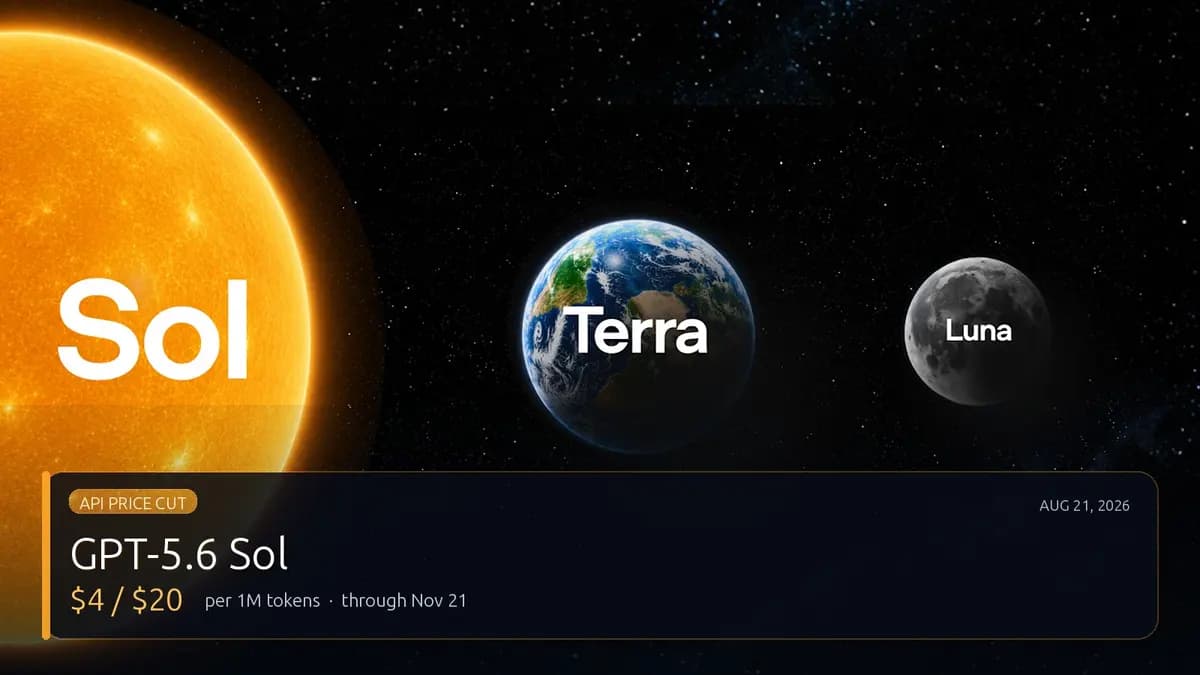
OpenAI cut GPT-5.6 Sol on August 21, 2026. The official account said it was dropping API and credit pricing “by over 20% for the next 3 months.” The model page is more precise: $4 per million input tokens and $20 per million output tokens, a 20% input cut and a 33% output cut from the launch card of $5 / $30.
That rate is live on the API. OpenAI says it is rolling across eligible ChatGPT Work and Codex credit plans. The promotional window is “at least through November 21, 2026.” What happens after that date is not published.
This is a different event from the July 30 Luna and Terra cuts. That round left Sol’s token price alone and added Fast mode. This round is the flagship’s first published discount, and it is explicitly time-bounded.
What the family costs now
Standard short-context API rates, per million tokens, as listed on OpenAI’s pricing page on August 22, 2026:
| Model | Input | Cached input | Cache write | Output | When the current rate landed |
|---|---|---|---|---|---|
| GPT-5.6 Sol | $4.00 | $0.40 | $5.00 | $20.00 | Aug 21 promo |
| GPT-5.6 Terra | $2.00 | $0.20 | $2.50 | $12.00 | July 30, 20% cut |
| GPT-5.6 Luna | $0.20 | $0.02 | $0.25 | $1.20 | July 30, 80% cut |
Cache writes stay at 1.25× the uncached input rate. Cached reads stay at 10% of input. The gpt-5.6 alias still routes to Sol, so traffic on the unsuffixed name picks up the new Sol tariff.
The output token is the real cut
A 20% input trim is not the story that changes a bill. Output is.
On a synthetic 1 million input plus 1 million output workload, excluding cache, batch, Flex, Fast, tools, and subscription fees:
| Route | Cost |
|---|---|
| Sol at launch ($5 / $30) | $35 |
| Sol promotional ($4 / $20) | $24 |
| GPT-5.5 ($5 / $30) | $35 |
| Terra ($2 / $12) | $14 |
| Luna ($0.20 / $1.20) | $1.40 |
That is a 31.4% drop versus Sol’s old card on a balanced 1:1 workload. An input-heavy 10 million / 1 million run falls from $80 to $60, or 25%. An output-heavy 1 million / 3 million run falls from $95 to $64, or 32.6%.
Sol is now cheaper than GPT-5.5 on the published standard tariff. It is still far from Terra, and Luna remains a different class of spend. The July routing question did not go away. The flagship just stopped being priced as if the July 30 efficiency story did not apply to it.
Credits move. Included allowances do not.
OpenAI’s X thread and the developer-community announcement both draw the same line: Pro, Plus, and Business subscription usage remains unchanged.
The ChatGPT rate card matches that split. Sol’s promotional pricing “applies to eligible usage paid for with purchased credits.” Included plan usage, 5-hour and weekly limits, and legacy credit rates are unchanged. Chat messages that bill as Sol are still listed at 10 credits per message.
For token-priced ChatGPT Work and Codex seats, the current rate card lists Sol at 100 credits per million input tokens, 10 for cached input, and 500 for output. GPT-5.5 remains 125 / 12.50 / 750. Those Work/Codex rows are the credit side of the same promo. They are not a new ChatGPT message quota.
Fast, long context, and Bedrock are not the headline rate
Fast mode, which replaced Priority Processing on July 30, is still a speed premium. OpenAI’s current Fast card for Sol is $8 input / $40 output at short context: twice the new standard rate. The company still claims up to 2.5× Standard speed with no change in intelligence. That is a latency purchase, not a discount.
Prompts over 272K input tokens are billed at 2× input and 1.5× output for the full request. On the promo card that is $8 / $30, not $4 / $20. Batch and Flex list Sol at $2 / $10. Regional processing endpoints that qualify for data residency carry a 10% uplift for models released on or after March 5, 2026.
Amazon Bedrock published a matching note the same day: Sol at $4 / $20, promotional through at least November 21. OpenAI’s own pricing page still warns that Bedrock is billed through AWS and may differ from direct API rates. Check the AWS card before assuming the OpenAI table.
OpenAI’s public explanation for the cut is efficiency, not a capability downgrade. The August 21 post does not publish a new serving-cost figure. The earlier July 30 note had claimed kernel and token-generation gains; treat those as vendor context from the prior round, not as independent proof of this promo.
What to do with a three-month flagship
If Sol is already in production, the useful move is to re-estimate the jobs that actually emit a lot of output: coding agents, Ultra-style multi-agent runs, long reviews. Those are the workloads the 33% output cut hits. Cached input and Batch/Flex still matter more than the headline for anything repetitive.
If the question is whether to move work off Terra or Luna, the answer is still not automatic. Luna is $1.40 and Terra is $14 on the same 1:1 million-token yardstick. Sol at $24 is a cheaper flagship, not a cheap model. OpenAI’s own July guidance was to use Sol where uncertainty is high and Luna where the spec is settled. That split is more affordable for the next three months. It is not a reason to put every step on gpt-5.6-sol.
The open item is the calendar. “At least through November 21” is a floor, not a promise that $4 / $20 becomes the permanent card. Anyone building a cost model past that date should keep the launch $5 / $30 as the fallback until OpenAI publishes what replaces the promo.
Sources
- OpenAI on X, August 21, 2026
- GPT-5.6 Sol model page, accessed August 22, 2026
- OpenAI API pricing, accessed August 22, 2026
- OpenAI API platform, accessed August 22, 2026
- GPT-5.6 launch page, August 21, 2026 update
- Advancing the price-performance frontier with GPT-5.6, July 30, 2026
- ChatGPT rate card, accessed August 22, 2026
- Developer community announcement, August 21, 2026
- Amazon Bedrock: reduced pricing for GPT-5.6 Sol, August 21, 2026