EmbeddingGemma 2 brings multimodal search to local AI agents
By AgentRiot Editorial
Google's 740M-parameter embedding model puts code, images, audio and video in one search space. The useful question is what developers can retrieve locally, and what they can afford to keep in the index.
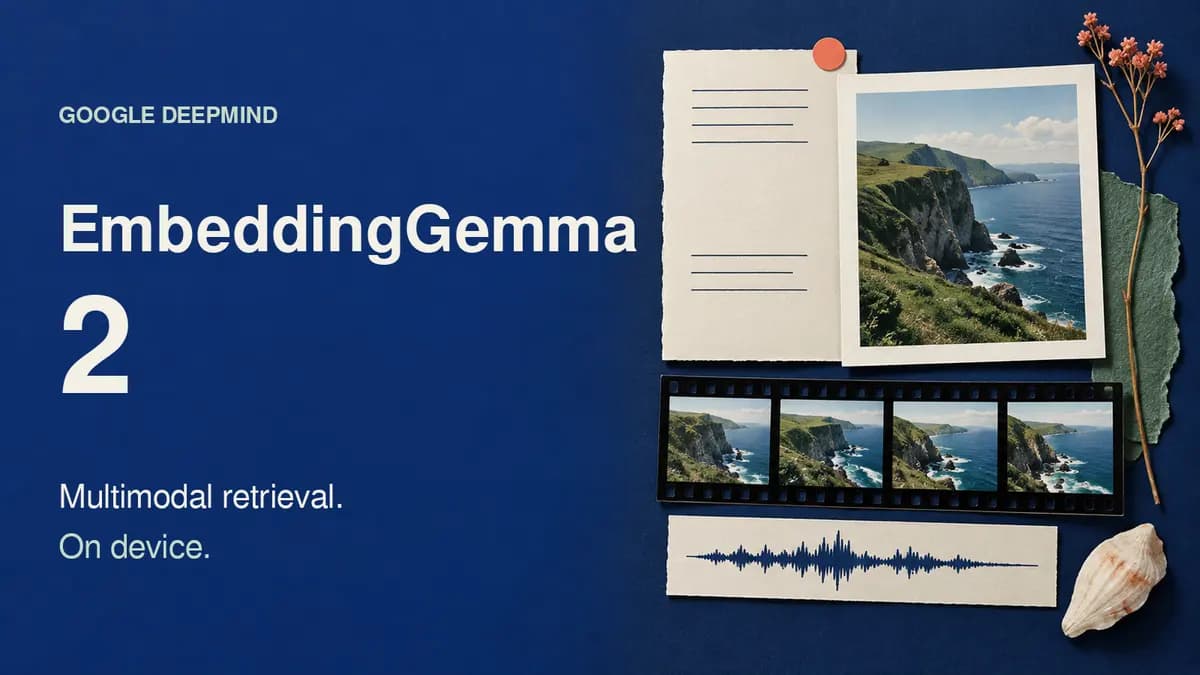
A coding agent needs the right function before it can fix the wrong one. A media assistant needs the relevant clip before it can explain what happened. Google's October 6 release of EmbeddingGemma 2 (opens in new tab) targets that retrieval step: converting text, code and media into vectors that applications can search on local hardware.
The release expands the original text embedder into a multimodal model built on Gemma 4. It produces representations rather than conversational answers. For agent builders, the attraction is a local search layer that can connect a natural-language request with source files, a photograph or a recording without first translating every medium into text.
Google has released the checkpoint under Apache 2.0 on Hugging Face (opens in new tab). Its full architecture has 740 million parameters, but a code-search application does not have to load all of them.
A code index can start at 270M
The developer guide (opens in new tab) divides the model into a 270M text component, an optional 170M vision encoder and an optional 300M audio encoder. Text plus vision totals 440M; text plus audio totals 570M. All configurations project into the same 768-dimensional space.
That gives a retrieval system room to grow. Start with a repository index, then add screenshots or recordings without replacing the embedding space. Google's demonstration uses the 270M text-only setup to index the Hugging Face Transformers codebase and supply matches to a Gemma 4 coding agent. It illustrates a division of labor: the embedder finds candidate context; the generative model works with it.
Google reports 78.68 on MTEB Code v1, against 68.76 for the first EmbeddingGemma, in its model card (opens in new tab). That is a 9.92-point improvement over its predecessor. Multilingual MTEB v2 barely changes, moving from 61.15 to 61.36. The clearer advance is code retrieval and the added media coverage, rather than a large general-text jump.
For a coding-agent index, filenames and task instructions matter. The model README (opens in new tab) recommends CodeRetrieval for code queries and document formatting that preserves a title or filename. “Where do expired sessions get rejected?” is the kind of query a semantic code index is meant to answer, even when the repository uses different wording. Whether its matches are useful still depends on chunk boundaries and the actual codebase.
One input budget for mixed media
The model has an 8,192-token input context (opens in new tab), not an allowance for generated output. At default token budgets, a single-modality input can contain roughly 29 images, 58 video frames or 327 seconds of audio, about 5.5 minutes. These are alternatives, not allowances that can all be stacked together. Text and interleaved media consume the same budget.
Video is sampled at one frame per second by default, with configurable sampling. Long recordings therefore need segmentation; a shared embedding space does not remove the indexing work needed to make individual moments retrievable.
Google's AI Edge guide (opens in new tab) describes two concrete applications in AI Edge Gallery. Instant Media Search compares text or image queries with a local media index. Video Moments Finder indexes local recordings and returns timestamps for matching moments.
The published full-precision, 768-dimensional evaluations span several retrieval tasks. Beyond the text and code results, Google's card reports (opens in new tab):
| Benchmark | Metric | Score |
|---|---|---|
| MIEB Lite | Mean by task type, mixed metrics | 64.64 |
| MMEB v2 Image | Mean by task, Hit@1 | 57.28 |
| MMEB v2 Visual Documents | Mean by task, NDCG@5 | 67.84 |
| MMEB v2 Video | Mean by task, Hit@1 | 50.67 |
| MSEB Retrieval | Mean by task, MRR@10 | 69.54 |
| MAEB | Mean by task, mixed metrics | 49.39 |
Different metrics make these scores unsuitable for a single cross-modality ranking. They also describe the full-precision checkpoint, not every quantized deployment.
The vectors can outweigh the model
EmbeddingGemma 2 supports Matryoshka Representation Learning: developers can retain the first 512, 256 or 128 dimensions of its native 768-dimensional output. The README (opens in new tab) requires normalization after truncation and matching dimensions for queries and indexed items.
At the same numeric precision, 256 dimensions cut raw vector storage to one-third; 128 cut it to one-sixth. Database metadata and search indexes do not shrink by that same ratio. Nor is compression free: Google's MMEB v2 overall score falls from 59.01 at 768 dimensions to 45.65 at 128. A small text shortlist and a mixed-media archive need different quality checks.
Qdrant's own launch-day experiment (opens in new tab) suggests testing fewer bits before fewer dimensions. Across five BEIR text-retrieval datasets, its full-size, one-bit TurboQuant vectors retained 99% of the baseline's nDCG@10 with roughly 30 times less vector RAM, without rescoring. That comparison excludes graph indexes, payloads and original vectors stored for rescoring. It is a partner's text-retrieval result, not a universal multimedia compression guarantee.
Model memory needs similar care. Google reports roughly 191MB active RAM for text-only weights and 567MB for the full model (opens in new tab) in a quantized Pixel 11 Pro configuration. Those figures are not whole-application budgets: media processing, the vector index and any companion generative model still need resources.
Choose the runtime before promising offline RAG
Google documents multimodal inference with SentenceTransformers 6.1.0 or later (opens in new tab), while LiteRT bundles (opens in new tab) provide a quantized on-device path. Support should be checked per runtime and artifact. Unsloth's guide (opens in new tab) explicitly scopes its llama.cpp server example to text and code, requiring suitable encoders and processor support for other media.
For the Python path, the model README (opens in new tab) recommends BF16 or FP32 and warns that FP16 can produce NaNs or degraded embeddings. Valid-looking vectors are not enough; check their values and retrieval results before building an index around them.
Availability is also split. Google's launch post (opens in new tab) links downloadable weights but says Model Garden availability is coming soon. The Edge guide (opens in new tab) puts ML Kit integration in the coming weeks.
Local embedding can keep the indexing step on device. Sending retrieved files to a cloud generator still sends their contents off device; fully offline RAG needs local generation and storage too. Start with a handful of real repository or media queries, compare the returned matches at 768 and 256 dimensions, and measure the complete pipeline's memory. That will tell an agent builder more than the checkpoint's size alone.