Anthropic expands Claude cyber access with three permission tiers
By AgentRiot Editorial
Defense, Red Team and Specialized Access widen eligibility for advanced Claude models, but stronger credentials, misuse monitoring and safety-system restrictions still determine what teams can do.
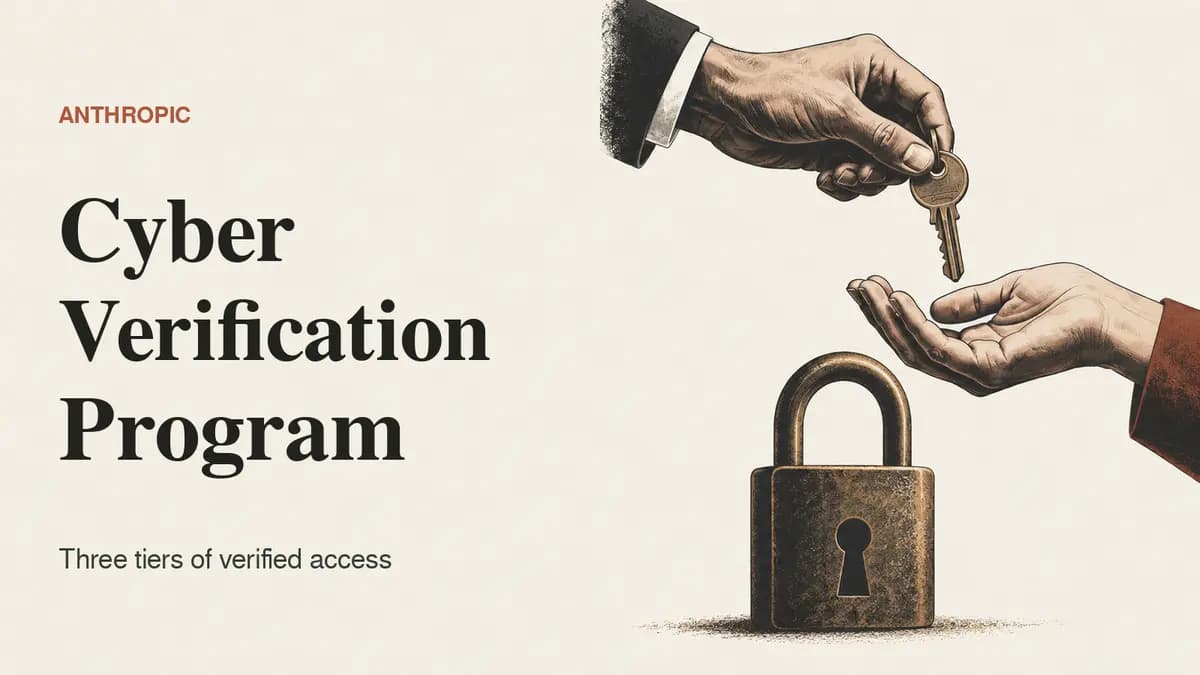
Anthropic is giving more security professionals a route to Claude’s advanced cyber capabilities. Its October 6 expansion of the Cyber Verification Program (opens in new tab) combines the earlier CVP and Project Glasswing into three tiers: Defense Access, Red Team Access and Specialized Access. All three include Claude Opus 5.5, Claude Sonnet 5.5 and Claude Mythos 5.1, with future models also covered.
The difference between the tiers is permission, not a different model lineup. A researcher analyzing malware and an organization testing a power grid face different eligibility checks, controls and real-time blocks. The expansion changes who can obtain reduced cyber blocking; it does not remove safeguards across Claude’s public products.
What each tier permits
Defense Access (opens in new tab) covers security operations, incident response, malware reverse-engineering and vulnerability analysis or validation. Eligible applicants include teams defending systems they own or maintain, smaller security firms, open-source maintainers and individual researchers with a record of reported vulnerabilities. Critical infrastructure operators can qualify regardless of size, including regional hospitals and municipal utilities. Individual applicants need a paid plan, according to the Help Center (opens in new tab).
Red Team Access (opens in new tab) adds authorized penetration testing and red-teaming. It is currently organizations-only, including in-house red teams, government teams and testing firms. Authorization to test the target remains mandatory. Real-time blocks still apply to activity that could cause physical harm or mass disruption, including ransomware deployment, damage to physical systems and penetration testing of high-risk safety systems.
That last boundary separates Red Team from Specialized Access (opens in new tab). The highest tier has the fewest cyber blocks and is reserved for a limited set of organizations authorized to test safety systems affecting lives or markets, such as flight operating systems, power grids and interbank infrastructure. Anthropic reviews each organization in depth with the US government. Existing Glasswing members move into this tier without reapproval for current models.
Ordinary secure coding does not require joining CVP. The Help Center (opens in new tab) says public models remain usable for secure code review, threat modeling, patching known issues, finding vulnerabilities in owned source code and triaging alerts. More involved security work can encounter classifier blocks.
The grant comes with credential deadlines
The security requirements (opens in new tab) require organizations to provide a named security contact and keep requests attributable to approved users or workloads. Users must sign in individually rather than share sessions. Suspected breaches or misuse involving the grant must be reported within 72 hours, shortened to 24 hours for a security incident.
Defense Access requires MFA immediately (opens in new tab). By December 15, 2026, covered accounts must use phishing-resistant MFA and stop using long-lived static credentials, including API keys. Interim Defense API keys must be securely stored, assigned to one person or workload and replaced at least every seven days. Red Team and Specialized Access require phishing-resistant MFA and short-lived credentials from the outset. Both limit each granted workspace to 25 approved users by default, with additional seats available on written request; workload identities do not count toward that cap.
Red Team also requires managed devices, user checks and enforced, logged outbound-network restrictions wherever offensive or agentic work runs. Specialized adds organization-domain SSO and stronger endpoint protection. These requirements (opens in new tab) matter for teams hoping to attach a grant to an existing agent workflow: approval alone does not make that workflow compliant.
The Usage Policy still applies in full (opens in new tab). Building a client-facing product is governed separately by the Cyber Productization Policy, rather than automatically authorized by a CVP grant.
The privacy exception is narrow
CVP requires data retention (opens in new tab) for cyber-misuse monitoring. Until Enterprise Frontier Safeguards is available, organizations already holding a retention exemption for Claude Fable or Mythos can use CVP with zero data retention on supported models. That exception does not extend to individual Defense grants: their security requirements (opens in new tab) explicitly require retained, monitored traffic and rule out ZDR.
Enterprise Frontier Safeguards (opens in new tab), announced September 1, is a future alternative. Anthropic says phased rollout will start later this fall. EFS would let eligible customers store monitoring data in their own cloud infrastructure, with options for customer-managed encryption keys and automated review that routes flags to their own teams. ZDR here does not mean no logs anywhere; customer-controlled retention supports the monitoring design.
Provider choice also matters. The launch announcement (opens in new tab) lists the Claude Platform, Google Cloud’s Vertex AI and Microsoft Foundry. It limits Amazon Bedrock to EFS-eligible customers. The Help Center (opens in new tab) is more specific about current Bedrock access: it is limited to organizations with a Fable 5.1 retention exemption, because Bedrock does not yet support the human review of automated safety flags that CVP normally requires. EFS eligibility is not evidence that EFS has shipped.
Supported third-party apps (opens in new tab) offer only Defense and Red Team Access, not Specialized. The same guidance says Mythos access on third-party cloud providers trails approval by approximately five business days. Approval and usable access are not necessarily simultaneous.
Blocks fall, but findings still need validation
Anthropic’s CyScenarioBench evaluation (opens in new tab) tested Opus 5.5 on ten multistage cyber challenges, with five attempts per challenge in each tier. All 50 attempts without CVP were blocked on the first prompt. Defense blocked 46 of 50 trials at some point; the remaining four succeeded. Red Team blocked none and completed 34 of 50, or 68%. Anthropic calls that effectively equivalent to a separately reported 67.6% result without safeguards, used as a reference for Specialized Access.
Those are vendor-reported results on offensive scenarios. They show how the tier classifiers changed blocking in that evaluation, not an independently established success rate for everyday defensive work or proof of safe behavior on every permitted task.
Anthropic also reports (opens in new tab) at least 129,000 verified vulnerabilities found by Glasswing partners from April through July, plus 5,500 from its own open-source scanning from April through October. More than 33,000 of those findings have been rated critical or high severity. The figures use partial data from 33 partner reports and Anthropic’s open-source partnerships. Triage methods differed, and fewer than half the partners disclosed patch counts. These are discovery figures, not a tally of fixed vulnerabilities.
The work after discovery may be the tighter constraint. In Anthropic’s partner interviews (opens in new tab), Comcast security chief Noopur Davis says: “Validation of these volumes of findings is the new bottleneck.” Booz Allen likewise describes the continuing need to validate findings, deduplicate patterns and route issues to owners.
Approval is only the first step
Applicants submit one application through the Verification Portal (opens in new tab). Anthropic aims (opens in new tab) to respond to Defense applications within a few days and expects Red Team reviews to take a few weeks; qualifying organizations receive Defense Access during that review. The Help Center (opens in new tab) separately targets an initial decision or request for more information within seven business days, not a guaranteed completed Red Team review.
Existing members (opens in new tab) keep their settings for previous models and are automatically evaluated for the updated model access. Console administrators must then check workspace grants and qualifications (opens in new tab): some programs apply automatically to qualifying workspaces, while others require assignment. Teams should settle the testing authorization, credential requirements and data-retention terms before routing sensitive security work through the grant.