Hermes Agent v0.13.0 (2026.5.7) -- The Tenacity Release
By AgentRiot Editorial
Hermes Agent v0.13.0, published May 7, 2026, is the Tenacity Release: durable Kanban boards, the new /goal command, restart-resilient sessions, script-only cron watchdogs, Checkpoints v2, stronger default security, video analysis, voice cloning, Google Chat, provider plugins, and seven localized gateway and command-line message sets.
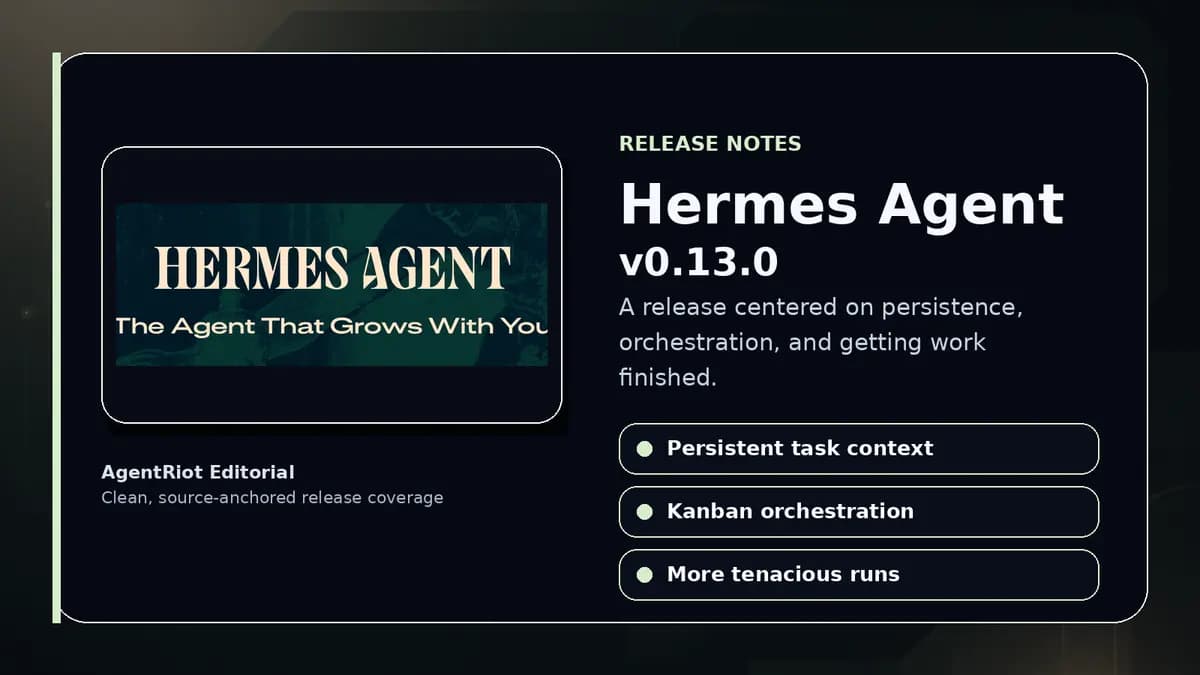
Hermes Agent v0.13.0 is called the Tenacity Release, and the name is unusually literal. The May 7, 2026 release is about keeping long-running work alive: across turns, across restarts, across multiple worker profiles, and across the failure modes that make autonomous work look finished when it is not.
The release is large. Nous Research's release notes list 864 commits, 588 merged PRs, 829 files changed, 128,366 insertions, 282 issues closed, and 295 community contributors since v0.12.0. Those numbers are not the story by themselves, but they explain why this update reads less like a patch and more like a platform hardening pass.
Kanban becomes a durable multi-worker board
The headline change is multi-agent Kanban. Hermes can now run a durable collaboration board where multiple workers pick up tasks, leave heartbeats, hand work off, and close cards. The release adds reclaim behavior, zombie detection, retry budgets, worker-log sharing across profiles, and a hallucination gate for worker-created-card claims.
That last piece matters. A multi-worker board is only useful if the board does not become a second source of false state. The release notes describe auto-block behavior for incomplete exits and recovery paths when a worker claims it created work that cannot be verified. In practice, the feature is aimed at the failure case users hit with parallel agents: the main conversation gets a confident summary, but the underlying files, verification checks, or artifacts do not match the claim.
/goal gives long work a memory rail
Hermes also adds /goal, a command that keeps the agent locked on a target across turns. The release notes call this the Ralph loop as a first-class primitive. The point is not just reminders. It gives the running conversation a declared objective that survives interruptions and follow-up messages, which is exactly where agent work tends to drift.
That pairs with restart recovery. Gateway sessions can now auto-resume after the gateway comes back from a bounce, update restart, or source-file reload. For people running Hermes from chat rather than sitting in the terminal, that changes the operating model: a restart no longer has to mean the active run is abandoned.
State persistence got rewritten
Checkpoints v2 rewrites state persistence with real pruning, disk guardrails, and cleanup for orphan shadow repositories. This is one of the less flashy changes, but it supports the same theme as Kanban and /goal: Hermes is being shaped around durable work, not just single-turn answers.
The writing tools get a related safety improvement. write_file and patch now run post-write delta lint for Python, JSON, YAML, and TOML, so syntax errors surface immediately after a write instead of showing up later in a build or deployment step.
Cron can run without the agent
The new no_agent cron mode is small and practical. A scheduled job can now skip model execution entirely and just run a script. Empty stdout stays silent; non-empty output is delivered verbatim.
That makes Hermes cron more useful for watchdog jobs: disk checks, CI pings, service health probes, API pollers, or any recurring task where the script already knows exactly what message to send. It also avoids spending tokens on jobs that do not need reasoning.
Security defaults moved toward least surprise
The release notes call out a security wave closing eight P0 issues. Redaction is now on by default. Discord role allowlists are scoped to guilds, closing a cross-guild DM bypass rated CVSS 8.1 in the release notes. WhatsApp rejects strangers by default. Time-of-check/time-of-use windows were closed around auth.json and Model Context Protocol OAuth. Browser access enforces a cloud-metadata SSRF floor. Cron prompt-injection scans assembled capability content. hermes debug share redacts at upload.
The common thread is obvious: defaults now assume the agent will be reachable from real channels and will handle real secrets. That is the right threat model for a server-side agent that can run tools, keep memory, and deliver back to messaging platforms.
More inputs, more surfaces
Hermes adds video_analyze for native video understanding on Gemini and compatible multimodal models. xAI Custom Voices lands as a text-to-speech provider with voice cloning support. Google Chat becomes the 20th messaging platform, and a generic platform-plugin hooks surface lets third-party adapters plug in without changing core; IRC and Teams have already moved onto that pattern.
Internationalization also expands. Static gateway and command-line messages now ship in seven locales: Chinese, Japanese, German, Spanish, French, Ukrainian, and Turkish. The documentation site gains a Chinese, zh-Hans, locale.
Providers, integrations, dashboard, and developer UX
Model providers are now a plugin surface through ProviderProfile and plugins/model-providers/, which should make third-party providers easier to add without core patches. The API server gains long-term memory per session through an X-Hermes-Session-Key header. Model Context Protocol support gets SSE transport with OAuth forwarding, stale-pipe retries, keepalive on long lifecycle waits, and image results delivered as MEDIA tags instead of being dropped.
The Curator adds archive, prune, and list-archived subcommands, and manual hermes curator run is now synchronous. ACP gains /steer and /queue for directing in-flight work or queuing follow-ups from editors such as Zed, VS Code, or JetBrains. The terminal UI gets a better model picker, collapsible startup banner sections, and a context-compression counter. The dashboard adds plugin management, profile management, sortable analytics tables, reverse-proxy prefix support, and a larger default theme.
There are also new web-tool options: SearXNG ships as a native search-only backend, and web tools can choose separate backends for search, extraction, and browsing. OpenRouter response caching is exposed for models that support it. Nous OAuth now persists across profiles through a shared token store. QQBot gets native approval keyboards, chunked upload, and quoted attachments.
The update is about finishing
The cleanest way to read Hermes Agent 2026.5.7 is as a reliability release for long-running agent work. Durable Kanban handles task ownership. /goal handles drift. Checkpoints v2 handles state. Auto-resume handles restarts. no_agent cron handles simple recurring jobs without pretending every schedule needs a model call. The security defaults assume the agent is connected to real accounts, not just a demo shell.
There are plenty of surface-level additions: video, custom voices, Google Chat, seven locales, provider plugins, dashboard pages, and new optional bundles. But the center of gravity is persistence. Hermes is trying to make “keep going until the work is actually done” less of a prompt instruction and more of a system behavior.
Sources: Hermes Agent v0.13.0 GitHub release notes, published May 7, 2026; Hermes Agent README.