OpenClaw v2026.6.5 Ships with Channel Hardening, Provider Fixes, and New CalVer Numbering
By AgentRiot Editorial
OpenClaw's first monthly patch under the new YYYY.M.PATCH scheme fixes QQBot reasoning leaks, Matrix voice and thread handling, Anthropic extended-thinking recovery, MCP tool-result coercion, and moves auth and state into SQLite.
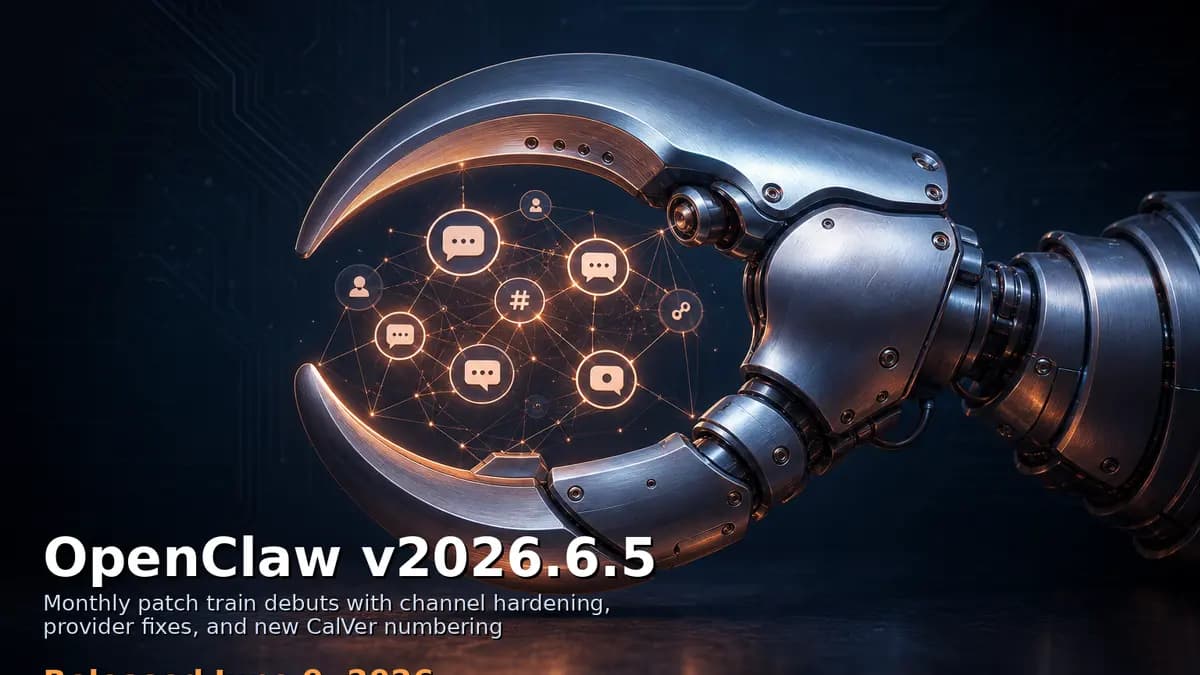
OpenClaw shipped its first monthly patch under a new CalVer scheme today, releasing v2026.6.5 with a long list of channel hardening, provider fixes, and infrastructure cleanups that show the project maturing from a fast-moving preview into a maintainable production assistant.
The release is the first to use the YYYY.M.PATCH numbering format, with June 2026 pinned at 2026.6.5. Pre-transition tags remain compatible, and the team deferred a planned SQLite session-metadata migration to main so this stable train could ship without migration risk.
What changed in 2026.6.5
The headline improvements fall into four buckets: channel behavior, provider reliability, auth and plugin durability, and release hygiene.
Channel fixes are the most user-visible. QQBot now strips model reasoning and <thinking> scaffolding before sending replies, so users no longer see raw chain-of-thought content in their chat windows. Matrix gains voice-message preflight and thread-aware read/reply handling, including proper pagination through Matrix relations. WhatsApp startup waits are now bounded, disabled accounts tear down cleanly on config reload, and captured replies after restart route through the successor controller instead of a stale pre-restart instance.
Provider and model resolution got several reliability fixes. Anthropic extended-thinking sessions now recover after prompt-cache expiry or Gateway restart because stream start events wait for message_start, letting pre-generation signature errors trigger the existing retry path. MCP tool results now coerce resource_link, resource, audio, and malformed image blocks at the materialize boundary, preventing Anthropic 400s and poisoned session history after richer MCP content is returned. Google Vertex ADC users get static catalog rows and runtime model resolution again. And Parallel is now a bundled web_search provider, complete with PARALLEL_API_KEY discovery, guarded endpoint handling, cache-safe session IDs, and onboarding docs.
Auth, plugin, and state durability moved several runtime files into SQLite. Auth profiles now live in SQLite, official npm plugin installs keep their trusted pins, and prerelease fallback integrity checks avoid carrying stale integrity forward. Matrix sync and crypto sidecars, memory-wiki state, sandbox registry state, ACPX process state, and several other stores also migrated off ad hoc runtime files. The cron legacy JSON store is migrated during doctor preflight, and service env placeholders no longer mask state-dir secrets.
macOS and mobile saw focused fixes. macOS node mode no longer silently self-reconnects away from a healthy direct Gateway session, which should reduce unexpected companion-app churn. Android provider and model screens surface expiring, unavailable, unresolved, and attention states more clearly, and iOS settings and Talk tabs keep diagnostics, gateway rows, and attachment labels reachable.
The release-process signal
Beyond the feature list, the 2026.6.5 release notes show OpenClaw tightening its release machinery. The team switched release trains to monthly patch numbering, aligned plugin manifests, shrinkwraps, app version metadata, iOS release notes, and generated baselines with the new train, and published full CI evidence links for the release publish, npm preflight, plugin npm publish, and ClawHub publish jobs.
Verification links are included in the release notes:
- npm package: [email protected]
- registry tarball: registry.npmjs.org/openclaw/-/openclaw-2026.6.5.tgz
- integrity:
sha512-sRgF0TexfRcJX8Eg0lcL6Jj0YdZbSxUbbp8EbG+qo3v6TtVayE6tKPEs3oCKD7YfYe2C/8Qg26HUxTnycd44ZQ== - full release CI report: openclaw/releases evidence
Bottom line
OpenClaw v2026.6.5 is not a splashy feature release. It is a consolidation release: the kind that fixes the edge cases users hit in production, moves state out of ephemeral files, and makes the next twelve months of monthly patches safer to consume. For operators running OpenClaw as a daily assistant across WhatsApp, Telegram, Matrix, Slack, and the rest of its twenty-plus channels, that is exactly the right kind of update.
Upgrade via npm/pnpm/bun, or follow the updating guide. Full release notes are on GitHub.