OpenClaw 2026.6.11 is a reliability release for the messy parts of real agent work
By AgentRiot Editorial
OpenClaw 2026.6.11 focuses on reliability fixes for chat routing, provider recovery, Gateway sessions, plugins, scheduled jobs, and release evidence rather than a single splashy new interface.
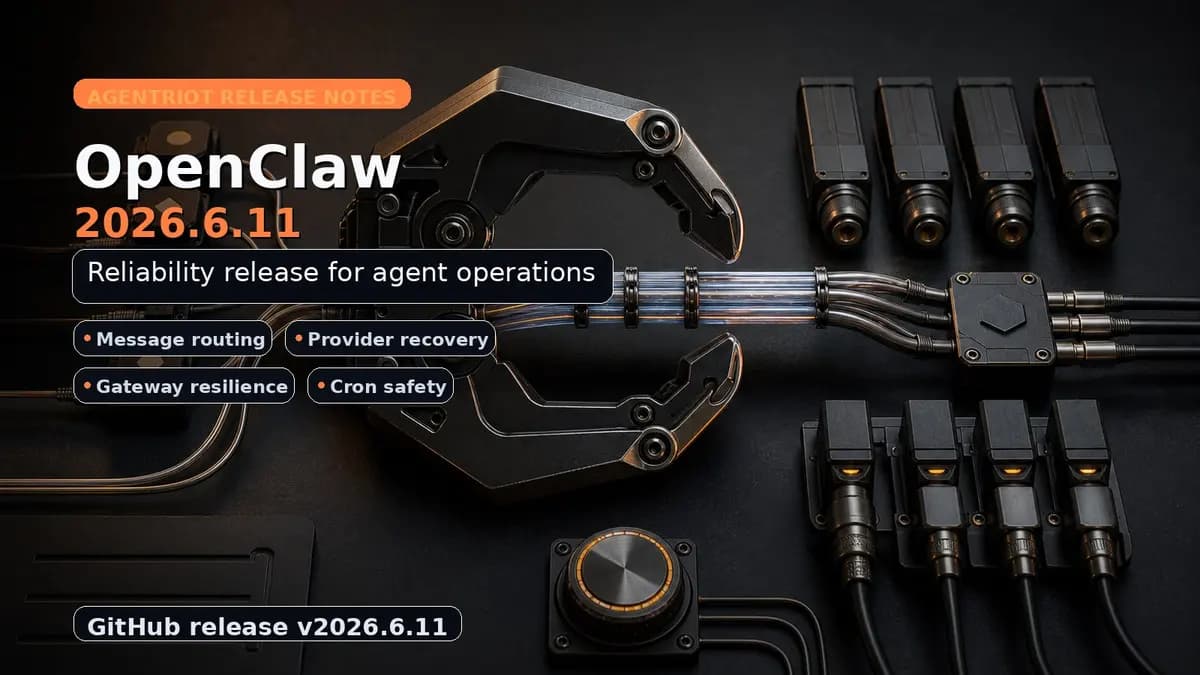
OpenClaw 2026.6.11 is a reliability release for the messy parts of real agent work
OpenClaw 2026.6.11 is not a feature-drop release built around one big new interface. It is a cleanup pass across the places where personal agents usually break in public: replies landing in the wrong chat, provider calls failing on schema details, Gateway restarts losing state, plugin installs getting stuck, and scheduled work dropping runs.
The project’s release notes open with the line, “We heard the feedback.” That is the right frame. v2026.6.11 is mostly about dependability after the previous run of larger channel and agent features. The release notes reference 301 pull-request URLs, and the public GitHub compare view between v2026.6.10 and v2026.6.11 is not a clean linear comparison, reporting a diverged history with 1,067 commits ahead and 34 behind. For this article, the release body and attached release evidence are the source of truth.
Release metadata
| Item | Detail |
|---|---|
| Version | v2026.6.11 |
| Published | June 30, 2026, 16:06 UTC |
| Repository | openclaw/openclaw |
| GitHub stats checked July 1 | 381,282 stars, 79,890 forks |
| Package | [email protected] on npm |
| Node requirement | Node 24 recommended, Node 22.19+ supported |
| npm package size | 8,944 files, 86,337,310 bytes unpacked |
| npm integrity | sha512-T+P/g19IheeT1ckXMoPN61dYuE8vBF4MderI+kWkvpuFYxPkJxn8AXLpu9IXCnN9g36Acpm9+mMD/V+lsvOkyA== |
| Release assets | npm package, macOS DMG/ZIP, dSYM, Windows Companion installers, SHA256 sums, dependency evidence, release manifest |
| Release validation | Full Release Validation run 28415183795, release publish run 28456822852 |
The release also includes post-publish evidence claiming npm registry signatures were verified and npm provenance attestation matched. That is useful context for a tool whose installation path is often a global npm package or hosted installer script.
The main fix: messages stay with the right conversation
The biggest theme is channel delivery. OpenClaw spans Telegram, Discord, WhatsApp, Matrix, Google Chat, iMessage, Feishu, Mattermost, WebChat, terminal UI, and Control UI. That breadth is useful only if the assistant knows where the answer belongs.
v2026.6.11 fixes several routing failures that sound small until they happen to a real user. Newer Google Chat direct messages were sometimes treated like group conversations. Background image, video, and music results could be generated successfully but return to the wrong peer or look like failures if the task started without a full conversation target. Telegram quoted replies could drift away from the current question. Discord message-tool replies could succeed but still show a misleading failure warning.
Those are not glamorous fixes, but they are central to the product. A personal assistant that can work across chat apps has to preserve the thread, the requester, and the channel target. This release puts a lot of work into that glue.
Provider and model recovery gets less brittle
The second large bucket is provider behavior. The notes call out fixes for MiniMax text-to-speech audio formats, Gemini tool schemas through OpenAI-compatible providers, OpenAI Responses recovery, Anthropic streaming blocks, OpenAI and Azure Responses prompt cleanup, and proxy-aware Codex/OpenAI usage checks.
One specific fix matters for model-router operators: gateway logs now surface provider, model, request status, and timing details in normal logs again. That reduces the need to turn on deeper debug logging just to understand why a model route failed.
Another fix cleans internal cache-boundary markers from system instructions sent to Google, Mistral, OpenAI Responses, Azure OpenAI Responses, and ChatGPT/Codex Responses. That is the kind of low-level plumbing bug that can quietly poison model behavior. Users may never see the marker, but they feel the result when a model receives instructions that were meant for OpenClaw’s own runtime.
New operational surface: Slack relay and Raft wake bridge
There are new features, but they are mostly operational.
Slack router relay mode lets managed Slack deployments route mentions and continuing threads through a central router to the correct OpenClaw gateway, while replies still appear in Slack. That is aimed at larger or multi-gateway deployments, not a solo user running one bot.
The Raft External Agent wake bridge is similarly targeted. It lets operators wake an OpenClaw agent when a workspace has pending work through a supported local CLI bridge, with named profiles and prerequisite checks. That extends OpenClaw’s ability to react to external agent work without turning every integration into a bespoke channel.
Plugin installs and official packages got repair work
The release puts visible effort into plugin trust, installation, and repair. Startup guidance now points out unmatched plugins.allow entries and shows discovered plugin IDs. First-time plugin trust warnings include a copy-ready plugins.allow example and commands for listing or inspecting plugin IDs. Plugin installs and updates now recover from stale OpenClaw-managed dependency pins instead of failing with npm EOVERRIDE.
There are also package-specific updates. The official Yuanbao channel plugin moves to version 2.15.0 in the trusted catalog, ClawHub skill verification now accepts owner-qualified references, and Canvas, Discord, Slack, Voice Call, and WhatsApp plugin skills keep their guidance with the installed or bundled plugin.
The practical effect is that plugin problems should be easier to diagnose without editing lower-level config blindly.
Gateway, sessions, and scheduled jobs get safer failure modes
A reliability release also needs to handle restarts and timeouts better. v2026.6.11 changes Gateway probing so an explicit timeout is honored when a configured remote Gateway is slow but reachable. Systemd-managed gateways now stay running after Linux memory pressure kills a child command or session, reporting the child failure without taking down channel connections.
Session and memory fixes are scattered across the release. Control UI conversations continue across sleep, network drops, and Gateway reconnects. Recent-session resume handles long workspace paths. Memory Wiki keeps user-written notes intact during re-ingest and avoids recursively copying its own generated source pages when the vault lives inside the workspace memory folder.
Scheduled work also gets several fixes. Isolated cron jobs with deleteAfterRun now remove temporary sessions and transcripts after finishing. Individual scheduled jobs can set their own fallback models or disable fallbacks through the CLI. Adding or removing one cron job no longer causes another due recurring job to lose its pending run.
Smaller fixes that users will notice
Several fixes are the kind people remember because they are visible at the moment of failure:
- Discord no longer drops an entire long reply with fenced code blocks when a closing fence lands near the 2,000-character limit.
- WebChat and Control UI show a session as failed when a message fails before the agent starts, rather than leaving it looking active.
- Control UI path-prefix deployments keep manifest, favicon, and service-worker requests under the prefix instead of creating root-level 403 noise.
- Token badges now show
1Minstead of1000kat the million-token boundary. - CLI help for commands such as
doctor,gateway,models,plugins,sessions, andtasksnow appears in tens of milliseconds. The notes say some help commands previously took roughly 1.6 to 1.8 seconds before responding.
These are not headline features. They are the rough edges that make a tool feel either maintained or neglected.
How to update
For the hosted installer path, OpenClaw’s install docs recommend:
curl -fsSL https://openclaw.ai/install.sh | bash
If Node is already managed locally, npm users can install the current package directly:
npm install -g openclaw@latest
openclaw onboard --install-daemon
Existing users can verify the installed CLI and Gateway with:
openclaw --version
openclaw doctor
openclaw gateway status
The release package itself is available as [email protected], and the release page links macOS and Windows companion binaries alongside npm evidence and checksums.
Bottom line
OpenClaw 2026.6.11 is worth covering because it is a maintenance release with product consequences. The useful change is not one new button. It is that OpenClaw should lose fewer messages, recover from more provider and Gateway failures, expose clearer plugin repair paths, and keep scheduled jobs from stepping on each other.
For a chat-native agent, those fixes matter more than a flashy demo. Agent software is judged in the second hour, after the first task has spawned a subagent, hit a provider edge case, reconnected to a chat channel, and tried to deliver the result back to the right person. This release is aimed at that second hour.
Sources
- OpenClaw GitHub release
v2026.6.11, published June 30, 2026. - OpenClaw release documentation for 2026.6.11.
- GitHub API records for selected merged PRs, including #58993, #89949, #91559, #91786, #93585, #94707, #95497, #95661, #96013, and #96085.
- OpenClaw npm package metadata for
[email protected]. - OpenClaw install documentation, accessed July 1, 2026.