OpenClaw 2026.6.10 makes the assistant feel faster without loosening the guardrails
By AgentRiot Editorial
OpenClaw 2026.6.10 is a runtime-quality release: fast mode for short conversational turns, tighter Zai and GLM routing, safer session and channel state, preserved trusted policies, and a provider onboarding fix.
OpenClaw 2026.6.10 makes the assistant feel faster without loosening the guardrails
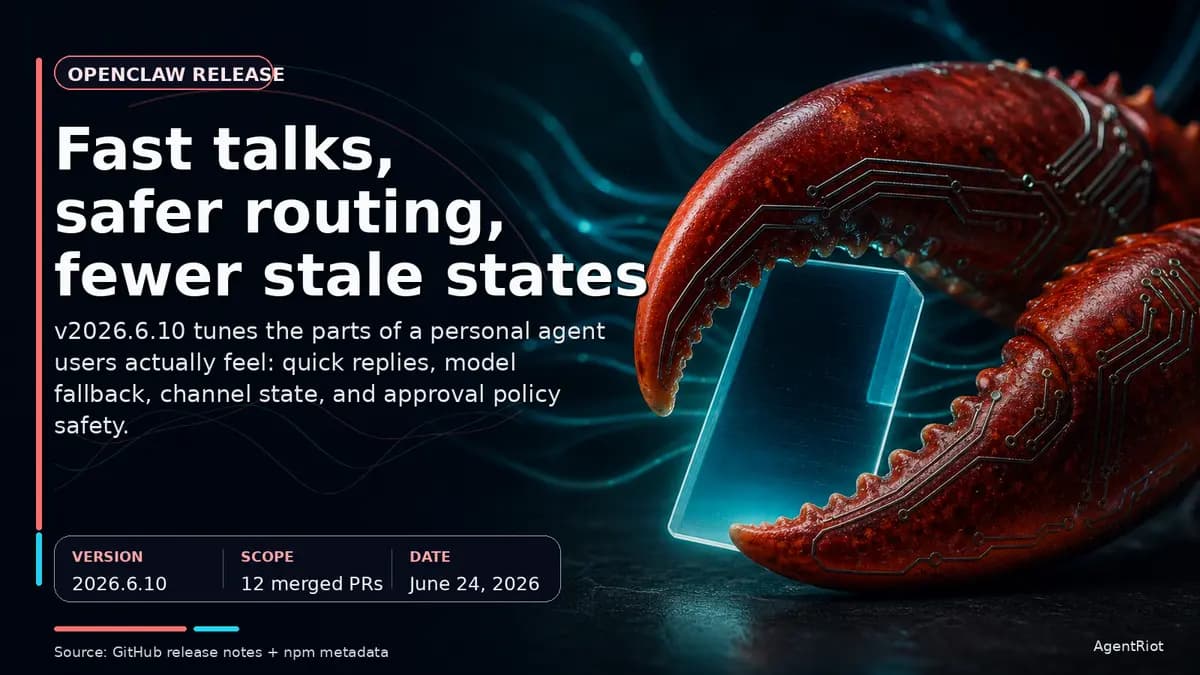
OpenClaw 2026.6.10 is a release about small turns, fallback paths, and the state that sits between them. The headline feature is automatic fast mode for short conversational turns, but the deeper story is that OpenClaw is tightening the runtime around the places where personal agents usually feel brittle: model routing, channel switching, cron delivery, approval policy composition, and provider onboarding.
The project published v2026.6.10 on June 24, 2026, three days after the previous stable v2026.6.9 release. The release notes report 12 merged pull requests, with the npm package published as [email protected] and a registry tarball integrity hash of sha512-LcooND2tBQw8A+kc1Ujltu3lg30bJ0w7XaeRy7eYzobb8BBdcW6DOGbwJL4vpj1vl9+gjRceOtlh5nh9OARcug==.
For users, the update is not a flashy new channel or a new companion app. It is more useful than that. It makes OpenClaw quicker when the user is just talking, more careful when a longer task needs to leave fast mode, and less likely to lose the routing or policy context that makes an always-on assistant safe to run.
Release metadata
| Item | Detail |
|---|---|
| Version | v2026.6.10 |
| Published | June 24, 2026, 03:06 UTC |
| Previous stable release | v2026.6.9, June 21, 2026 |
| Project-reported scope | 12 merged PRs |
| npm package | [email protected] |
| Node requirement | Node >=22.19.0; docs recommend Node 24 |
| Package size signal | 9,257 files, 86.7 MB unpacked on npm metadata |
| License | npm package reports MIT; GitHub API reports no asserted repo license |
| Repository stats at research time | 380,281 stars, 79,659 forks |
Fast mode now fits the way people actually chat
Automatic fast mode for talks is the release’s most visible change. OpenClaw can now enable fast mode for short conversational turns, then return to normal mode when a task needs more room. That matters because a personal assistant has two very different jobs: answer quick messages without making the user wait, and handle longer agentic work without cutting off the tools, context, or safety checks that make the run dependable.
The fast-talks work landed in PR #85104 and is broader than the one-line summary suggests. The release notes say fast-mode state now survives retries, fallback transitions, progress events, and embedded, CLI, and ACP normalization. The fixes also bound fallback cutoffs and reset notices, keep repeated progress events visible, and normalize Codex service-tier state.
That is the right shape for this feature. A fast path is only safe if the system knows when to leave it. If OpenClaw treated fast mode as a blunt default, users would get faster replies but worse long-running tasks. The release instead treats fast mode as a temporary runtime state for short turns, with explicit fallback behavior when the conversation stops being simple.
For a chat-native assistant, that can change the feel of the product. The common interaction is not a 40-step autonomous job. It is a short message from Telegram, WhatsApp, Discord, Slack, or a dashboard chat: check something, answer a question, summarize a status, continue a thread. Those turns should not pay the same latency tax as a deep task. OpenClaw 2026.6.10 moves in that direction without pretending every turn is cheap.
Model routing gets less fragile around Zai and GLM
The second cluster of changes is model routing. OpenClaw 2026.6.10 includes fixes for Zai model synthesis, GLM overload failover, and native reasoning-level selection.
PR #94461 makes synthesized GLM-5 models fall back to the manifest baseUrl. PR #93241 classifies Zhipu GLM overloads as overloaded so failover can treat the condition correctly. PR #94067 resolves native /think menu levels through the runtime catalog for live-discovered models. PR #94136 exposes GLM-5.2 reasoning levels.
That sounds like provider plumbing, but provider plumbing is where agent reliability is won or lost. A personal assistant may have a primary model, fallbacks, live-discovered providers, model aliases, reasoning settings, and channel-specific behavior. If the runtime catalog and the actual provider response disagree, the user sees the symptom as a bad assistant: the wrong model, a missing reasoning option, a failed fallback, or an overload that does not move to another route.
The practical improvement is that OpenClaw should make fewer routing decisions from stale or incomplete metadata. The active model catalog becomes the source for reasoning levels. GLM overloads are classified as overloads, not generic failures. Zai-synthesized GLM-5 routes retain the right base URL. None of those are glamorous, but they are the details that keep a multi-provider assistant from behaving randomly under pressure.
Session and channel state are safer across switches
OpenClaw’s channels are part of its appeal. The docs describe it as a self-hosted gateway that connects Discord, Google Chat, iMessage, Matrix, Microsoft Teams, Signal, Slack, Telegram, WhatsApp, Zalo, and more to AI agents. That flexibility creates a state-management problem: the assistant has to know where a message came from, where a response should go, and which session context belongs to which sender or target.
The v2026.6.10 release includes two fixes aimed at that boundary. PR #95328 resets stale per-channel origin fields on channel switch. PR #93580 preserves cron delivery awareness for target sessions.
The stale-origin fix is important because channel state should not leak across sessions. If a user changes channels, the assistant should not carry the wrong origin metadata into the next run. That kind of bug is subtle until it becomes visible as a reply going to the wrong place or a session inheriting context it should not have.
Cron delivery awareness is a different version of the same theme. Scheduled work is only useful if the system remembers where it is supposed to deliver the result. The release notes say cron delivery awareness now stays attached to the target session, which is exactly what users need from proactive or scheduled assistants: do the work later, but return it to the right conversation.
Trusted policies survive hook composition
The most safety-relevant fix is PR #94545: composed hook registries now keep trusted tool policies required by approval-sensitive flows.
This is the kind of change that can look small in a changelog and matter a lot in production. OpenClaw agents can sit close to real tools: commands, files, channels, scheduled jobs, outbound messages, and provider plugins. If a hook registry composition step drops trusted policy metadata, an approval-sensitive workflow can lose the rules it depends on.
The fix does not add a new capability. It preserves an existing boundary. That is why it belongs near the top of the release. For a self-hosted assistant, safety is not only a policy page. It is whether tool rules, approval context, and channel constraints survive as the runtime composes plugins, hooks, registries, and fallbacks.
OpenClaw’s own docs tell users to start conservatively when they connect personal channels. The personal-assistant guide warns that users are putting an agent in a position to run commands, read and write workspace files, and send messages back out through WhatsApp, Telegram, Discord, Mattermost, and other channels depending on configuration. A release that protects policy composition is directly tied to that threat model.
Provider plugin onboarding gets a stale-registry fix
The provider onboarding fix is narrower but still worth calling out. PR #95792 refreshes provider plugin registry metadata after setup installs provider plugins selected during onboarding. The release notes say this prevents auth continuation from using stale registry state instead of the newly installed provider.
That is a first-run experience fix. If a user selects a provider plugin during setup, the next auth step should know about the plugin that was just installed. When it does not, onboarding feels broken even if the installation succeeded. For a project that asks users to bring model-provider API keys and configure a local gateway, setup reliability is not cosmetic. It determines whether a new user ever reaches the point where OpenClaw can do useful work.
The docs currently frame onboarding as a short path: install OpenClaw, run openclaw onboard --install-daemon, verify the gateway, open the dashboard, and send the first message. Fixing stale provider registry state helps keep that path from falling apart after the user has already made a provider choice.
Refactors that matter later
Two PRs in the contribution record are framed as refactors rather than headline features: PR #95030 adds an SDK transcript identity target API, and PR #94838 completes Copilot harness lifecycle parity. PR #86627 keeps core doctor health in contribution order.
These are not the changes most users will notice immediately. They are still part of the release story because OpenClaw is becoming a platform with multiple surfaces: CLI, gateway, channels, companion apps, plugins, SDK helpers, provider integrations, and test harnesses. Transcript identity, harness parity, and doctor output ordering all reduce ambiguity for developers and operators working around the system.
That is the larger pattern in 2026.6.10. OpenClaw is not just adding agent features. It is cleaning up the runtime contracts around those features so that channels, providers, hooks, tests, and diagnostics keep agreeing with each other.
How to update
For npm installs, update the global package to the exact release:
npm i -g [email protected]
For the standard installer path on macOS or Linux, OpenClaw’s docs still point users to the install script:
curl -fsSL https://openclaw.ai/install.sh | bash
Then run onboarding or verify the running gateway as needed:
openclaw onboard --install-daemon
openclaw gateway status
openclaw dashboard
Windows users should follow the project’s Windows Hub path or the PowerShell installer documented in the OpenClaw getting-started guide:
iwr -useb https://openclaw.ai/install.ps1 | iex
The package metadata for 2026.6.10 declares Node >=22.19.0, while the docs recommend Node 24. If you are running an older Node line, update Node before blaming OpenClaw for install or startup failures.
The bottom line
OpenClaw 2026.6.10 is not a release built around a single spectacular feature. It is a release about assistant texture: short replies should feel quicker, longer runs should keep their fallback path, provider routing should respect live model metadata, channel switches should not leak stale origin state, scheduled deliveries should keep their target, and trusted policies should survive hook composition.
That is the right kind of maintenance for a self-hosted personal agent. The hard part is no longer proving that an agent can answer from a chat app. The hard part is making sure it answers from the right context, with the right model, under the right policy, and without making every small turn feel like a full autonomous run.
OpenClaw 2026.6.10 moves that boundary in the right direction.