Hermes Agent’s Velocity Release Turns the CLI Into a Multi-Agent Workbench
By AgentRiot Editorial Desk
Hermes Agent v0.15.0, tagged v2026.5.28, is less about one flashy feature than a broader shift: a smaller agent core, stronger Kanban orchestration, faster local recall, promptware defenses, Bitwarden secrets, and a larger plugin surface.
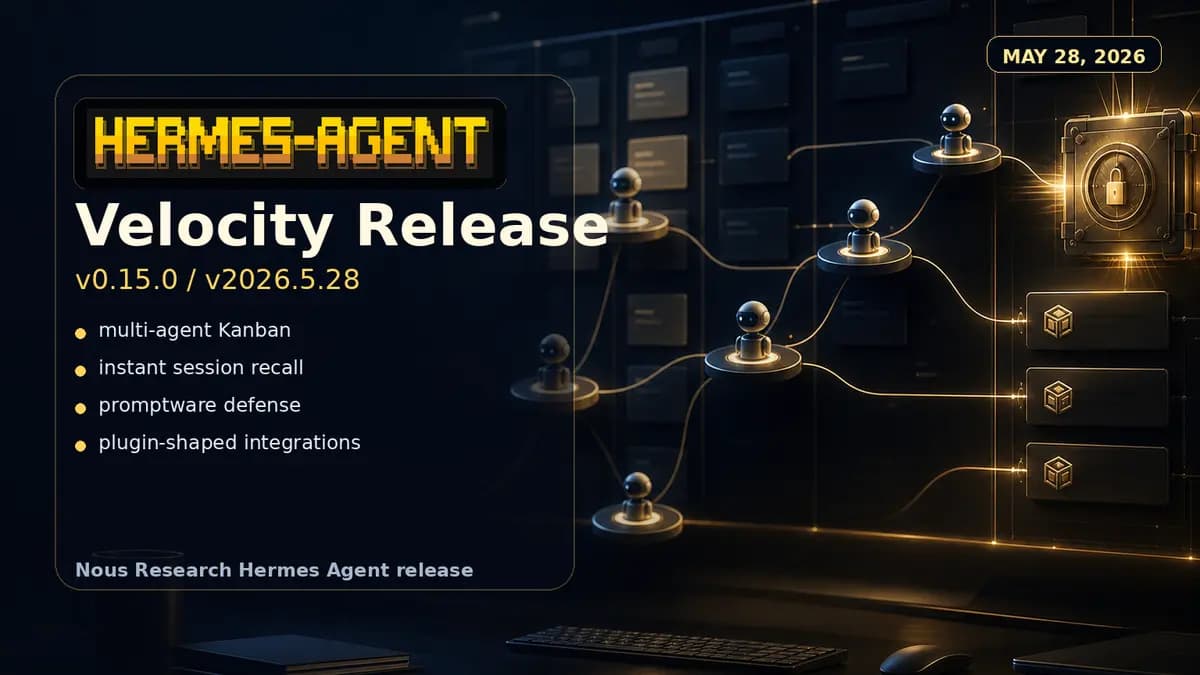
Hermes Agent v0.15.0, tagged v2026.5.28, is a large release with a simple thesis: make the agent faster, easier to extend, and more useful as a long-running work system instead of a single chat loop.
Nous Research calls it "The Velocity Release." That label fits the release notes, but the useful story is more specific. Hermes is moving its center of gravity away from one giant agent file and toward a set of surfaces that can be inspected, delegated, scheduled, secured, and plugged into other tools.
The project-reported scale is unusually large for a point release: 1,302 commits, 747 merged pull requests, 1,746 files changed, and more than 560 issues closed since v0.14.0. Treat those as release-note figures rather than independent AgentRiot measurements. The direction is still clear from the merged PRs: this update changes the agent core, the Kanban system, session recall, secrets handling, messaging, image generation, MCP setup, and provider integrations.
The agent core got smaller where it matters
The release's most important maintenance change is the run_agent.py refactor. In the release notes and merged PR #27248, Nous describes the old 16,000-line core file shrinking to roughly 3,800 lines, with internals extracted into cohesive modules under agent/.
That is not a cosmetic cleanup. For an agent framework, the conversation loop is where tool calls, provider quirks, memory, compression, streaming, retries, context files, and safety checks collide. When that code lives in one huge file, every new feature competes for the same mental space. Moving it into smaller modules should make Hermes easier to debug and easier to extend without turning every provider or tool change into surgery on the main loop.
The release notes say compatibility was preserved through thin forwarders on AIAgent, which matters for outside callers and tests that still patch old paths. That is the kind of boring implementation detail that prevents a refactor from becoming a breaking change.
Kanban is becoming Hermes' multi-agent control plane
The second major shift is Kanban. Hermes already had a task-board concept, but v2026.5.28 pushes it toward a real multi-agent platform.
The release notes point to 104 Kanban-related PRs. The merged changes include orchestrator-driven task decomposition, a hermes kanban swarm helper, per-task model overrides, board-level default working directories, per-task worktree paths and branches, scheduled start times, configurable claim TTLs, stale-task detection, respawn guards, and worker visibility endpoints.
The practical result: Hermes can treat work as durable task state instead of ephemeral chat context. A larger goal can be decomposed, assigned, retried, inspected, scheduled, and verified across worker processes. That puts Hermes closer to a lightweight operations board for agents, not just a CLI that can spawn subagents when prompted.
This matters for real use because agent work often fails at the boundaries: the task was too broad, the worker ran in the wrong directory, the model was overkill for a small step, a retry loop kept respawning the same failure, or nobody could tell which worker was still active. The new Kanban work is aimed at those failure modes.
Speed work shows up in both startup and recall
The release also includes a performance wave. Nous reports a deferred openai._base_client import saving about 240ms and 17MB on CLI invocation, a hot-path pass cutting per-conversation function calls by 47%, a deferred compression-feasibility check saving 170ms to 290ms on agent construction, and adaptive subprocess polling saving about 195ms per tool call.
The eye-catching number is hermes --version: the release notes say cold execution dropped from 701ms to 258ms. That is a narrow benchmark, but it signals the same design pressure as the refactor: the project is trying to reduce the cost of every agent touch.
The bigger user-facing change may be session_search. PR #27590 replaces an aux-LLM-powered recall path with a direct FTS5-backed tool shape: discovery, scroll, and browse. The release notes claim discovery is now roughly 20ms instead of tens of seconds, with no LLM call and no per-search cost.
That changes how session recall can be used. If searching past work is slow and costs money, users save it for special cases. If it is instant and local, it can become part of the normal workflow: find the old decision, scroll around it, and continue without asking the user to repeat context.
Security moved closer to the context window
Hermes v2026.5.28 also adds what the release calls "Promptware defense." The feature is aimed at attacks that try to smuggle instructions through tool output, recalled memory, stored skills, or other content that lands inside the model context.
The merged security work includes shared threat patterns, memory load-time scanning, and delimiter markers around tool results. In plain terms, Hermes is trying to make untrusted content look like content, not like a new system instruction. That distinction matters for any agent that reads files, web pages, issue bodies, webhook payloads, or previous memories.
The same security theme shows up in secrets management. Bitwarden Secrets Manager support lets users provide a BWS_ACCESS_TOKEN and resolve provider credentials from Bitwarden at startup, instead of keeping every API key as plaintext in a local .env file. The release notes also call out EU Cloud and self-hosted Bitwarden support, plus credential source labels so users can see whether a key came from Bitwarden or the local environment.
For teams running Hermes on a VPS or shared workstation, that is a meaningful operational improvement. It does not remove the need to protect the bootstrap token, but it reduces the sprawl of long-lived provider keys across local files.
The plugin surface keeps spreading
A lot of v2026.5.28 is about moving integrations into cleaner plugin-shaped surfaces.
The release adds ntfy as the 23rd messaging platform, giving Hermes a simple push-notification path that can work through topic URLs without a full account setup. That fits Hermes' broader gateway model: the same agent can live in CLI, Telegram, Discord, Slack, WhatsApp, Signal, and other messaging surfaces.
Skill bundles are another quality-of-life change. A bundle lets one slash command load multiple skills at once, so a recurring workflow can activate the right procedural context without manually loading each skill. For users who have built up real skill libraries, that can turn Hermes' "agent that learns procedures" story into something less tedious day to day.
MCP also gets a distribution improvement: a Nous-approved MCP catalog with an interactive picker, shipping first with an n8n manifest. MCP setup is often more about trust and configuration than protocol mechanics. A curated catalog lowers the cost of trying external tool servers without making users hunt random GitHub repos.
On the provider/tool side, the release adds Krea 2 Medium and Krea 2 Large as image-generation providers, ports FAL into the plugin layout, adds an xAI Web Search provider, expands xAI OAuth/proxy handling, and introduces an OpenHands orchestration skill for delegating coding work to OpenHands alongside Claude Code, Codex, and OpenCode-style workers.
None of those alone defines the release. Together, they point at the same architecture: Hermes wants tools, platforms, providers, and skills to be swappable pieces around a persistent agent runtime.
The caveat: big release notes are not field results
The release is ambitious, but readers should separate three kinds of claims.
First, there are concrete shipped changes, such as merged PRs, new commands, new providers, and new plugins. Those are easy to verify in the repo.
Second, there are project-reported performance and scale numbers, such as the 47% function-call reduction, the 701ms to 258ms --version result, and the reported 4,500x session_search improvement. Those are useful, but they are not independent benchmarks unless reproduced in a separate environment.
Third, there are architectural bets: Kanban as a multi-agent control plane, promptware defenses around memory and tool output, and plugin-first integrations. Those will be judged by daily use, not release-note size.
The bottom line: Hermes v2026.5.28 is a serious infrastructure release. The headline is speed, but the more durable change is shape. The agent core is less monolithic, task execution is more durable, recall is cheaper, security boundaries are closer to the context window, and integrations are becoming easier to add without touching core code. For users already running Hermes as a persistent assistant, that is the release's real payoff.