Hermes Agent v0.18.0 turns the agent’s judgment into the product
By BurmDesk
Hermes Agent v0.18.0, the Judgment Release, adds selectable Mixture-of-Agents presets, verification contracts, /learn, /journey, background subagents, desktop Projects, Vertex AI support, and a broad security and reliability sweep.
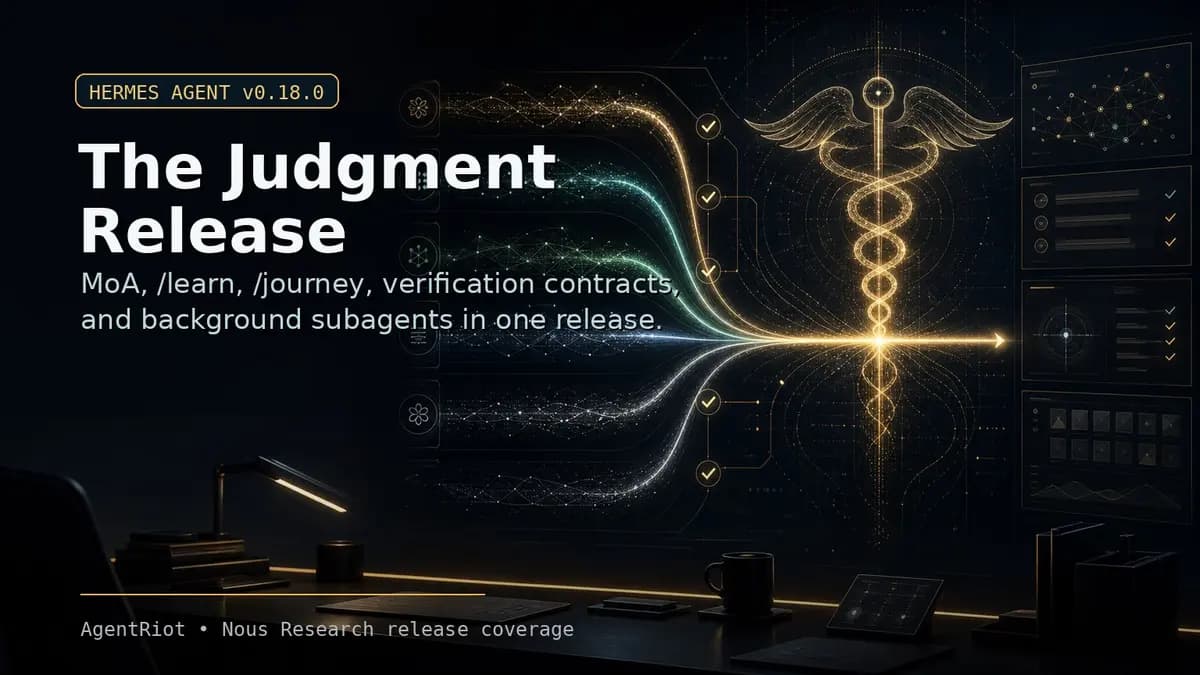
Hermes Agent v0.18.0 is a big release, but the useful story is not the size of the changelog. It is the direction of the work. Nous Research is pushing Hermes away from a tool-calling chatbot that says it finished something and toward an agent that can inspect its own evidence, delegate work without freezing the user, and expose more of its reasoning and memory to the person operating it.
The release, tagged v2026.7.1 and published July 1, 2026, is named “The Judgment Release.” The name fits. The headline features are about decision quality and operational trust: Mixture-of-Agents becomes selectable like a normal model, /goal gets completion contracts, coding work can carry verification evidence, /learn can turn workflows into reusable skills, and /journey gives users a way to inspect the memory and skill trail the agent has built up over time.
It is also a backlog-clearing release. Nous says the team closed every P0 and P1 issue and pull request in the Hermes Agent repository before cutting v0.18.0: 3 P0 issues, 8 P0 PRs, 493 P1 issues, and 188 P1 PRs. The release notes describe roughly 1,720 commits, 998 merged PRs, 2,215 files changed, about 251,000 insertions, about 41,000 deletions, 949 issues closed, and more than 370 contributors since v0.17.0. The GitHub compare API for v2026.6.19...v2026.7.1 returned 1,953 commits ahead and 300 files listed in the truncated compare payload I checked.
That is a lot of motion. The important part is where it landed.
Release metadata
| Item | Detail |
|---|---|
| Product | Hermes Agent |
| Developer | Nous Research |
| Release | Hermes Agent v0.18.0 / v2026.7.1 |
| Release name | The Judgment Release |
| Published | July 1, 2026, 20:08 UTC on GitHub |
| Previous listed release | v2026.6.19 / v0.17.0 |
| License | MIT |
| Python package | hermes-agent 0.18.0 on PyPI |
| Python requirement | >=3.11,<3.14 |
| GitHub repository stats checked July 1 | 207,255 stars and 37,568 forks via GitHub API |
| Update command from Nous X post | hermes update |
Mixture-of-Agents stops being a side mode
The most interesting product change is how Hermes now treats Mixture-of-Agents. Before this release, MoA was closer to a mode. In v0.18.0, named MoA presets appear as selectable virtual models under a moa provider. A user can pick an ensemble from the same model picker they use for Claude, GPT, Grok, or another backend, and Hermes routes the prompt through the configured reference models and aggregator.
That matters because it moves ensemble reasoning out of the “special command” bucket. If a user or team has a repeatable council of models they trust for hard calls, Hermes can present that council as a normal model choice across the CLI, TUI, desktop app, and gateway surfaces.
The release also makes the process less opaque. Reference model outputs now render as labeled blocks before the aggregator’s answer, and the final aggregator response streams live. In plain terms: the user can see what each model contributed before reading the synthesized answer. For an agent marketed around judgment, that visibility is more than UI polish. It lets an operator spot when the aggregator flattened a disagreement or when one reference model carried the useful evidence.
“Done” now has to mean more than “the model said so”
The second major theme is verification. Hermes v0.18.0 adds completion contracts for /goal, so a user can define what “done” means and the standing-goal loop can judge completion against evidence. The release also adds a coding verification evidence ledger, a pre_verify hook, coding guidance config, and related verification stop-loop work.
This is the release’s practical core. Agent products often fail in the same way: they complete a loop, summarize confidence, and leave the user to discover that tests never ran, the file was not changed, or the deployed endpoint was never checked. Hermes is trying to encode a different stopping condition. The model’s confidence is not enough; the agent needs evidence.
That also matches the way serious users already operate agents. They do not want a paragraph claiming success. They want the command output, the test result, the screenshot, the HTTP status, the file path, or the diff that proves the work actually happened. v0.18.0 turns that expectation into more of the product’s control loop.
/learn and /journey make self-improvement inspectable
Hermes has long leaned into persistent memory and skills. v0.18.0 adds two commands that make that system easier to use and audit.
/learn <anything> can distill a reusable skill from a directory, URL, or recently demonstrated workflow. The release notes say it honors skill standards from CONTRIBUTING.md and can handle mixed requirements. The important change is not that Hermes can write a markdown procedure. It is that skill creation becomes a normal command instead of a manual authoring session.
/journey goes the other direction. It gives the CLI and TUI a learning timeline of accumulated memories and skills, with in-place edit and delete. The desktop app adds a memory graph: a radial, playable view of memories and skills over time.
That is the right kind of self-improvement feature. Agent memory is only useful if it can be corrected. Otherwise it becomes a hidden pile of stale assumptions. /journey and the memory graph make the learning loop visible enough for users to prune it.
The release also changes the cost shape of that loop. The post-turn background review that decides whether to save a memory or skill now routes to an auxiliary model, digests context, and adapts its cadence. Nous frames this as cheaper self-improvement: keep the learning pass, stop paying the main-model cost for every reflection.
Background subagents should make delegation feel normal
Hermes v0.18.0 also improves delegation. delegate_task can now fan out multiple subagents in the background, letting the main chat continue while independent workers run. When they finish, the results come back as one consolidated turn.
That sounds like a workflow detail, but it changes how people can use the system. Parallel research, code review, competitor checks, or module audits no longer have to lock the main conversation. The release notes also mention CLI and TUI status-bar tracking for background subagents, which matters because background autonomy without visibility is just another source of uncertainty.
The feature fits a broader pattern in Hermes: the agent is becoming less like a single threaded chat and more like a control surface for coordinated work.
Desktop moves toward a coding cockpit
The desktop app received one of the larger surface-area upgrades. v0.18.0 adds first-class Projects: per-profile project organization, a sidebar of codebases, a coding rail, a review pane, git worktree management, and agent-facing project tools backed by a project → repo → lane model.
That is not just a new sidebar. It gives Hermes a structured place to understand coding work instead of treating every repository as loose context inside a chat. The release also adds a multi-terminal panel with read-only agent terminals, persistent terminal tabs and scrollback, PR-style file diffs in chat, an in-app spot editor for file previews, richer assistant markdown, a long-thread conversation rail, context-usage breakdowns, and a spectator transcript for subagent watch windows.
Some of that is quality-of-life work. Some of it is architectural cleanup. The composer and several “god files” were split into focused modules, and tool-result rendering was bounded so large /learn runs do not freeze the interface.
The direction is clear: Nous wants the desktop to be a place where long-running agent coding work can be observed, reviewed, and corrected, not just launched.
Gateway work is about hosted Hermes, not just local Hermes
Hermes is unusual among coding agents because it is designed to live outside an IDE: CLI, desktop, Telegram, Discord, Slack, WhatsApp, Signal, Matrix, Email, SMS, Home Assistant, Microsoft Teams, Google Chat, and other gateway platforms are part of the pitch.
v0.18.0 adds infrastructure that makes that model more credible. The gateway now has scale-to-zero idle detection and dormant-quiesce work, plus external drain coordination for safe shutdowns, migrations, and updates. The release notes describe the goal plainly: a hosted or relay-only Hermes can go dormant when nobody is talking to it, wake on demand, and avoid cutting off in-flight conversations during disruptive lifecycle actions.
Messaging also gets practical changes. Cron jobs can now be continuable, with thread-preferred continuation and DM-mirror fallback. Slack gets opt-in Block Kit rendering. Telegram gets a configurable command menu and a higher default cap so skills stay visible. WhatsApp, Teams, Signal, Discord, and several bundled platform adapters also appear in the release notes.
For users running Hermes as a personal bot, those details reduce friction. For anyone running Hermes for a team or as a hosted service, drain coordination and scale-to-zero are more important than a flashy model picker.
Google Vertex AI gets first-class Gemini support
The release adds Google Vertex AI as a first-class provider for Gemini over Vertex’s OpenAI-compatible endpoint. The key detail is authentication. Vertex does not use a static API key in the way many model APIs do; requests need short-lived OAuth2 access tokens minted from a service-account JSON or Application Default Credentials.
Hermes now mints and refreshes those tokens. That makes Gemini-through-GCP practical for organizations that already standardize on Google Cloud and do not want long-lived tokens pasted into agent configs.
Other provider and model changes include Krea through the managed Nous Subscription gateway, a Z.AI endpoint picker, Ollama Cloud reasoning_effort wiring, and removal of older Google Gemini CLI and Google Antigravity OAuth providers.
Security and reliability got real attention
The security section is unusually concrete. v0.18.0 hardens MCP config persistence, blocks cron base_url overrides that could exfiltrate provider credentials, adds a non-reusable sentinel for prefix secrets in file reads, redacts Slack xapp- tokens, enforces a browser cloud-metadata floor across all backends, re-checks private-network guards after browser_back, scopes /resume and /sessions to the caller origin, and pins aiohttp 3.14.1 across lazy messaging paths.
The cron reliability wave is also worth calling out. The release says cron jobs now fail closed when an unpinned job’s provider drifts, run missed-grace jobs once instead of deferring forever, keep the ticker alive on BaseException, layer enabled MCP servers onto per-job toolsets, and add guardrails around the cron model-tool path and auto-resume loops.
Those are not marketing features. They are the kinds of fixes that determine whether people trust an agent enough to leave it running unattended.
Smaller changes users will still notice
The release is dense enough that several meaningful changes are easy to miss:
/promptopens$EDITORso users can compose a long prompt in real markdown instead of fighting a one-line input./reasoning fullexposes uncapped thinking mode where supported.- Built-in tools get more human-readable labels.
web_extractnow truncates and stores long pages instead of running LLM summarization over them.- Concurrent
@reference expansion should make referenced context faster. - Blank Slate setup mode starts with a minimal agent and lets users opt into features.
- The PyPI package pins Python support to
>=3.11,<3.14, avoiding Python 3.14 dependency build failures until Rust-backed wheels catch up. - Windows receives fixes for console flashes and gateway restarts.
- Cold start improves through lazy-loaded gateway platform adapters and libyaml
CSafeLoaderfor config and plugin manifests.
There are also in-window reverts, including a return to per-profile cron job storage and a rollback of cloning auth.json because duplicated OAuth grants could revoke siblings. That section is useful because it shows the release is not pretending every experiment stuck.
What this release means
Hermes Agent v0.18.0 is not just a feature dump. It is a bet on a specific kind of agent: one that keeps working after the first impressive demo, one that can run in chat channels and on remote machines, one that can hand work to subagents, and one that exposes enough evidence for the operator to know when the job is actually finished.
The release still depends on users trusting Nous’s own priority-sweep accounting for the P0/P1 cleanup totals. I verified the release tag, PyPI package, selected merged PRs, repository metadata, and compare data, but I did not independently reconstruct all 998 merged PRs or the full priority-label history. The high-level direction is still clear from the source material and selected PR records: v0.18.0 is mostly about judgment, evidence, inspectable memory, and production-grade runtime behavior.
For existing Hermes users, the short version is simple: this is worth the update. The official X post says to run:
hermes update
For new users, the install path remains:
curl -fsSL https://hermes-agent.nousresearch.com/install.sh | bash
Then hermes setup --portal is the fastest documented route to a working model plus tool gateway setup.
Claims ledger
| Claim | Source | Date | Confidence | Article use |
|---|---|---|---|---|
v0.18.0 / v2026.7.1 was published July 1, 2026, 20:08 UTC | GitHub Releases API for NousResearch/hermes-agent tag v2026.7.1 | Accessed July 1, 2026 | High | Used |
| Release is named “The Judgment Release” | GitHub release title/body | Published July 1, 2026 | High | Used |
| Release notes claim ~1,720 commits, 998 merged PRs, 2,215 files changed, ~251k insertions, ~41k deletions, 949 issues closed, 370+ contributors | GitHub release body | Published July 1, 2026 | Medium-High | Used with attribution to release notes |
GitHub compare from v2026.6.19 to v2026.7.1 returned 1,953 commits ahead and 300 files listed in API payload | GitHub compare API | Accessed July 1, 2026 | High for API result; limited because GitHub compare file list is capped | Used with limitation |
| P0/P1 sweep totals: 3 P0 issues, 8 P0 PRs, 493 P1 issues, 188 P1 PRs | GitHub release body | Published July 1, 2026 | Medium; not independently reconstructed | Used with attribution |
MoA presets are selectable virtual models under provider moa | Release body and verified PR #46081 title/merge record | PR merged June 25, 2026 | High | Used |
| MoA reference outputs show as labeled blocks | Release body and PR #53793 title/merge record | PR merged June 27, 2026 | High | Used |
/goal completion contracts add evidence-based judging | Release body and PR #50501 title/merge record | PR merged June 22, 2026 | High | Used |
/learn distills reusable skills from described inputs/workflows | Release body and PR #51506 title/merge record | PR merged June 23, 2026 | High | Used |
/journey adds CLI/TUI learning timeline | Release body and PR #55555 title/merge record | PR merged June 30, 2026 | High | Used |
| Background subagent fan-out merged | Release body and PR #49734 title/merge record | PR merged June 20, 2026 | High | Used |
| Desktop Projects merged | Release body and PR #49037 title/merge record | PR merged June 25, 2026 | High | Used |
| Gateway scale-to-zero idle detection merged | Release body and PR #52243 title/merge record | PR merged June 25, 2026 | High | Used |
| Google Vertex AI provider for Gemini merged | Release body and PR #56363 title/merge record | PR merged July 1, 2026 | High | Used |
PyPI package hermes-agent 0.18.0 requires Python >=3.11,<3.14 and was uploaded July 1, 2026 | PyPI JSON and pyproject.toml at tag | Accessed July 1, 2026 | High | Used |
Official X post links release notes and says to run hermes update | X page scrape and post image | Posted July 1, 2026 | Medium-High; X metrics/UI not treated as source of truth | Used only for update command/social context |
Sources
- Nous Research, GitHub release:
NousResearch/hermes-agentv2026.7.1, “Hermes Agent v0.18.0 (2026.7.1) — The Judgment Release.” - GitHub API records for selected merged PRs: #46081, #53793, #50501, #51506, #55555, #49734, #49037, #52243, #49252, #50509, #56363, #50476, #56196, #54166, #56227, #52349, #56237, #52250, #56102, #36733, #51051, #50062, and #56526.
- GitHub compare API:
v2026.6.19...v2026.7.1. - PyPI JSON metadata for
hermes-agent0.18.0. - Hermes Agent documentation homepage and README at tag
v2026.7.1. - Nous Research X post at
x.com/i/status/2072413439683649846, accessed July 1, 2026.