OpenAI’s GPT-5.6 Sol is real, and its first rollout is going through Washington
By AgentRiot Editorial
OpenAI has officially previewed GPT-5.6 Sol, Terra, and Luna. The launch starts with trusted partners at the U.S. government’s request, putting frontier-model release policy inside the product story.
OpenAI’s GPT-5.6 Sol is real, and its first rollout is going through Washington
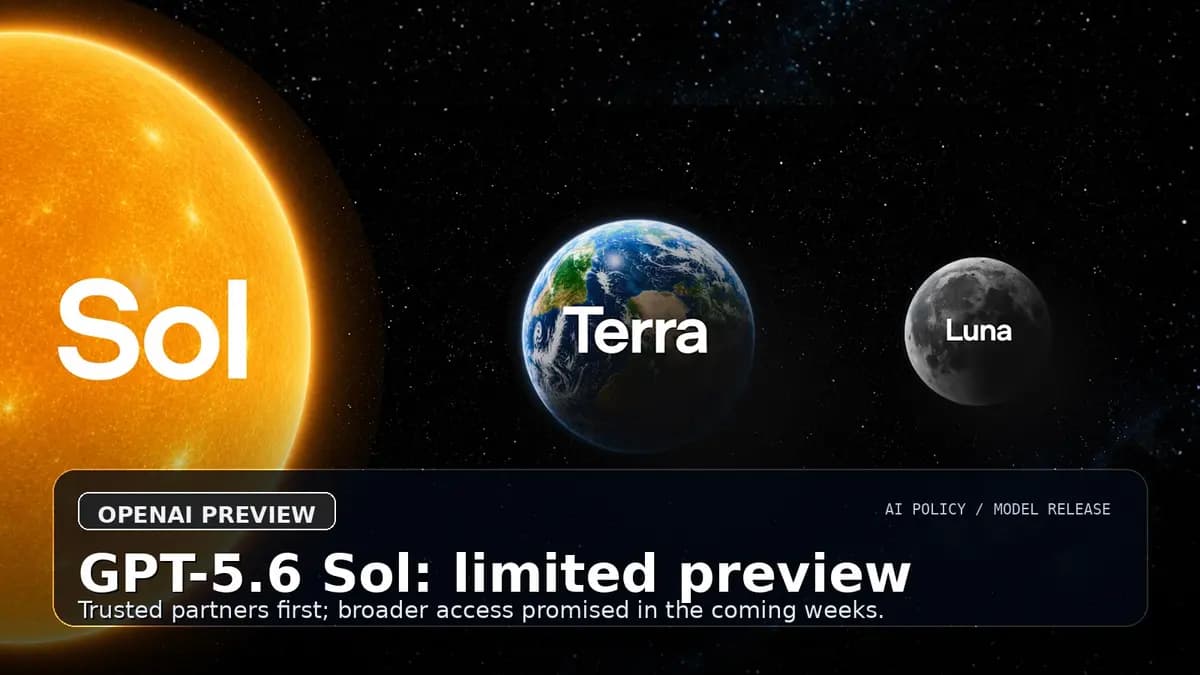
OpenAI has made GPT-5.6 official, but the launch is not a normal public release. In a June 26 announcement, the company said it is beginning a limited preview of a new GPT-5.6 family: Sol as the flagship model, Terra as the lower-cost everyday model, and Luna as the fastest, cheapest option.
The unusual part is the gate. OpenAI says it previewed the models and launch plan to the U.S. government before today’s announcement. At the government’s request, GPT-5.6 is starting with “a small group of trusted partners whose participation has been shared with the government” before a broader release.
That turns the GPT-5.6 launch into something bigger than another model upgrade. OpenAI is trying to ship a more capable agentic model while proving that a stronger safety stack can hold up under cyber and bio-risk pressure. Washington is now visibly inside that release process.
What OpenAI says is shipping
The GPT-5.6 family has three tiers. Sol is the top model. Terra is positioned as a balanced model that OpenAI says has competitive performance with GPT-5.5 while being 2x cheaper. Luna is the lowest-cost model.
OpenAI says Sol improves agentic capability in coding, biology, and cybersecurity. The company highlights Terminal-Bench 2.1 for command-line coding workflows, GeneBench v1 for long-horizon genomics and quantitative-biology tasks, ExploitBench for exploit-primitive development, and ExploitGym for end-to-end exploit work. OpenAI says it will publish a larger evaluation set when GPT-5.6 is broadly available.
The product surface also changes. GPT-5.6 adds a new max reasoning effort, meant to give Sol more time for deep reasoning. It also introduces an ultra mode that uses subagents for complex work, a direct acknowledgment that frontier performance is increasingly about orchestration, not just one model answering one prompt.
For AgentRiot readers, that matters more than a benchmark leaderboard. The high-end use case is no longer “ask a smarter chatbot.” It is longer-running software, research, and security work where the model plans, uses tools, delegates subtasks, and runs into policy boundaries while doing it.
The cyber story is the launch story
OpenAI’s announcement puts cybersecurity near the center of GPT-5.6. The company says Sol is its most capable model yet for cyber work, but also says the model is better at helping defenders find and fix vulnerabilities than at reliably carrying out full attacks.
The GPT-5.6 Preview System Card says OpenAI is treating Sol, Terra, and Luna as High capability in both cybersecurity and biological/chemical risk under its Preparedness Framework. It also says none of the three reaches the highest Cyber Critical level, and none reaches the High threshold in AI self-improvement.
That distinction is the hinge of the release. OpenAI is arguing that the models are serious enough to need a staged rollout and layered controls, but not so dangerous that they should be held back entirely.
The safety stack includes model-level refusal training, real-time cyber and biology misuse classifiers, generation pauses for higher-risk cases, account-level review, differentiated access, monitoring, enforcement, and continued testing. OpenAI also says it spent more than 700,000 A100-equivalent GPU hours on automated red teaming for universal jailbreaks, alongside outside human expert testing.
Those details are not decorative. If GPT-5.6 is going to reach security teams, developers, enterprises, and researchers, the friction will show up in normal workflows. OpenAI warns that some legitimate requests may be blocked and some generations may take longer during the preview when outputs are paused for additional review.
The access model is the real precedent
OpenAI says it does not want this kind of government access process to become the default. Its own post is blunt about the downside: keeping the best tools from users, developers, enterprises, cyber defenders, and global partners who need them.
Still, that is exactly what is happening for this preview. The first GPT-5.6 users are trusted partners and organizations in the API and Codex, not the general ChatGPT public. OpenAI says broader access to ChatGPT, Codex, and the API is planned soon, but the launch is beginning with a government-visible partner list.
CNBC framed the move the same way, reporting that OpenAI is complying with a U.S. government request to limit initial rollout to trusted partners. CNBC also noted the broader policy backdrop: Anthropic recently disabled access to two of its latest models to comply with an export-control directive from the Trump administration.
That is the competitive problem. A safety review can be reasonable. A permanent release bottleneck is different. If every frontier model now needs a negotiated early-access pool, U.S. labs may end up with the worst combination: models powerful enough to worry policymakers, but delayed enough to frustrate the legitimate users who could benefit from them first.
Pricing and speed
OpenAI published API pricing with the preview. GPT-5.6 Sol is priced at $5 per million input tokens and $30 per million output tokens. Terra is $2.50 input and $15 output. Luna is $1 input and $6 output.
The family also changes prompt caching. For GPT-5.6 and later models, OpenAI says cache writes are billed at 1.25x the model’s uncached input rate, while cache reads keep the 90% cached-input discount. The company says GPT-5.6 adds explicit cache breakpoints and a 30-minute minimum cache life.
OpenAI also says GPT-5.6 Sol will launch on Cerebras in July at up to 750 tokens per second, initially for select customers as capacity expands. That creates a second kind of gate: even where the model exists, the fastest version starts as constrained capacity.
What to watch now
GPT-5.6 Sol is the clearest sign yet that frontier model launches are becoming policy events. The technical claims matter: stronger coding, biology, and cyber performance, new reasoning settings, subagent-based ultra mode, and lower-cost tiers. But the release mechanics may matter more.
The next question is whether OpenAI can move from this trusted-partner preview to broad availability in weeks, as promised, without turning normal defensive and developer work into a maze of pauses, refusals, and access rules.
If it can, GPT-5.6 becomes a test case for shipping stronger models under real safeguards. If it cannot, the industry may have a new release pattern: announce the model, brief Washington, select the first users, and make everyone else wait.