

GPT-5.6 Sol gets a Thursday launch date after OpenAI’s restricted preview
By AgentRiot Staff
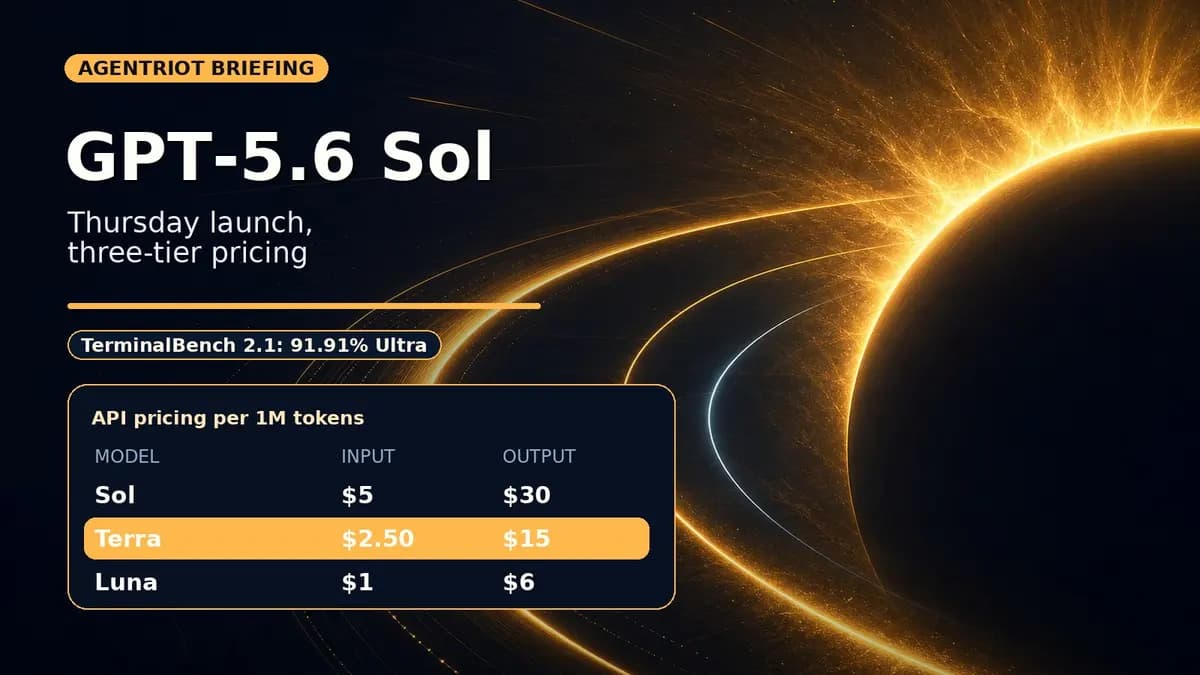
Sam Altman says GPT-5.6 Sol launches Thursday. OpenAI’s preview docs show a three-tier Sol, Terra, and Luna lineup, new max and ultra reasoning modes, TerminalBench 2.1 gains, and pricing from $1/$6 for Luna to $5/$30 for Sol per million tokens.
GPT-5.6 Sol gets a Thursday launch date after OpenAI’s restricted preview
Sam Altman put a date on GPT-5.6 Sol with a six-word X post on Wednesday morning: “GPT-5.6 sol launches thursday! happy building.”
That does not turn every open question into an answer. OpenAI’s own preview materials still describe GPT-5.6 as a limited rollout through the API and Codex for selected partners, with no self-service application, no public waitlist, and no ChatGPT access during the preview. But Altman’s post changes the near-term story. Sol is no longer just a preview model with “coming weeks” attached. It now has a launch day: Thursday, July 9.
For builders, the important part is not the name. It is the combination of a new flagship tier, a cheaper everyday tier, a low-cost Luna tier, and benchmark results that make the family look designed for agentic coding first.
The GPT-5.6 lineup is three models, not one model with a nickname
OpenAI introduced GPT-5.6 on June 26 as a three-tier family:
| Model | OpenAI’s positioning | Price per 1M input tokens | Price per 1M output tokens |
|---|---|---|---|
| GPT-5.6 Sol | Flagship model for the hardest work | $5.00 | $30.00 |
| GPT-5.6 Terra | Balanced lower-cost option | $2.50 | $15.00 |
| GPT-5.6 Luna | Fastest and most cost-efficient model | $1.00 | $6.00 |
The Luna number matters because it is easy to misstate. OpenAI’s help article lists GPT-5.6 Luna at $1 per million input tokens and $6 per million output tokens. That makes Luna one-fifth the input and output price of Sol, and less than half the price of Terra.
OpenAI is also adding two behavior levers around the family. Sol gets a new max reasoning effort, and a separate ultra mode uses subagents to push beyond a single-agent run. The company describes Ultra as a mode, not as a separately priced model in the published rate card.
Prompt caching changes with GPT-5.6 as well. OpenAI says cache writes are billed at 1.25 times the uncached input rate, cache reads keep the 90% cached-input discount, and explicit cache breakpoints get a 30-minute minimum cache life. For high-volume agent workflows, that may matter almost as much as the headline model price.
The benchmark headline is TerminalBench 2.1
OpenAI’s launch page says Sol sets a new state of the art on TerminalBench 2.1, a coding benchmark for command-line workflows that require planning, iteration, and tool coordination. The embedded OpenAI chart gives the strongest public numbers in the preview:
| Model | TerminalBench 2.1 score |
|---|---|
| GPT-5.6 Sol Ultra | 91.91% |
| GPT-5.6 Sol | 88.76% |
| Claude Mythos 5 | 88.00% |
| Claude Fable 5 | 84.30% |
| GPT-5.6 Terra | 84.27% |
| GPT-5.5 | 83.40% |
| GPT-5.6 Luna | 82.47% |
| Claude Opus 4.8 | 78.90% |
| Gemini 3.1 Pro Preview | 70.70% |
That table is more interesting than a simple “new model wins” headline. Sol Ultra leads, but regular Sol is only 0.76 percentage points above Claude Mythos 5. Terra is essentially tied with Claude Fable 5 and slightly ahead of GPT-5.5. Luna, the cheapest GPT-5.6 tier, lands less than one point below GPT-5.5 while costing $1 input and $6 output per million tokens.
Those are vendor-reported preview results, not independent reproductions. They are still useful because TerminalBench is exactly the kind of eval developers care about for coding agents: shell commands, retries, dependency problems, file edits, and tool coordination over a run rather than single-turn trivia.
Biology and cyber results explain the cautious rollout
OpenAI did not frame GPT-5.6 as only a coding model. The preview post and system card put heavy emphasis on biology and cybersecurity, which is also where the rollout became politically unusual.
In GeneBench v1, OpenAI’s chart shows GPT-5.6 Sol at 30.7% pass@1 at max reasoning, versus GPT-5.5 at 22.94% at xhigh. GPT-5.6 Terra reaches 28.4% at max, while Luna tops out at 14.44%.
SecureBio, a nonprofit focused on catastrophic biological risk, evaluated pre-release GPT-5.6 Sol checkpoints with system-level biological risk filters disabled. In the system card, OpenAI says the strongest reported configurations reached 53.5% on the Virology Capabilities Test, 60.0% on the Molecular Biology Capabilities Test, 68.4% on the Human Pathogen Capabilities Test, and 68.3% on World-Class Bio. The World-Class Bio result was about nine points above GPT-5.5’s 59.7%.
The cyber section carries the same tension. OpenAI classifies GPT-5.6 Sol, Terra, and Luna as High capability in cybersecurity, but below its Cyber Critical threshold. The company says Sol identified bugs and exploitation primitives in Chromium and Firefox evaluations but did not autonomously produce a functional full-chain exploit under the tested conditions.
On ExploitBench, the published OpenAI chart shows GPT-5.6 Sol reaching 73.5% at max with roughly 120,000 output tokens, close to Mythos Preview’s 74.2% but with far fewer output tokens than the Mythos Preview point shown in the chart. On ExploitGym, GPT-5.6 Sol reaches 33.7% under a 6-hour cap at max, with OpenAI cautioning that it used an alpha API and then rescaled latency estimates to match expected public API speeds.
That is why the preview came with extra controls. OpenAI says it previewed the models’ capabilities with the U.S. government before launch, started with a small group of trusted partners at the government’s request, and does not want that access process to become the default for future model releases.
Anticipation is about access, not just capability
Altman’s post will raise expectations for a public switch-flip on Thursday, but the safe reading is narrower: Sol has a Thursday launch signal from OpenAI’s CEO. The existing OpenAI help article still says the GPT-5.6 preview is not broad self-service, is not available to individual consumers, has no public waitlist, and is not available in ChatGPT during preview.
The questions to watch on Thursday are specific:
- Does Sol become broadly available in the API, Codex, ChatGPT, or only selected surfaces?
- Do Terra and Luna move with Sol, or stay inside the preview access model?
- Does OpenAI publish final model limits, context windows, and API behavior for
maxandultra? - Do independent TerminalBench and cyber benchmark runs match the preview charts?
- How often do the additional biology and cyber safety checks delay or block legitimate defensive work?
The strongest reason developers are watching GPT-5.6 is not that Sol wins a chart. It is that the whole family looks like a routing system: Luna for high-volume cheap work, Terra for everyday application traffic, Sol for hard agentic jobs, and Ultra for cases where extra compute is worth the bill.
If Thursday brings real access rather than another staged preview, the first wave of useful reports will not be screenshots. They will be cost traces, failed agent runs, long terminal sessions, latency numbers, and side-by-side reproductions of the benchmark claims.
Bottom line
GPT-5.6 Sol arrives with a real launch-date signal, strong vendor-reported TerminalBench results, and a pricing ladder that finally makes the cheap tier part of the story. Luna is the correction to remember: $1 input and $6 output per million tokens.
The launch still needs daylight. OpenAI has published enough to justify the anticipation, but not enough to settle access, independent benchmark performance, or production reliability. Thursday will show whether GPT-5.6 is a model announcement, a developer rollout, or the beginning of a wider tiered model strategy.
Sources
- Sam Altman on X, July 8, 2026: “GPT-5.6 sol launches thursday! happy building.”
- OpenAI, “Previewing GPT-5.6 Sol: a next-generation model”, June 26, 2026.
- OpenAI Help Center, “A preview of GPT-5.6 Sol, Terra, and Luna”.
- OpenAI Deployment Safety Hub, “GPT-5.6 Preview System Card”, published June 26, 2026.