GPT-5.6 shows the new frontier-model problem: release speed is becoming policy
By AgentRiot Editorial
Reports say OpenAI may stage GPT-5.6 access after U.S. government security concerns. The bigger issue is whether frontier-model safety review becomes a release bottleneck for U.S. labs while open competitors keep shipping.
GPT-5.6 shows the new frontier-model problem: release speed is becoming policy
OpenAI has not publicly launched GPT-5.6. That is the story.
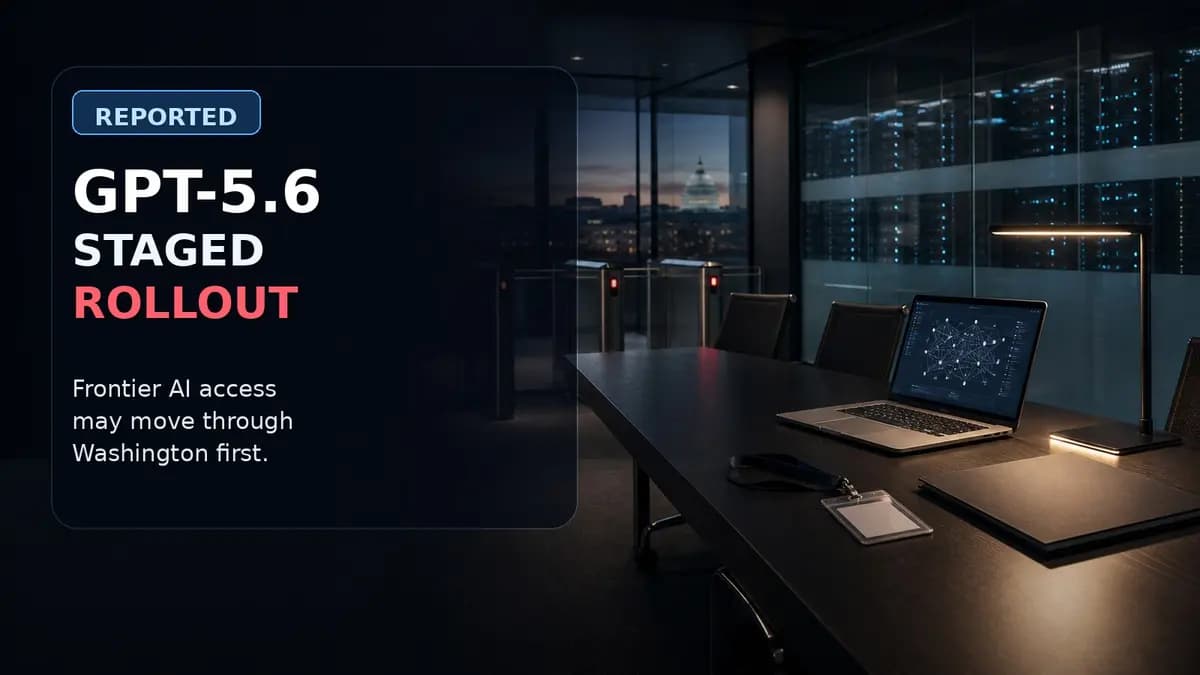
Reports from The Information, Axios, The Decoder, and TNW say the Trump administration has asked OpenAI to limit the first release of GPT-5.6 to a small set of trusted or government-approved partners before any broader rollout. Axios, via Yahoo News, described the request as the first known case where the U.S. government preemptively asked an American AI company to restrict a model launch before release. The Decoder reported that Sam Altman told staff access would be approved “customer by customer” during the preview period.
If those reports hold, GPT-5.6 is no longer just another model update waiting on product timing, capacity, or safety evaluation. It is an example of a new deployment regime: the most capable AI systems are starting to look less like normal software releases and more like controlled infrastructure.
That is a serious shift for developers, enterprise customers, and U.S. AI competitiveness.
The reported GPT-5.6 plan is not a normal rollout
The basic shape of the reported plan is simple: OpenAI would give GPT-5.6 first access to a limited partner group, while government offices review or approve access during the preview window. Axios reported that the White House Office of the National Cyber Director and the Office of Science and Technology Policy were involved as the administration builds a security evaluation framework for new models. The Decoder says Altman told employees OpenAI does not view this as its preferred long-term release model.
That caveat matters. OpenAI has not published an official GPT-5.6 launch post, model card, pricing page, or public release schedule. OpenAI’s own public release notes still point users toward GPT-5.5-era updates, including GPT-5.5 Instant quality changes and Codex updates such as Codex Remote GA, one-to-one QR pairing, and a DigitalOcean Droplet Workspace plugin.
So the cleanest factual statement is this: GPT-5.6 is reported to be moving into a restricted, government-shaped preview before public availability, but the exact model details, launch date, pricing, and wider access plan are not public yet.
That uncertainty should not make the story smaller. It makes the policy problem sharper.
Fable 5 made the risk real
This does not come out of nowhere. Anthropic’s Fable 5 and Mythos 5 episode already showed how quickly frontier-model access can become a national-security action.
On June 12, Anthropic published a statement saying the U.S. government had issued an export-control directive requiring it to suspend access to Fable 5 and Mythos 5 by any foreign national, including foreign national Anthropic employees. Anthropic said the practical effect was that it had to disable Fable 5 and Mythos 5 for all customers to ensure compliance. Other Claude models were not affected.
Anthropic disagreed with the breadth of the action. The company said the government had not provided specific details of its national-security concern and that the cited issue appeared to involve a narrow jailbreak technique for identifying software flaws. Anthropic argued that applying that standard across the industry would “essentially halt all new model deployments for all frontier model providers.”
That line is the bridge to GPT-5.6. Once a government directive can remove deployed frontier models from the market, labs have to assume the next high-capability release may be reviewed before it ships. OpenAI is now reportedly facing that exact pressure.
The executive order says voluntary. The market may hear mandatory.
The White House’s June 2026 executive order on advanced AI innovation and security is written to avoid the appearance of a formal licensing regime. It directs agencies to develop a classified benchmarking process for advanced cyber capabilities and a voluntary framework where developers can provide government access to covered frontier models before release.
It also includes an important sentence: nothing in that section should be construed to authorize a mandatory licensing, preclearance, or permitting requirement for new AI models.
That language is meant to protect innovation. But the reported GPT-5.6 process creates a harder practical question. If a lab is “asked” to stage access, if customers are approved one by one during preview, and if a prior model family was pulled after a directive, then voluntary review can start to behave like preclearance even without the legal label.
For a frontier lab, the incentives are obvious. Cooperate early, get political cover, avoid a Fable-style recall, and preserve a path to wider release. For customers and developers, the downside is equally obvious: the best model becomes available first to whoever is inside the approval circle.
That is not a normal software market.
The competitive cost is not theoretical
Safety concerns around frontier models are real. Cyber misuse, autonomous vulnerability discovery, biological assistance, and distillation are not imaginary categories. Anthropic’s own Fable statement leaned heavily on defense in depth and monitoring. The White House order focuses on cyber capabilities, critical infrastructure, and model access for government testing.
But release friction has a cost. In AI, model access is not only a product feature. It determines which startups can build, which enterprises can migrate, which developers standardize on a stack, and which ecosystem gets feedback first.
That is where U.S. policy can hurt U.S. labs if it becomes uneven. Axios framed the bigger market pressure clearly: American AI labs are racing each other while also facing increasingly capable Chinese open-source models. GLM, DeepSeek, Qwen, Kimi, and similar systems do not need to beat the very best closed model on every benchmark to take share. They need to be available, cheap, customizable, and good enough for a growing class of workloads.
If the U.S. slows its own strongest closed models while open-weight competitors keep moving, the market will not wait for a perfect policy compromise. Developers will route around delay. Enterprises will test alternatives. Some customers will accept slightly weaker capability in exchange for predictable access.
That is how a safety gate can become a distribution penalty.
The hard part is drawing a line that labs can actually use
The right answer is not “release everything instantly.” Frontier models can create real dual-use risk, and the government has a legitimate role in protecting critical infrastructure and national security. The problem is opacity.
Labs need to know what triggers a covered-frontier designation. Customers need to know whether access decisions are technical, political, nationality-based, infrastructure-based, or use-case-based. Smaller companies need to know whether they are being protected from risk or locked out while large partners get the first wave of capability.
A usable policy would have at least four pieces:
- A clear capability threshold for extra review, not an improvised decision after launch rumors start circulating.
- A narrow, time-limited review window with published categories of concern.
- Transparent access criteria for early partners, so the process does not quietly favor incumbents.
- A fast appeal or remediation path if a model is delayed, restricted, or pulled.
Without that, every major model launch becomes a guessing game. Traders watch rumor windows. Developers wait for a model picker to change. Enterprise buyers wonder whether the API they plan around will exist next month. Foreign competitors get the easiest marketing line in the world: their models are available now.
The bottom line
GPT-5.6 may still arrive broadly within weeks. The reported preview may end up being a short, awkward transition while the U.S. government builds a real process. OpenAI may decide the political cost is worth the delay.
But the pattern is now visible. Anthropic’s Fable 5 and Mythos 5 were pulled after a government directive. OpenAI’s next model is reportedly being staged before release. The White House says this is not mandatory licensing, but the market is starting to see a checkpoint.
That checkpoint may reduce misuse risk. It may also hand distribution momentum to every model provider that can say yes faster.
The question is no longer whether frontier AI should have safety review. It should. The question is whether the United States can design that review without slowing its own best labs into a competitive disadvantage.