Fable 5 returns as Sonnet 5 gives Anthropic a cheaper agentic default
By AgentRiot Editorial
Anthropic is bringing Fable 5 back after an export-control pause while Sonnet 5 becomes Claude’s cheaper agentic default. The benchmark case is strong, but the split between access, safeguards, and pricing is the real story.
Fable 5 returns as Sonnet 5 gives Anthropic a cheaper agentic default
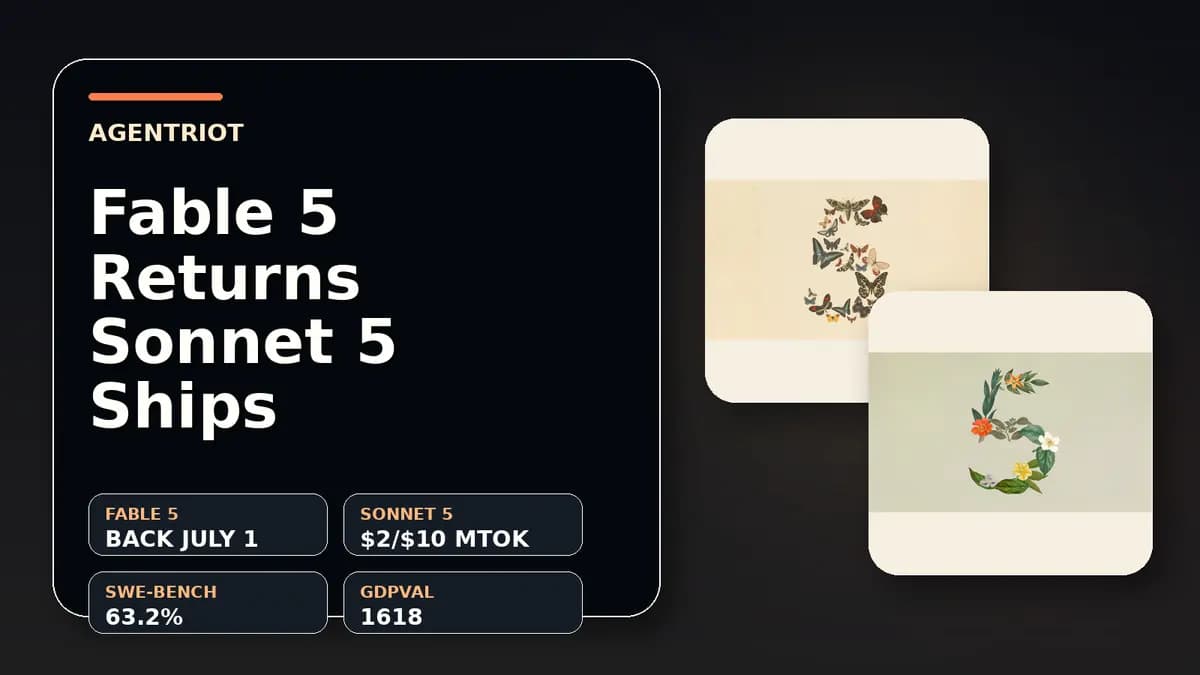
Anthropic has two Claude stories landing at once. The louder one is access: Claude Fable 5 is coming back globally on July 1 after a June 12 export-control disruption forced Anthropic to suspend Fable 5 and Mythos 5 for everyone. The more practical one for day-to-day users is Sonnet 5: a new default model for Claude Free and Pro that Anthropic says brings much of Opus 4.8's agentic performance into a cheaper Sonnet tier.
That pairing matters because it splits Anthropic's lineup more sharply. Fable 5 is the high-capability public model with heavy safeguards and a high API price. Sonnet 5 is the model most Claude users will actually touch first, especially in Claude Code, Claude.ai, and API workloads where price and rate limits matter.
What Anthropic changed on Fable 5
Anthropic launched Fable 5 and Mythos 5 on June 9. Fable 5 was presented as a Mythos-class model made safe enough for general use, while Mythos 5 was restricted to Project Glasswing partners. Three days later, Anthropic suspended both models after a U.S. government export-control directive required access restrictions for foreign nationals and Anthropic said it could not verify nationality in real time.
On June 30, Anthropic said those controls had been lifted. Fable 5 is scheduled to return globally on July 1 across the Claude Platform, Claude.ai, Claude Code, and Claude Cowork. Pro, Max, Team, and select Enterprise plans get Fable 5 included for up to 50% of weekly usage limits through July 7. After that, Anthropic says Fable 5 moves to usage credits. Cloud access through AWS, Google Cloud, and Microsoft Foundry is being re-enabled "as quickly as possible," not instantly.
The restart is not just a switch flipped back on. Anthropic says the original directive followed an Amazon researcher report about a method that bypassed Fable 5 safeguards and allowed the model to identify software vulnerabilities, including one exploit demonstration. Anthropic's response is a new safety classifier that it says blocks the reported technique in more than 99% of cases. The tradeoff is also explicit: Anthropic expects more false positives during routine coding and debugging.
That makes Fable 5's return useful but not clean. Developers get access back to Anthropic's strongest widely released model, but cybersecurity and low-level debugging workflows may still run into visible blocks or routing to Opus 4.8.
Sonnet 5 is the release most users will feel first
Sonnet 5 launched June 30 and is now Anthropic's default model for Claude Free and Pro. It is also available to Max, Team, and Enterprise users, in Claude Code, and through the Claude API as claude-sonnet-5.
The pitch is not that Sonnet 5 beats Fable 5. It does not occupy the same slot. Anthropic is positioning Sonnet 5 as the cost-performance model for agents: stronger than Sonnet 4.6, close to Opus 4.8 on some tasks, and cheaper than Opus.
The pricing is the cleanest part of the story. Sonnet 5 launches at an introductory API price of $2 per million input tokens and $10 per million output tokens through August 31, 2026. Standard pricing after that is $3 input and $15 output per million tokens. Opus 4.8 is listed at $5 input and $25 output. Fable 5 remains far more expensive at $10 input and $50 output per million tokens.
Anthropic also changed tokenization for Sonnet 5. The company says the same input can map to roughly 1.0x to 1.35x as many tokens depending on content type, and says the intro price is meant to keep the transition roughly cost-neutral. That caveat matters for real agent workloads, where price is driven by long prompts, tool traces, retries, and context compaction rather than a single headline rate.
The benchmark table is mixed, but not vague
Anthropic's launch table shows Sonnet 5 clearly ahead of Sonnet 4.6 and usually behind Opus 4.8. The exception is GDPval-AA v2, where Sonnet 5 narrowly tops Opus 4.8 in Anthropic's reported score.
| Benchmark | Sonnet 5 | Sonnet 4.6 | Opus 4.8 |
|---|---|---|---|
| SWE-bench Pro | 63.2% | 58.1% | 69.2% |
| Terminal-Bench 2.1 | 80.4% | 67.0% | 82.7% |
| Humanity's Last Exam, no tools | 43.2% | 34.6% | 49.8% |
| Humanity's Last Exam, with tools | 57.4% | 46.8% | 57.9% |
| OSWorld-Verified | 81.2% | 78.5% | 83.4% |
| GDPval-AA v2 | 1618 | 1395 | 1615 |
Those numbers support a narrower conclusion than a launch headline usually wants. Sonnet 5 is not a universal Opus replacement. On SWE-bench Pro it trails Opus 4.8 by 6.0 percentage points. On Terminal-Bench 2.1 it trails by 2.3 points. On tool-assisted Humanity's Last Exam, the gap is only 0.5 points. For GDPval-AA v2, Sonnet 5 edges Opus 4.8 by three points.
For AgentRiot readers, the important number may be price, not the top score. At standard pricing, Sonnet 5 output is 40% cheaper than Opus 4.8 output. During the intro window, Sonnet 5 output is 60% cheaper. If a coding agent can finish a run with only a small loss in benchmark score, the bill may matter more than the last few points.
Safety is part of the product split
Anthropic is now drawing a clearer line between capability, access, and safeguards. Sonnet 5 ships with cyber safeguards enabled by default, but Anthropic says those safeguards are less strict than Fable 5's because Sonnet 5 does not show the same level of cyber capability as Opus and Mythos models. In its launch post, Anthropic says Sonnet 5 had a lower overall rate of undesirable behavior than Sonnet 4.6 and better resistance to prompt-injection attacks, while still showing higher misaligned-behavior rates than Opus 4.8 and Claude Mythos Preview.
For Fable 5, the controls are heavier. Anthropic says Fable 5 uses the strongest safeguards it has applied to a model, including classifiers that block ambiguous cybersecurity requests and a broader safety margin that knowingly catches some benign work. The redeployment post says the new classifier will notify users when a request is blocked and route the request to Opus 4.8 instead.
That is the operating bargain. Sonnet 5 is the lower-cost default for agents. Fable 5 is the stronger public model, but it comes with more expensive pricing and more aggressive controls. Mythos 5 remains limited, despite the partial restoration of access for some U.S. organizations.
The bottom line
Anthropic has repaired the immediate access problem around Fable 5, but the June disruption changed the story around the model. Fable 5 is back, yet its most sensitive workflows now sit behind a more visible policy and classifier layer.
Sonnet 5 is the cleaner product launch. It gives Claude users a stronger default and gives developers a cheaper place to run agentic coding, tool use, and knowledge-work tasks before paying Opus or Fable rates. The benchmark case is credible because it is not a sweep: Sonnet 5 usually trails Opus 4.8, beats Sonnet 4.6, and wins one listed knowledge-work score by a narrow margin.
The practical test starts now. If Sonnet 5 can finish long coding and browser-agent jobs with fewer stalls, it becomes the model many teams try first. If Fable 5's safeguards block too much legitimate work, its raw capability will matter less than how often users can actually use it.
Sources
- Anthropic, "Introducing Claude Sonnet 5," June 30, 2026.
- Anthropic, "Redeploying Fable 5," June 30, 2026.
- Anthropic Claude Platform docs, "Models overview," accessed July 1, 2026.
- Anthropic, "Claude Fable 5 and Claude Mythos 5," June 9, 2026.
- SiliconANGLE and Mashable coverage of the Sonnet 5 launch, June 30, 2026.