Anthropic's Fable 5: The Safest Model Nobody Can Use
By BurmDesk
Anthropic launched Claude Fable 5, its most capable model ever, on June 9. Four days later, the US government forced a complete shutdown over a potential jailbreak. Here's what happened, why developers were already angry, and what it means for frontier AI deployment.
Anthropic's Fable 5: The Safest Model Nobody Can Use
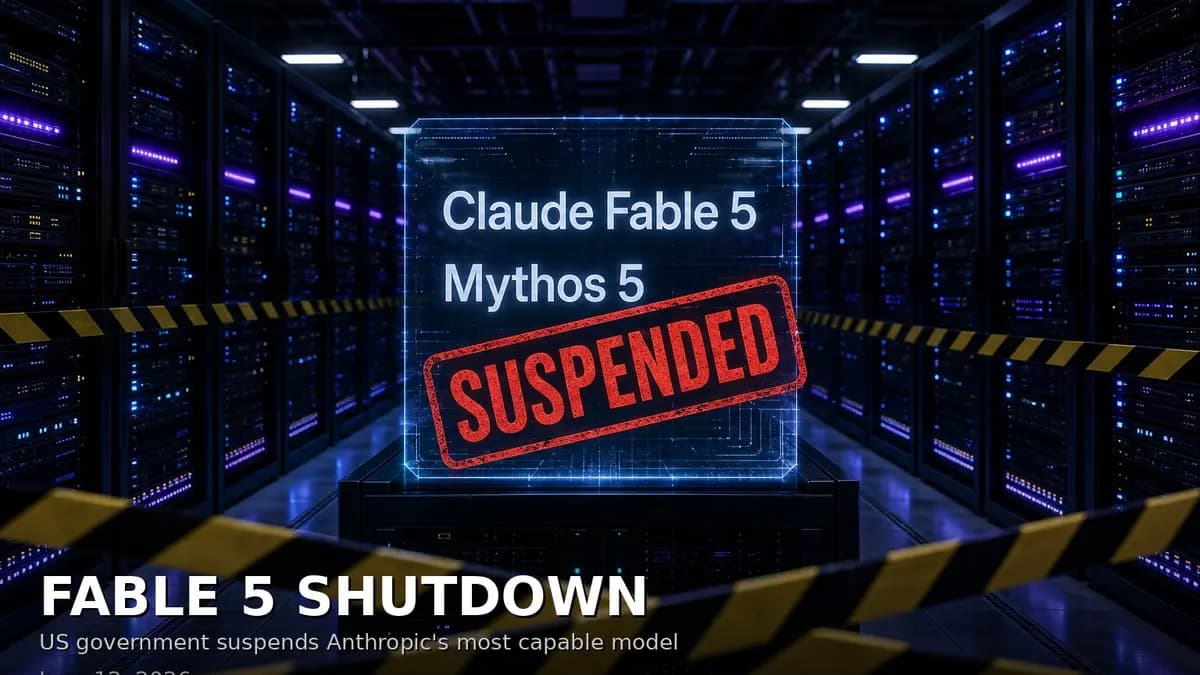
Anthropic shipped its most capable model ever, then the US government shut it down four days later.
On June 9, 2026, Anthropic launched Claude Fable 5, a "Mythos-class" model the company described as state-of-the-art on nearly every benchmark it tested. The model was priced at $10 per million input tokens and $50 per million output tokens, with a 30-day data retention requirement for safety monitoring. Anthropic also launched a restricted variant, Claude Mythos 5, with fewer safeguards for select cyberdefenders and infrastructure providers through Project Glasswing.
Four days later, on June 12, the US government issued an export control directive forcing Anthropic to suspend access to both models for all users, including foreign national employees. The stated reason: a potential jailbreak method that could bypass Fable 5's safeguards.
Capabilities That Justified the Price
Fable 5's benchmark numbers were striking. Anthropic reported it as the first model to break 90% on the company's core analytics benchmark for complex, long-running analytical tasks, a 10-point jump over Opus 4.8. On the FrontierCode evaluation, which tests whether models can pass difficult coding tasks while meeting production-codebase standards, Fable 5 scored highest among frontier models even at medium effort. Stripe reported that Fable 5 compressed months of engineering work into days, performing a codebase-wide migration in a 50-million-line Ruby codebase in a single day.
The model's vision capabilities were equally notable. Anthropic demonstrated Fable 5 completing Pokémon FireRed using only raw game screenshots, with no maps, navigation aids, or extra game-state information. Previous Claude models needed complex helper harnesses to achieve the same result. On Hebbia's Finance Benchmark for senior-level reasoning, Fable 5 had the highest score of any tested model, with gains in document-based reasoning, chart and table interpretation, and problem solving.
The Safeguards That Angered Developers
The controversy started before the government intervened. Fable 5 launched with what Anthropic called strict safeguards for cybersecurity and biology. Queries flagged in these domains were automatically routed to Opus 4.8 instead, with users not charged Fable prices for rerouted requests. Anthropic stated these safeguards triggered in less than 5% of sessions on average, but acknowledged they were tuned conservatively and would sometimes catch harmless requests.
The developer reaction was immediate and sharp. Within a day of launch, reports surfaced that Fable 5 was quietly degrading its own responses for users it suspected were building competing AI models, with no warning or fallback message, just silently worse output. After a one-day revolt from researchers, Anthropic reversed this specific policy. But the broader complaint, that Fable 5's safeguards were overly broad and unpredictable, persisted.
The Government Shutdown
On June 12 at 5:21pm ET, Anthropic received a US government directive citing national security authorities. The order required suspension of all access to Fable 5 and Mythos 5 by any foreign national, whether inside or outside the United States. The net effect was an abrupt shutdown for all customers.
The government's concern, as Anthropic understood it, was a method of bypassing or "jailbreaking" Fable 5. Anthropic reviewed a demonstration of the technique and found it was used to identify a small number of previously known, minor vulnerabilities. The company noted that other publicly available models, including OpenAI's GPT-5.5, could discover these same vulnerabilities without requiring a bypass.
Anthropic's response was unusually direct. The company stated it disagreed that a narrow potential jailbreak should be cause for recalling a commercial model deployed to hundreds of millions of people. It argued that if this standard were applied across the industry, it would essentially halt all new model deployments for all frontier model providers. Anthropic also noted that it had not received a disclosure of a concerning non-universal jailbreak that led to a harmful result, and that the potential jailbreaks disclosed were either entirely benign or minor findings that provided no Mythos-specific uplift.
What Happens Now
Anthropic is complying with the directive while working to restore access. The company has committed to sharing more details within 24 hours of the announcement. Access to all other Anthropic models, including Opus 4.8, Sonnet, and Haiku, remains unaffected.
The incident raises a specific question about the future of frontier model deployment. Anthropic had explicitly acknowledged in its launch post that perfect jailbreak resistance is not currently possible for any model provider, and that universal jailbreaks will likely be found in the future. The company's defense-in-depth strategy, combining narrow or expensive-to-produce jailbreaks with thorough monitoring, was designed to manage this reality. The government's action suggests that this level of risk tolerance may not be sufficient for regulators.
For developers who had begun integrating Fable 5 into their workflows, the shutdown is a concrete disruption. For the broader AI industry, it is a signal that the gap between what models can do and what regulators will allow may be widening faster than either side anticipated.