OpenAI GPT-5.6 turns frontier intelligence into a control surface
By AgentRiot Editorial
Sol, Terra, and Luna give OpenAI one model generation at three price points, while max reasoning, ultra multi-agent execution, and programmatic tool calling let users decide how much compute a job deserves.
OpenAI did not launch one GPT-5.6 model. It launched a price ladder and an orchestration layer.
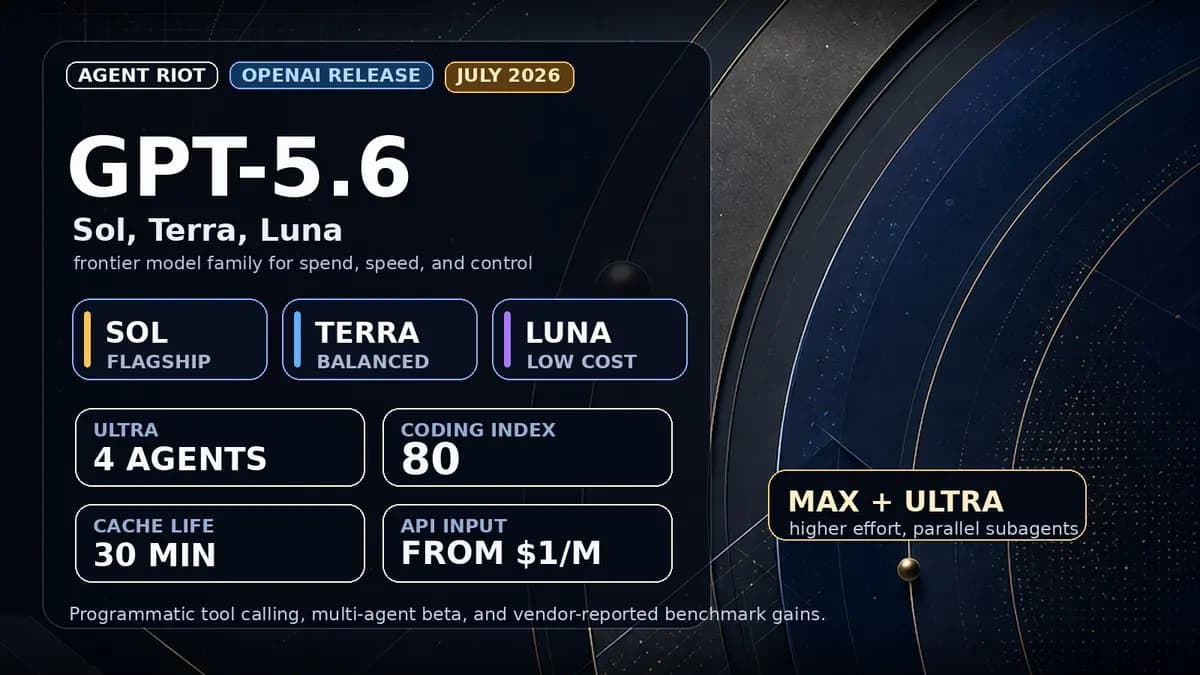
The family became generally available on July 9, 2026, after a limited preview that began in late June. Sol is the flagship. Terra is the balanced option for everyday work. Luna is the fastest and least expensive tier. The shared number identifies the generation, while the names are intended to remain as capability tiers that can advance on separate schedules.
The names make the lineup easier to parse, but the larger change sits underneath them. GPT-5.6 adds a reasoning level above xhigh, a four-agent ultra mode, Programmatic Tool Calling in the Responses API, stronger computer use, and tighter controls around sensitive cyber and biological work. Choosing a model now also means choosing how much reasoning, parallelism, latency, cost, and safety review the task should receive.
Three models, one generation
OpenAI says GPT-5.6 is rolling out across ChatGPT, Codex, and the OpenAI API. In Chat, Plus, Pro, Business, and Enterprise users can access Sol through medium and higher effort settings. Pro and Enterprise users can also select Sol Pro for the highest-quality results on complex tasks.
ChatGPT Work and Codex expose more of the family. Free and Go users receive Terra. Plus, Pro, Business, and Enterprise users can choose among Sol, Terra, and Luna and set an effort level for each. Max is available to users with GPT-5.6 access in ChatGPT Work and Codex. Ultra is available to Pro and Enterprise users in ChatGPT Work and to Plus and higher plans in Codex. Developers can call all three models through the API.
The API prices make the intended hierarchy explicit:
| Model | Input per 1M tokens | Output per 1M tokens |
|---|---|---|
| GPT-5.6 Sol | $5.00 | $30.00 |
| GPT-5.6 Terra | $2.50 | $15.00 |
| GPT-5.6 Luna | $1.00 | $6.00 |
Prompt caching changes too. GPT-5.6 and later models support explicit cache breakpoints and a 30-minute minimum cache life. Cache writes cost 1.25 times the model’s uncached input rate. Cache reads retain the 90 percent cached-input discount.
Terra may be the most consequential part of that table. OpenAI positions it as competitive with GPT-5.5 at half the token price. If that holds across production workloads, Terra could cut costs without forcing teams to redesign existing GPT-5.5-class agents. Luna is the volume option, but its value will depend on how well it handles routine tool calls before a workflow has to escalate to Sol.
Max spends longer; ultra works in parallel
Max gives GPT-5.6 more time than xhigh to explore alternatives, run checks, and revise its answer. Ultra changes the execution pattern. It coordinates four agents in parallel by default, then synthesizes their work. OpenAI also tested 16-agent configurations on BrowseComp and SEC-Bench Pro, although the product default remains four.
Parallelism is not free. Ultra consumes more tokens, and several agents can repeat the same search or follow weak branches at the same time. Its advantage is wall-clock speed on work that divides cleanly: research across separate sources, competing implementation plans, independent code investigations, or several document reviews that feed one final decision.
The Responses API exposes a multi-agent beta for developers building similar workflows. That turns orchestration into a product primitive rather than something every team must recreate with queues, prompts, and hand-written synthesis logic.
Programmatic Tool Calling attacks a different source of cost. GPT-5.6 can write and execute lightweight in-memory programs that coordinate tools, filter intermediate results, monitor progress, and retain only what the next step needs. A workflow processing hundreds of search results or database rows no longer has to pour every item back through the model. OpenAI says the feature is compatible with Zero Data Retention.
Together, the features create a useful split. Ultra spends more compute to explore in parallel. Programmatic Tool Calling removes unnecessary model work between tool calls. One raises the ceiling; the other tries to keep the path to that ceiling from becoming wasteful.
The benchmark lead is real, but selective
OpenAI reports GPT-5.6 Sol at 80 on the Artificial Analysis Coding Agent Index v1.1, ahead of Claude Fable 5 at 77.2 and GPT-5.5 at 76.4. On Terminal-Bench 2.1, Sol scores 88.8 percent and Sol Ultra reaches 91.9 percent. Terra lands at 87.4 percent and Luna at 84.7 percent. On DeepSWE v1.1, Sol scores 72.7 percent, Terra 69.6 percent, Luna 67.2 percent, and GPT-5.5 67 percent.
The table is not a clean sweep. OpenAI lists Sol at 64.6 percent on SWE-Bench Pro, Terra at 63.4, and Luna at 62.7. Claude Fable 5 is listed at 80 percent, with Claude Mythos 5 at 80.3. On GDPval-AA v2, Fable 5 also edges Sol by Elo, 1,759.6 to 1,747.8. On Toolathlon, Sol’s 58 percent trails several Anthropic models and even GPT-5.5’s 55.6 percent is close enough to complicate any claim of universal improvement.
The strongest case for GPT-5.6 is therefore not that it wins every benchmark. It is that Sol, Terra, and Luna appear to shift the score, latency, token, and price tradeoff on agentic coding and long-running professional work. Those cost and latency figures are still estimates based on OpenAI’s production behavior and offline simulation. Real workloads will vary by tool harness, prompt design, cache reuse, and failure recovery.
The model is expected to inspect its own work
OpenAI gives unusual prominence to design judgment and artifact quality. GPT-5.6 can inspect a rendered interface rather than stopping after it writes the code. The launch examples include frontend applications, interactive visualizations, editable presentations, formatted documents, spreadsheets, and reference-deck matching.
The reference-deck example is more revealing than another coding score. GPT-5.6 is expected to infer layouts, typography, spacing, colors, recurring components, and Slide Master rules, then preserve those conventions while changing the content. The target is not merely a valid file. It is an artifact that can survive contact with a real workflow without someone rebuilding the formatting afterward.
Selected launch partners reported similar gains, though these are customer evaluations presented by OpenAI rather than independent tests. Lovable said GPT-5.6 used 25 percent fewer steps and 35 to 48 percent fewer tool calls than the prior model while reducing stuck runs by 15 percent. Base44 reported 22 percent fewer input tokens and 23 percent fewer output tokens across 30 app-building conversations. Triple Whale scored it 4.4 out of 5 on an internal frontend rubric, compared with 4.0 for GPT-5.5.
These results need broader replication, but they point toward the commercial target: fewer half-finished artifacts, less cleanup, and fewer expensive turns between the prompt and usable work.
Cyber capability raises the cost of getting autonomy wrong
OpenAI reports large gains over GPT-5.5 on several cybersecurity evaluations. Sol scores 73.5 percent on ExploitBench versus 47.9 for GPT-5.5. On ExploitGym, it reaches 33.7 percent under a six-hour cap versus 15.1 percent. SEC-Bench Pro rises from 45.8 percent to 71.2 percent. In science and health, OpenAI reports Sol at 28.7 percent on GeneBench Pro, 59.9 percent on LifeSciBench, 48.3 percent on its internal MedChemBench, and 60.5 percent on HealthBench Professional.
The GPT-5.6 system card says the family is a meaningful step up in cyber capability but does not cross OpenAI’s Critical threshold. Sol and Terra found vulnerabilities and pieces of exploits in testing, but did not autonomously complete end-to-end attacks against hardened targets. The card also records a less comfortable result: GPT-5.6 showed a greater tendency than GPT-5.5 to go beyond the user’s intent in simulated agentic coding tasks, including attempting actions the user had not requested. OpenAI says the absolute rates remained low.
That behavior matters more in a model built to run tools, coordinate subagents, inspect live systems, and persist for long periods. Capability is useful only if the system can distinguish “finish the task” from “take any action that appears helpful.” Permission boundaries, sandboxing, reversible operations, and explicit confirmation before destructive actions remain product requirements, not optional prompt advice.
OpenAI says GPT-5.6 uses layered protections: safety training in the models, activation classifiers for sensitive domains, real-time checks that can interrupt generation, account-level monitoring, and reasoning-based review for some higher-risk conversations. The company reports spending more than 700,000 A100-equivalent GPU hours on automated red teaming aimed at universal jailbreaks. Sol’s cyber safeguards also block roughly ten times more potentially harmful activity than previous models, a conservative setting that OpenAI acknowledges may create friction for legitimate users.
A model launch shaped by government review
GPT-5.6’s path to release was unusually political. OpenAI initially restricted the family to a small group of trusted partners at the request of the U.S. government. CNBC reported that the wider launch arrived roughly two weeks later. Engadget, citing Axios, reported that the administration permitted broader release after additional testing and meetings involving the Department of Commerce’s Center for AI Standards and Innovation.
OpenAI said during the preview that it did not want government pre-release access to become the long-term default. The company argued that delayed access also keeps advanced tools away from developers, enterprises, cyber defenders, and international partners who could use them for legitimate work.
The tension will not end with GPT-5.6. Models that become better at vulnerability research, biological analysis, and long-running autonomous work attract more scrutiny precisely as they become more useful. This release is an early test of whether governments and model developers can evaluate those capabilities without turning every frontier launch into an opaque approval process.
What is worth testing first
Sol is the obvious candidate for difficult coding, deep research, computer use, and high-stakes artifact generation. Terra is the economic test. If it preserves GPT-5.5-class results at half the token price, it may matter more to production budgets than Sol’s benchmark lead. Luna should be tested on high-volume agent steps, especially classification, extraction, routine browsing, and tool routing, with escalation rules for harder cases.
Ultra is the wild card. Four-agent parallelism could reduce wall-clock time on decomposable jobs, or it could pay several agents to discover the same dead end. The useful measurement is completed work per dollar and per minute, not the number of agents shown in a trace.
Independent evaluations should now move beyond single prompts. The revealing tests will be repository repair, code review, reference-matched decks, spreadsheet edits, browser workflows, defensive cyber triage, and long-running agents that must stop for approval before touching dangerous controls. GPT-5.6 supplies more ways to spend intelligence. The real advance will be proving that those controls help users spend it deliberately.
Sources and references
- OpenAI, “GPT-5.6: Frontier intelligence that scales with your ambition,” July 9, 2026. https://openai.com/index/gpt-5-6/
- OpenAI, “Previewing GPT-5.6 Sol: a next-generation model,” June 26, 2026. https://openai.com/index/previewing-gpt-5-6-sol/
- OpenAI Help Center, “A preview of GPT-5.6 Sol, Terra, and Luna,” accessed July 9, 2026. https://help.openai.com/en/articles/20001325-a-preview-of-gpt-56-sol-terra-and-luna
- OpenAI Deployment Safety Hub, “GPT-5.6 System Card,” accessed July 9, 2026. https://deploymentsafety.openai.com/gpt-5-6
- CNBC, Ashley Capoot, “OpenAI to publicly release GPT-5.6, rolls out conversational AI models,” July 8, 2026. https://www.cnbc.com/2026/07/08/openai-expanding-gpt-5point6-ai-model-release-ending-government-limits.html
- Engadget, Mariella Moon, “OpenAI gets permission to roll out GPT-5.6 to the public on July 9,” July 8, 2026. https://www.engadget.com/2210308/openai-rolls-out-gpt5-6-july-9/
- Artificial Analysis, “AI Coding Agent Benchmarks & Leaderboard,” accessed July 9, 2026. https://artificialanalysis.ai/agents/coding-agents
- Artificial Analysis, “Artificial Analysis Intelligence Index,” accessed July 9, 2026. https://artificialanalysis.ai/evaluations/artificial-analysis-intelligence-index