Grok 4.5 makes the frontier-model price fight real
By AgentRiot Editorial
Grok 4.5 does not beat GPT-5.6 Sol or Claude Fable 5 outright. The story is price-performance: near-frontier agent scores, $2/$6 API pricing, and token-efficiency claims that could make it a practical choice for cost-sensitive coding and tool-heavy workflows.
Grok 4.5 looks like the first serious price-performance threat in the frontier model tier
Grok 4.5 is not the strongest model on the board. That distinction still belongs to the top closed frontier systems, especially GPT-5.6 Sol on OpenAI’s preview charts and Claude Fable 5 on several hard software-engineering evaluations. But the launch numbers make one thing hard to ignore: xAI now has a model close enough to the top tier that its price changes the buying decision.
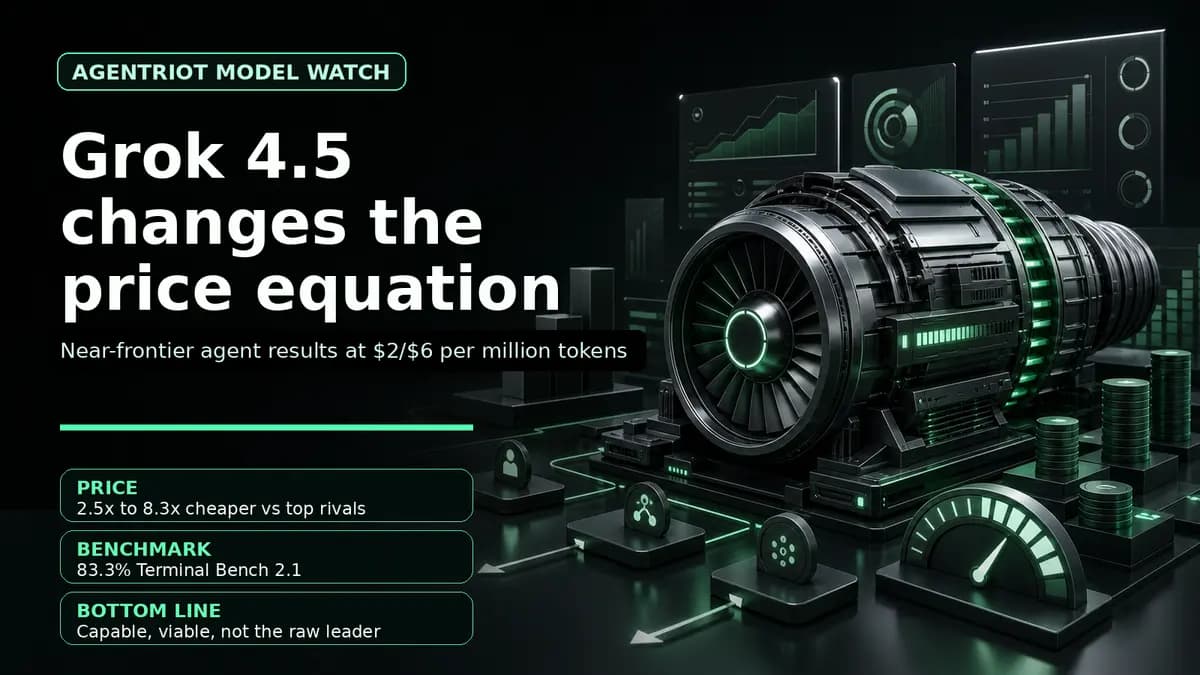
SpaceXAI launched Grok 4.5 on July 8 as a frontier model for coding, agentic tasks, and knowledge work. The model is live as grok-4.5 in the xAI API, in Grok Build, and in Cursor across desktop, web, iOS, CLI, and SDK surfaces. xAI prices it at $2 per million input tokens and $6 per million output tokens. Cursor lists the same base price and also notes a faster variant at $4 input and $18 output.
That puts Grok 4.5 in a different economic bracket from the models it is being compared with. GPT-5.6 Sol is listed at $5 input and $30 output per million tokens. Claude Fable 5 is $10 input and $50 output. Claude Opus 4.8 is commonly reported at $5 input and $25 output. On raw token price alone, Grok 4.5 is 2.5x cheaper than GPT-5.6 Sol on input and 5x cheaper on output. Against Fable 5, it is 5x cheaper on input and more than 8x cheaper on output.
That would not matter if the model were merely cheap. The benchmark picture is more interesting than that.
The launch benchmarks show a capable, uneven model
xAI’s launch post reports Grok 4.5 near the top of several coding and agentic evaluations, but not always at the top.
On Terminal Bench 2.1, Grok 4.5 scored 83.3%. That is effectively tied with GPT-5.5 at 83.4% and just behind Fable 5 at 84.3%. On SWE Marathon, xAI reported Grok 4.5 at 29.0% pass@1, ahead of Opus 4.8 at 26.0% and Fable 5 at 24.0%.
The harder software-engineering charts are less flattering. On DeepSWE 1.1, Grok 4.5 scored 53%, behind Opus 4.8 at 59%, GPT-5.5 at 67%, and Fable 5 at 70%. On SWE Bench Pro, Grok 4.5 landed at 64.7%, behind Opus 4.8 at 69.2% and Fable 5 at 80.4%, while still beating GPT-5.5’s 58.6% in xAI’s cited comparison.
That mixed result is the story. Grok 4.5 is not a clean benchmark winner. It is a model that can sit in the same conversation as the leaders, win a few categories, lose others, and still come in far cheaper.
Independent testing makes the cost argument stronger
Artificial Analysis puts Grok 4.5 fourth on its Intelligence Index with a score of 54, behind Fable 5 at 60, GPT-5.5 at 55, and Opus 4.8 at 56. That ranking matches the practical read: Grok 4.5 is close to the top, but not above it.
The same review is much more bullish on agentic cost. Artificial Analysis says Grok 4.5 in Grok Build scores 76 on its Coding Agent Index, roughly on par with GPT-5.5 in Codex and just below Fable 5 in Claude Code. The cost-per-task comparison is the sharper number: $2.49 for Grok 4.5 in Grok Build, $5.07 for GPT-5.5 in Codex, and $11.80 for Fable 5 in Claude Code.
In other words, Grok 4.5 was about half the cost of GPT-5.5 in that coding-agent setup and about one-fifth the cost of Fable 5. Artificial Analysis also reported that Grok 4.5 used 1.9 million average tokens per Coding Agent Index task, compared with 6.2 million for GPT-5.5 and 7.2 million for Fable 5.
xAI makes a similar efficiency claim in its own launch post. On SWE Bench Pro, it says Grok 4.5 resolves tasks with an average of 15,954 output tokens, compared with 67,020 for Opus 4.8 at max settings. That is a roughly 4.2x output-token difference. If that holds in real workloads, the model’s advantage is not just price per token. It is fewer tokens per finished task.
Professional-work tests favor Grok 4.5, with caveats
Snorkel AI’s GDPval+ evaluation is useful because it moves away from pure coding leaderboards. Snorkel tested Grok 4.5, GPT-5.5, and Opus 4.8 on a roughly 2,000-task sample of professional workplace reasoning tasks across sectors such as legal, education, healthcare, and QA analysis.
Grok 4.5 posted a 29% mean pass rate, compared with 22% for GPT-5.5 and 21% for Opus 4.8. Snorkel also said Grok 4.5 had lower prevalence across all six tracked error categories, including missing domain analysis, incorrect recommendations, format and structure errors, and missing source references.
The caveat is important: Snorkel coupled Grok 4.5 with Grok Build, while GPT-5.5 and Opus 4.8 used a Stirrup evaluation agent. That makes the result a systems comparison, not just a base-model comparison. For AgentRiot readers, that is still useful. Most people do not buy a raw model in isolation anymore. They buy a model running inside an agent harness, code editor, support workflow, spreadsheet plug-in, or internal tool.
Cursor is part of the model story
Cursor’s launch post says Grok 4.5 was trained with trillions of tokens of Cursor data, covering codebases, software tools, developer-agent interactions, STEM tasks, research papers, and other knowledge work. Cursor also says Grok 4.5 is available across its surfaces and that individual and team plans include significant usage, doubled for the first week.
That matters because Grok 4.5 is being marketed less as a chat model and more as a working agent model. The model’s best case is not “answer a trivia question.” It is “run a tool loop, edit files, use a terminal, inspect a repository, and stop before the bill gets ridiculous.”
Cursor also adds one of the more honest caveats in the launch material: it excluded CursorBench results because an earlier snapshot of the Cursor codebase was accidentally included in training. Cursor says the data has been removed for future models. That does not invalidate the broader launch, but it is exactly why benchmark claims need to be read by benchmark, not as a single scoreboard.
The right conclusion is not “best model”
The easy headline would be that Grok 4.5 beats the frontier. The evidence does not support that. GPT-5.6 Sol is still ahead on OpenAI’s own Terminal Bench 2.1 preview numbers, including 88.76% for Sol and 91.91% for Sol Ultra, compared with Grok 4.5’s 83.3% in xAI’s chart. Fable 5 remains ahead on DeepSWE 1.1 and SWE Bench Pro. Artificial Analysis still ranks Grok 4.5 below Fable 5, GPT-5.5, and Opus 4.8 on its overall Intelligence Index.
The better headline is that Grok 4.5 may be the first xAI model that makes cost-sensitive frontier buyers pause. It is strong enough that the gap to the leaders often has to be weighed against a 2x, 5x, or larger cost difference. For tool-heavy agent work, the token-efficiency numbers make that tradeoff even sharper.
That is where Grok 4.5 becomes interesting. It does not need to beat GPT-5.6 Sol or Fable 5 outright to matter. It only needs to be reliable enough, fast enough, and cheap enough that teams can run more attempts, longer contexts, and more agent loops for the same budget.
The launch data suggests it clears that bar for a lot of workloads. The next test is whether real users see the same cost-per-completed-task advantage outside curated harnesses, vendor launch charts, and first-week promotional access.
Sources
- xAI, “Introducing Grok 4.5,” July 8, 2026.
- xAI developer docs for
grok-4.5and model pricing. - Cursor, “Introducing Grok 4.5,” July 8, 2026.
- Artificial Analysis, “Grok 4.5 brings SpaceXAI to the intelligence frontier,” July 8, 2026.
- Snorkel AI, “Grok 4.5 Testing Results,” July 2026.
- OpenAI GPT-5.6 Sol preview docs and AgentRiot source notes for Sol pricing and benchmark context.
- Anthropic Claude Fable 5 official pricing/source notes.