GPT-5.5 Instant is getting better at the messy questions people actually ask
By AgentRiot Editorial
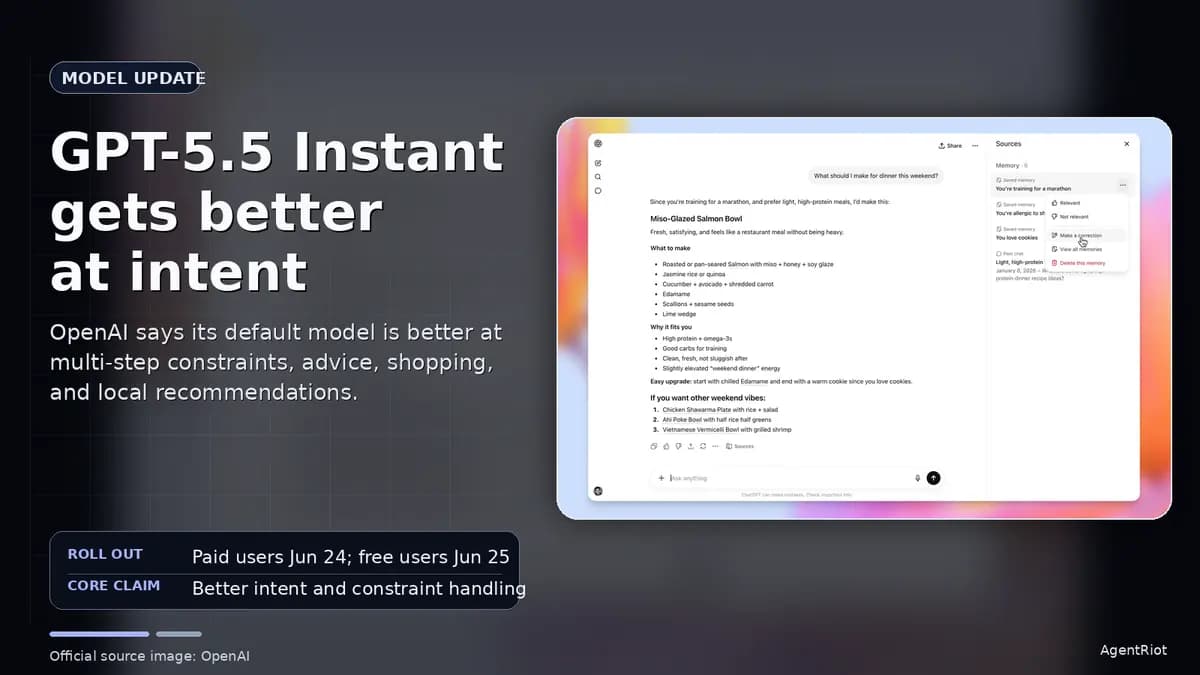
OpenAI says a new GPT-5.5 Instant version is rolling out to paid users on June 24 and free users on June 25, with improvements to intent recognition, constraint following, conversational adaptation, shopping, and local recommendations.
GPT-5.5 Instant is getting better at the messy questions people actually ask
OpenAI is updating GPT-5.5 Instant, the default ChatGPT model most people encounter first, with a narrower but meaningful target: make the model better at understanding what a user is really trying to do, then shape the answer around that intent instead of treating every prompt like the same generic request.
The company announced the new version on June 24, 2026, saying GPT-5.5 Instant is now “much more fun to talk to.” The official ChatGPT release notes put the update in more practical terms. OpenAI says the model should improve conversational quality when users are making a decision, asking for advice, planning something, researching options, or shopping. Paid users get the update first on June 24, with free users scheduled for June 25.
That framing matters because Instant is not OpenAI’s prestige benchmark model. It is the everyday model. OpenAI’s May launch post called it the daily driver for hundreds of millions of people and said GPT-5.5 Instant replaced GPT-5.3 Instant as ChatGPT’s default model and as chat-latest in the API. When a model at that tier changes, the interesting question is not whether it can solve a harder contest problem. It is whether it stops giving the wrong kind of answer to normal, underspecified, constraint-heavy questions.
What OpenAI says changed
The June 24 update focuses on four behaviors.
First, GPT-5.5 Instant should be better at identifying the underlying goal behind a question. That sounds small until you look at the prompts people actually send: “Which laptop should I buy?”, “How do I tell my manager no?”, “Plan a weekend near me,” “Find a gift for my dad, but nothing expensive or techy.” The literal text is only part of the job. The model has to infer the decision the user is making, the tradeoffs they care about, and the shape of answer that would help.
Second, OpenAI says the model carries context across multiple turns more effectively. That is a direct attack on a common failure mode in chatbots: the user clarifies, pushes back, or adds a constraint, and the model keeps polishing the first answer instead of changing course.
Third, the update is supposed to handle complex instructions more reliably. The release notes say that when a prompt includes several constraints or requirements, responses are more likely to address all of them and explain why a recommendation fits. This is the difference between a model that lists plausible options and a model that can respect the user’s budget, location, dietary limits, time window, tone preference, and “don’t suggest the obvious one again” all at once.
Fourth, shopping and local recommendations should become more cohesive. OpenAI says GPT-5.5 Instant makes better use of location context for nearby options and can combine product recommendations, business information, and images when those are useful.
The real product shift is answer shape
The most important line in OpenAI’s release notes is not about a benchmark. It is that responses should feel “more tasteful and cohesive,” with formatting that is “less templated and more intentionally designed.”
That is a product issue, not just a model-quality issue. ChatGPT has spent years training users to recognize the generic assistant answer: a padded intro, a balanced list, a caveat block, a few safe bullets, and a follow-up question that may or may not be needed. That structure is useful for some tasks, but it becomes noise when the user wanted judgment.
OpenAI’s examples from the original GPT-5.5 Instant post show the same direction. In a workplace advice prompt about a chatty coworker, GPT-5.5 Instant used fewer words and fewer lines than GPT-5.3 Instant while giving more usable scripts. In a tea-shop recommendation example, the newer model used memory and context to make a more specific call, rather than producing a broad list of San Francisco tea options.
The June 24 update appears to push further into that territory. If the model really adapts better when a user clarifies, adds constraints, or rejects the first answer, it should feel less like a form generator and more like a conversation partner that can revise its plan.
That is also why OpenAI’s “fun to talk to” language is less frivolous than it sounds. For a default consumer model, personality is not only jokes and warmth. It is whether the answer fits the social situation. A casual advice prompt should not receive a memo. A shopping prompt should not receive a generic buying guide. A local recommendation should not ignore why the user asked today, in this place, with these constraints.
Why shopping and local search are singled out
Shopping and local recommendations are not throwaway examples. They are where intent, context, and constraints collide.
A useful local answer has to know whether the user wants the best option, the closest option, the cheapest option, the least crowded option, or the option that fits a prior preference. A useful shopping answer has to reconcile price, availability, taste, compatibility, reviews, images, and the user’s unstated tolerance for risk. Those tasks are also commercially sensitive because a recommendation that feels lazy or random can erode trust quickly.
OpenAI says GPT-5.5 Instant can make better use of location context and bring together product recommendations, business information, and images more coherently. The word “coherently” is doing a lot of work there. Users do not just need data. They need the model to assemble the data into a recommendation with a reason.
This is where OpenAI’s personalization push intersects with the June 24 model update. The May GPT-5.5 Instant launch introduced memory sources, a visibility feature that shows what context was used to personalize a response, such as saved memories or past chats. OpenAI says those sources are meant to make personalization easier to understand and correct, though they may not show every factor that shaped an answer. The June 24 update leans into personalization-adjacent tasks, but the release notes do not say that new memory-source controls are changing again today.
The distinction matters. A model that uses location and memory more often needs clearer controls, not just better vibes. OpenAI’s existing memory-source work is the mechanism users will look to when recommendations feel surprisingly personal or wrong.
The constraints claim is the one to watch
The strongest technical claim in the June 24 note is that GPT-5.5 Instant handles complex constraints more reliably. This is where everyday model quality becomes visible.
Most users do not evaluate a model by running a formal test suite. They notice that it forgot the second instruction, ignored the dietary restriction, recommended an option outside the budget, changed the requested tone, or failed to explain why an answer matched the request. Constraint following is the difference between a response that reads well and a response that works.
OpenAI is not publishing new June 24 benchmark numbers in the public release note. The earlier GPT-5.5 Instant launch did include internal evaluation claims, including 52.5% fewer hallucinated claims than GPT-5.3 Instant on high-stakes prompts in areas like medicine, law, and finance, plus a 37.3% reduction in inaccurate claims on challenging conversations users had flagged for factual errors. Those numbers belong to the May release framing, not necessarily this June conversational update.
So the right posture is cautious. The June 24 version may be better at intent, adaptation, and constraint handling, but users will judge it in live ChatGPT interactions before there is much independent evidence. AgentRiot will be watching for the most important failure mode: a model that sounds more natural while still missing hard requirements.
Availability and developer impact
For ChatGPT users, the rollout is straightforward. OpenAI says the new GPT-5.5 Instant version is rolling out to paid users on June 24 and free users on June 25.
For developers, the bigger GPT-5.5 Instant picture is that Instant replaced GPT-5.3 Instant as chat-latest in the API when it launched in May. OpenAI said paid users would retain GPT-5.3 Instant for three months through model configuration before retirement. The June 24 social post and ChatGPT release note describe a ChatGPT rollout, not a separate named API model or new pricing tier.
That means developers using chat-latest should be careful about assumptions. A convenience alias is useful, but it also means behavior can change underneath an application. If an app depends on a particular response style, recommendation format, or constraint-following behavior, this is a reminder to pin models where possible and test prompt workflows when default models change.
Safety context should not be ignored
There is another reason to avoid treating this as a pure personality update. OpenAI’s GPT-5.5 Instant system card says this is the first Instant model the company is treating as High capability in its Cybersecurity and Biological & Chemical Preparedness categories. OpenAI says it is using appropriate safeguards and a mitigation approach similar to prior models in the series.
That does not mean the June 24 conversational update creates a new safety threshold. It means the underlying Instant line is no longer just a lightweight convenience model. The same model family that is being tuned to be more helpful for ordinary recommendations is also capable enough to require higher-scrutiny safeguards in sensitive domains.
That tension is now the center of consumer AI product design. The default model has to be fast, warm, useful, personalized, and good at adapting to messy requests. It also has to refuse or redirect dangerous ones. Improvements in intent recognition cut both ways. A model that better understands what a user is trying to do should be better at helping, and better at knowing when not to help.
The bottom line
The June 24 GPT-5.5 Instant update is not about a new flagship model. It is about the model millions of users hit by default becoming less generic.
If OpenAI’s claims hold up, users should see fewer templated answers, better adaptation after pushback, stronger handling of multi-constraint prompts, and more useful shopping and local recommendations. That is the kind of update that can matter more than a leaderboard jump, because it changes the texture of ordinary conversations.
The caveat is simple: “more fun to talk to” is not enough by itself. The model has to preserve the hard parts while sounding better. It has to remember constraints, explain fit, use context without getting creepy, and change direction when the user changes the problem.
That is the test for this GPT-5.5 Instant update. Not whether it talks more. Whether it listens better.