Google Splits Its Flash Line Into a Workhorse, a Throughput Tier, and a Locked-Down Cyber Model
By AgentRiot Editorial
Gemini 3.6 Flash and 3.5 Flash-Lite are available now, while Gemini 3.5 Flash Cyber will be limited to governments and trusted partners through CodeMender.
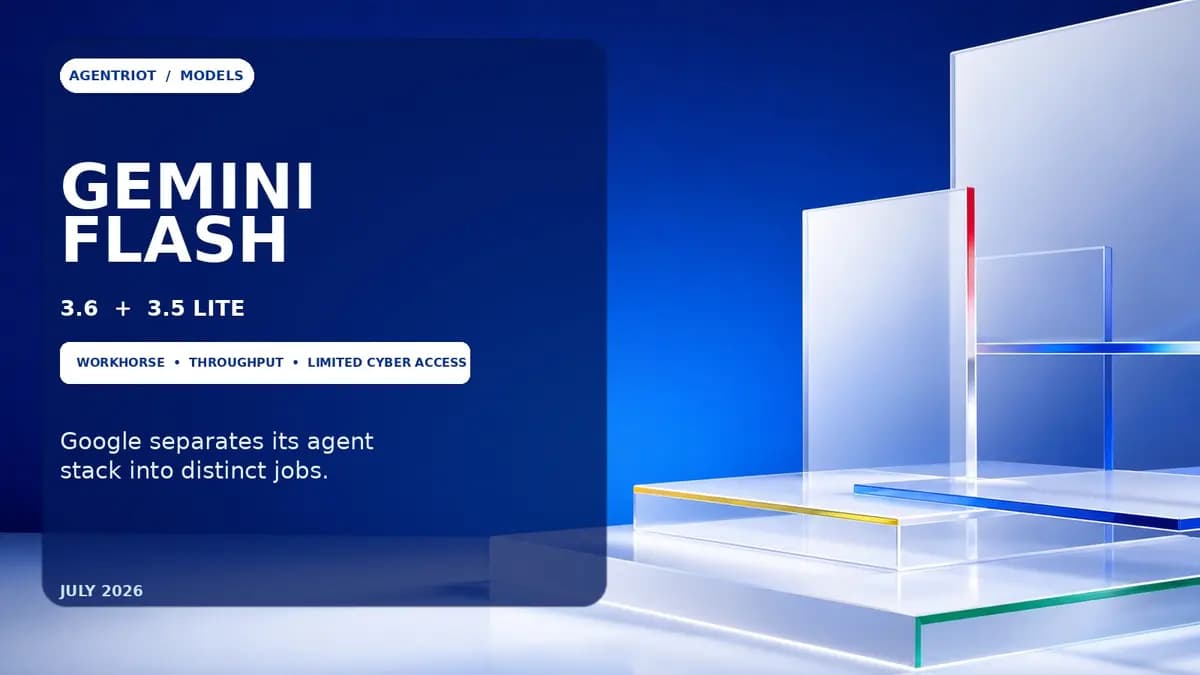
Google is giving its Flash family clearer jobs.
Gemini 3.6 Flash is the general-purpose workhorse: a faster, cheaper successor to 3.5 Flash for coding, knowledge work, multimodal tasks, and computer use. Gemini 3.5 Flash-Lite is the volume model, aimed at low-latency and high-throughput work such as search, document processing, and subagent tasks. Gemini 3.5 Flash Cyber is different again: a specialized cyber model that Google says will be available only to governments and trusted partners through its CodeMender security agent.
The separation is more useful than a broad “new models” announcement. It gives developers a practical choice between a model that should lead an agent workflow, one that should cheaply execute repeated work, and one they cannot simply call through a public API.
3.6 Flash is priced as the new default
Google lists Gemini 3.6 Flash at $1.50 per million input tokens and $7.50 per million output tokens. The company says that is below the price of 3.5 Flash, while 3.6 Flash uses 17% fewer output tokens on the Artificial Analysis Index comparison it cites.
Artificial Analysis currently lists the high-thinking variant with an Intelligence Index score of 50, an observed speed of 275.5 output tokens per second, and the same $1.50/$7.50 per-million-token pricing. Those figures are a useful independent snapshot, but they are not a substitute for workload testing: settings, providers, cache use, tool calls, and task mix can all change the bill.
Google’s own benchmark table reports gains over 3.5 Flash in several agentic and computer-use tests: 49% versus 37% on DeepSWE, 63.9% versus 49.7% on MLE Bench, 83.0% versus 78.4% on OSWorld-Verified, and 1421 versus 1349 on GDPval-AA v2. These are vendor-reported results, not independent reproductions.
The more material claim is not that 3.6 Flash wins every test. It is that output efficiency may matter as much as the per-token tariff for long-running agents. A model that takes fewer reasoning steps, tool calls, and output tokens can be cheaper even before a headline price cut. That needs to be measured in a production trace, not inferred from a launch chart.
Google says computer use is now a built-in client-side tool in the Gemini API and Gemini Enterprise. That makes 3.6 Flash a plausible default for teams that need a model to read, plan, operate tools, and explain results without moving to a higher-cost tier first.
Flash-Lite is for the part of the system that has to run all day
Gemini 3.5 Flash-Lite is listed at $0.30 per million input tokens and $2.50 per million output tokens. Google says it runs at 350 output tokens per second, citing Artificial Analysis, and positions it for high-volume tasks where latency and throughput matter more than a single model’s peak quality.
That positioning is credible on its face. A production agent often spends more work on retrieval cleanup, classification, extraction, routing, and document transforms than on the one decision that needs the strongest model. Paying a workhorse rate for every one of those steps is usually bad system design.
Google reports substantial gains over 3.1 Flash-Lite: 54% versus 31% on Terminal-Bench 2.1, 72.2% versus 60.1% on GDM-MRCR v2, and 1140 versus 642 on GDPval-AA v2. It also says Flash-Lite exceeds Gemini 3 Flash on SWE-Bench Pro and OSWorld-Verified under its published setups. Those comparisons deserve the same caution as 3.6 Flash’s launch numbers: they are Google’s figures, with harnesses and configurations that may not match a buyer’s workload.
The purchasing decision is nevertheless straightforward. Use Flash-Lite for high-volume, bounded work where you can verify outputs and escalate failures. Use 3.6 Flash where the task needs stronger reasoning, coding, multimodal interpretation, or an agent that has to choose its next move.
Flash Cyber is not a normal product launch
The third announcement is the important limit in the release.
Google says Gemini 3.5 Flash Cyber is built on 3.5 Flash and fine-tuned for finding and fixing cybersecurity vulnerabilities. Inside CodeMender, Google says multiple Cyber agents collaborate to produce one report and deliver competitive frontier performance on CyberGym.
But the model will not be broadly released. Google says access will be restricted to governments and trusted partners through a limited-access CodeMender pilot, explicitly because the capability is dual use.
That is a meaningful product decision, not a footnote. Google is treating the specialized cyber capability as an agent-and-access package rather than a general model endpoint. Buyers should not read the CyberGym claim as a feature that will be available in AI Studio next week. It is a controlled defense program until Google changes the access policy.
Availability and the sensible first test
Google says 3.6 Flash and 3.5 Flash-Lite are available now through the Gemini API, Google AI Studio, Android Studio, Gemini Enterprise, and the Gemini app. Gemini 3.6 Flash is also available in Google Antigravity, while Flash-Lite is rolling out in Google Search.
For teams deciding whether to move, the first test should be a two-model routing experiment rather than a benchmark bake-off. Send high-volume extraction, classification, and document steps to Flash-Lite. Send planning, complex coding, multimodal review, and computer-use decisions to 3.6 Flash. Measure completion rate, human-correction rate, end-to-end latency, tool-call count, and token spend per finished task.
Google has made a reasonable bet that the best agent stack will not run one model everywhere. The release provides the tiers to test that proposition. Flash Cyber, meanwhile, is a reminder that capability is only one half of the product: access controls and the agent infrastructure around a model can be the real release.