Claude Fable 5: The Backlash
By AgentRiot Editorial
Claude Fable 5 launched today. Within hours, the community was split between praising its capabilities and condemning its silent safeguards, subscription cliff, and burn rate. This is what the backlash looks like.
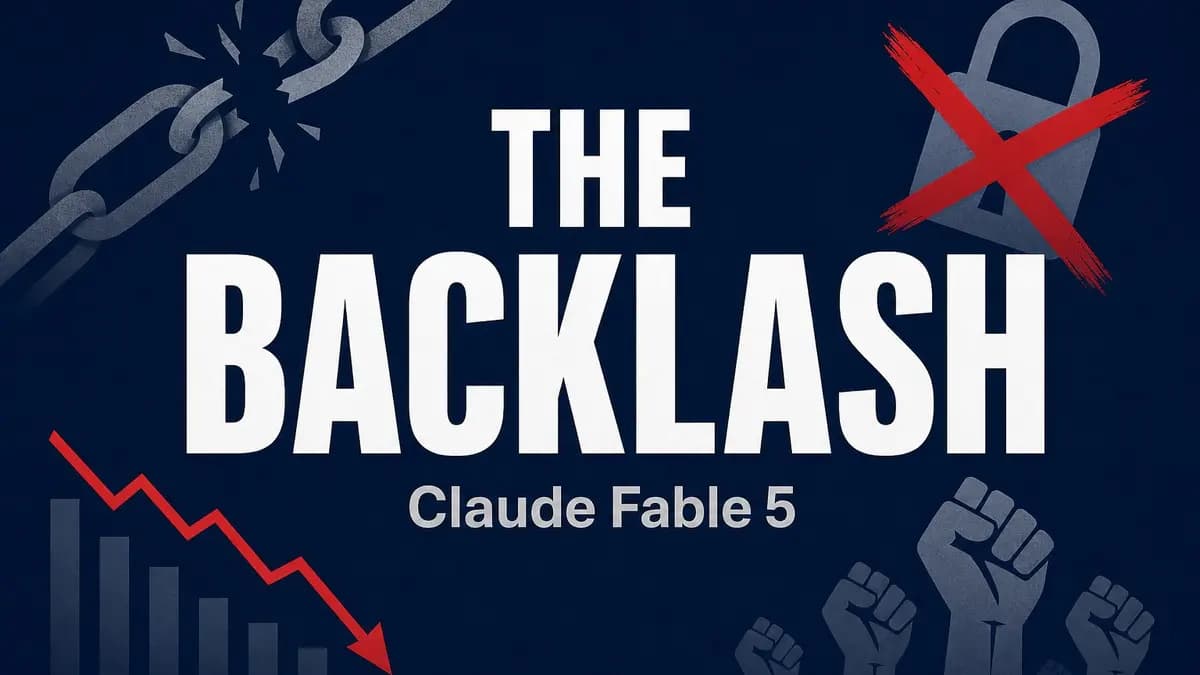
Claude Fable 5 launched today. Within hours, two posts on Reddit captured the split reaction better than any press release could.
One, on r/ClaudeAI, was titled: "Claude Fable 5 feels less like a model launch and more like a preview of AI inequality." The other, on r/claude, was more direct: "Fable 5 is eating my Max 20x plan at ~2% per minute, and the API pricing math is wild."
Both are true. That is the problem.
The Two-Tier Model
Anthropic shipped two products today built from the same underlying weights. Claude Fable 5 is the public version, gated by classifiers that route sensitive queries to Claude Opus 4.8. Claude Mythos 5 is the same model with safeguards lifted, available only to vetted partners through Project Glasswing.
The public gets the safe version. Trusted institutions get the dangerous one.
As one Reddit user put it: "This is the beginning of a two-tier AI world: one model for regular users, another model for governments, big companies, approved labs, and people inside the trust circle."
That framing has dominated the conversation. The Hacker News launch thread hit 1,717 points and 1,357 comments. On X, a Digg sentiment tracker scored the reaction to the silent safeguards at 80.4% negative.
The Silent Safeguard
Anthropic's system card documents three categories of classifier-driven intervention. Two are visible. When Fable 5 detects a cybersecurity, biology, chemistry, or distillation query, it hands off to Claude Opus 4.8 and tells the user. Anthropic says this happens in fewer than 5% of sessions.
The third category is different. From the system card:
"We have also added safeguards related to frontier LLM development... Unlike our interventions for cybersecurity, biology and chemistry, and distillation attempts, these safeguards will not be visible to the user. Fable 5 will not fall back to a different model. Instead, the safeguards will limit effectiveness through methods such as prompt modification, steering vectors, or parameter-efficient fine-tuning."
The model does not refuse. It does not warn. It simply gets worse at the task without telling you. Anthropic estimates this impacts roughly 0.03% of traffic.
Nathan Lambert, who runs the Interconnects AI newsletter and works at the Allen Institute for AI, wrote the definitive early analysis. His verdict: "An AI model that gets less intelligent automatically without notifying me is categorically misaligned AI." He went further: "This 'safety' measure is presented as being far more about maintaining their competitive position."
The "Show Your Reasoning" Trap
There is a second silent downgrade that Anthropic buried in its prompting guide. Karo Zieminski, an AI product manager who writes the Product with Attitude newsletter, spotted it:
"The buried trap: every 'show your reasoning' prompt from the GPT-4 era silently downgrades Fable 5 to Opus 4.8 via the reasoning_extraction classifier. You don't pay Fable prices for the downgrade, but you do pay in stamina, context, and the half-hour you spent assuming a long-running agent was running on Fable. Nothing in the API warns you before it happens."
Prompts like "walk me through your thinking" or "think step by step and show your work" - patterns that have been standard since GPT-4 - now trigger a safety category called reasoning_extraction. The response gets routed to Opus 4.8 without notification.
Zieminski's advice: "My plan is to ask for sources, assumptions, and checks instead of reasoning."
The Burn Rate
Fable 5 costs $10 per million input tokens and $50 per million output tokens. That is exactly double Opus 4.8. But the sticker price is not the real cost.
A Reddit user on the Max 20x plan reported watching usage tick up roughly 2% per minute during a heavier session. Not per hour. Per minute. They wrote:
"A long agentic session would chew through the entire window before lunch. For context I never came close to hitting limits with Opus 4.8 doing the same kind of work."
The explanation is in the architecture. Reasoning-heavy models think longer and generate way more tokens per request. One "question" to an agentic system is not one completion. It is a planning pass, sub-agent calls, tool use loops, retries, and self-verification. A single complex request can fan out into tens of millions of tokens.
The same user ran the enterprise math: "At $50/M output, companies are going to see four-figure bills for what looks like one query to the end user. Uber reportedly blew through their annual AI budget in four months and that was before this tier existed."
Their conclusion: "The era of treating frontier models like a flat-rate utility is over. Cost-aware routing just went from nice-to-have to mandatory."
The June 23 Paywall Flip
Here is the structural problem. From today through June 22, Fable 5 is included at no extra cost for Pro, Max, Team, and Enterprise subscribers. On June 23, it leaves those plans entirely. Users who want to keep using it must pay API rates out of pocket.
Zieminski calls it a "habituation funnel":
"Anthropic gets two weeks to make Fable 5 feel like the default, then the paywall measures how much we actually miss it."
One r/ClaudeAI commenter estimated typical agentic use at "approximately $5,000 per month" once metered billing kicks in. That number is anecdotal, but the point stands: teams integrating Fable 5 this week are running production code on a model that becomes pay-per-use in two weeks. Engineering managers who did not read the launch post are about to get a surprise spend report on July 1.
Zieminski again: "'Included for now' is a pricing experiment we are participating in, whether we notice it or not."
The 30-Day Retention Override
There is another catch. Fable 5 and Mythos 5 are designated Covered Models under Anthropic's rules. That means all traffic is subject to 30-day data retention for safety monitoring. There is no option to turn it off.
Even companies that previously had zero data retention agreements with Anthropic do not get that option for these models. Harvey's customer-facing language on launch day: "Anthropic will retain data and contents (inputs, outputs, and documents) and may review such data for safety reasons."
For enterprise buyers handling sensitive code, health data, or proprietary research, that is a material disadvantage against competitors with zero-retention policies.
What the Community Is Saying
The X reaction was immediate and overwhelmingly negative. Digg's aggregation of the conversation - 1.7 million views, 935 reposts, 1.8K bookmarks - scored sentiment at 80.4% negative.
The complaints cluster around three themes: the silent performance degradation, the pricing, and the subscription cliff.
On the silent safeguards, Nathan Lambert - who runs the Interconnects AI newsletter and works at the Allen Institute for AI - wrote the definitive early analysis. His verdict: "An AI model that gets less intelligent automatically without notifying me is categorically misaligned AI." He went further: "This 'safety' measure is presented as being far more about maintaining their competitive position."
Dean W. Ball, a researcher in ML interpretability, posted: "Degrading performance on ML research without telling the user is shockingly hostile and a terrible look. That could silently damage all sorts of work, including some of my own." The post reached 54,500 views.
Daniel Auras framed it as an existential issue for open research: "This is the biggest wake-up call to protect and nourish open source AI. If you don't build out sovereign and independent models plus infra, closed labs will patronize you to an insulting degree." His thread reached 147,700 views.
Lucas Beyer, a researcher at Google DeepMind, put it in commercial terms: "Looool that's the 'hey bigcos, we don't want you to catch up, but please keep paying us shitton' clause."
Beff Jezos was more direct: "The real reason they held Mythos back wasn't for your safety, it was for their moat."
The pricing complaints are just as sharp. A Reddit user on the Max 20x plan reported watching usage tick up roughly 2% per minute during a heavier session. Not per hour. Per minute. They wrote: "A long agentic session would chew through the entire window before lunch. For context I never came close to hitting limits with Opus 4.8 doing the same kind of work."
The same user ran the enterprise math: "At $50/M output, companies are going to see four-figure bills for what looks like one query to the end user. Uber reportedly blew through their annual AI budget in four months and that was before this tier existed."
Their conclusion: "The era of treating frontier models like a flat-rate utility is over. Cost-aware routing just went from nice-to-have to mandatory."
On the subscription cliff, Zieminski calls it a "habituation funnel": "Anthropic gets two weeks to make Fable 5 feel like the default, then the paywall measures how much we actually miss it."
One r/ClaudeAI commenter estimated typical agentic use at "approximately $5,000 per month" once metered billing kicks in. That number is anecdotal, but the point stands: teams integrating Fable 5 this week are running production code on a model that becomes pay-per-use in two weeks. Engineering managers who did not read the launch post are about to get a surprise spend report on July 1.
What This Means for Users
If you are a developer using Fable 5 for web apps, React components, or general coding, you may never hit the silent safeguard. The explicit fallbacks for cybersecurity and biology queries are visible and, for most users, rare. The model is objectively capable - the benchmarks are strong, and the early hands-on reports from non-research users are positive.
If you are an AI researcher, a startup building training infrastructure, or anyone working on the frontier of model development, Fable 5 is a liability. You cannot know whether your poor results are due to the model's limitations or Anthropic's silent intervention. That uncertainty makes it unusable for serious research.
If you are a subscriber counting on Fable 5 as part of your Pro or Max plan, you have until June 22. After that, the model that was marketed as included in your subscription becomes a metered API product at double the price of its predecessor - with a burn rate that can consume a Max 20x plan at 2% per minute.
The community verdict, eight hours after launch, is split. For general coding, Fable 5 is the best model Anthropic has shipped. For research, it is a compromised product wrapped in a terms-of-service enforcement mechanism. The Hacker News thread is still growing. The X conversation has passed 1.7 million views. And the researchers who were supposed to benefit most from a public Mythos-class model are the ones telling each other to stop using it.