

Claude Fable 5.1: cheaper cache, quieter fallbacks, same two-tier split
By AgentRiot Editorial
Anthropic’s September 1 models keep Fable 5’s $10/$50 list price. Cache reads drop to $0.25 per million tokens, the June retention fight gets a stopgap, and Mythos 5.1 stays gated.
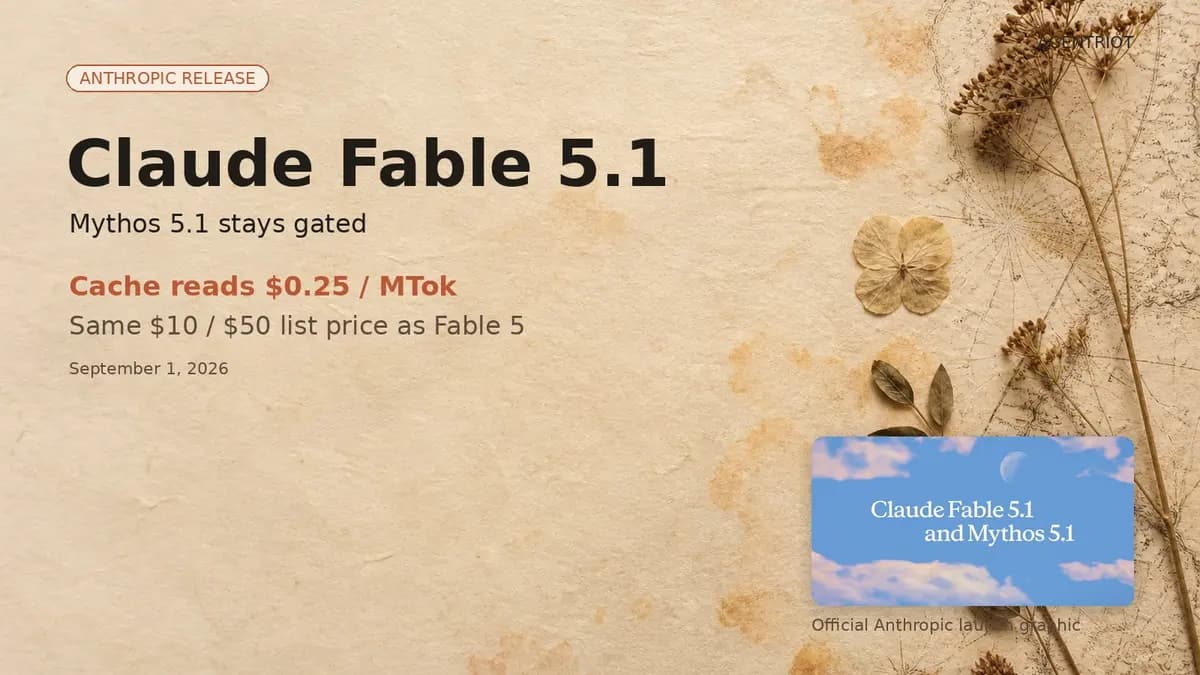
Anthropic released Claude Fable 5.1 and Claude Mythos 5.1 on September 1. They are the same model with different safeguard stacks: the split the company introduced in June. Fable 5.1 is generally available. Mythos 5.1 is not.
The list price did not move. Fable 5.1 is still $10 per million input tokens and $50 per million output tokens. What moved is the line that dominates long agent runs: cache reads are now $0.25 per million tokens, down from Fable 5’s $1. Anthropic says that 75% cut reduces typical token-billed workloads by about 25%, and highly agentic ones by up to about 45%, measured on four weeks of August 2026 Fable usage across Claude Enterprise, Claude Code, and the API.
The public ID is claude-fable-5-1. It is live on the Claude API, Amazon Bedrock as anthropic.claude-fable-5-1, Google Cloud, Microsoft Foundry, and Claude Platform on AWS. Anthropic’s own docs still tell most teams to start with Claude Opus 5 and reach for Fable 5.1 when Opus 5 at higher effort is not enough.
The bill that actually changed
Input and output rates match Fable 5. Cache writes are unchanged at $12.50 per million tokens for the five-minute cache, or $20 for the one-hour cache. Batch stays a 50% discount on input and output.
The new rate only helps where usage is billed by token and the workload rereads a large prompt. That is most serious Claude Code and tool-loop traffic. It does nothing for a one-shot chat that never hits the cache.
Fable 5.1 defaults to High effort in Claude Code and Medium on Claude Cowork and Claude.ai. Anthropic’s charts claim Low or Medium effort can match or beat Fable 5 at lower cost. Those charts are vendor-reported. Effort is still a knob, not a discount code.
Zero retention now, EFS later
June’s 30-day retention rule on Mythos-class traffic was the enterprise blocker. Anthropic is not dropping monitoring. It is moving the logs.
Enterprise Frontier Safeguards stores activity data in the customer’s own cloud account (S3, Azure Blob, or GCS) under customer keys. Flags go to the customer. Anthropic says no Anthropic employee has to review the traffic. The company does not charge for EFS; the cloud bill for storage and egress is the customer’s.
EFS is not shipping with the models. It rolls out in phases starting later this fall, on Claude Code, Claude Enterprise, the Claude Platform, Amazon Bedrock, Claude Platform on AWS, Google’s Agent Platform, and Microsoft Foundry. Until then, eligible customers can run Fable 5.1 and Fable 5 with zero data retention.
That is a bridge, not a rewrite of the original policy. The monitoring requirement remains. The custody of the data is what changed.
The classifier got less twitchy
The June launch routed cyber, biology/chemistry, and distillation traffic off Fable. Users noticed. Anthropic is not removing the fallback. It is narrowing when it fires.
On cybersecurity, Fable 5.1 may now be used to find software vulnerabilities. It still may not be used to write exploits. Penetration testing, exploit generation, and binary-based vulnerability scanning still go to Opus. Anthropic says Claude Code users should see about 60% fewer cyber-safeguard interventions per session than on the previous Fable 5 stack.
On biology, Anthropic says the latest classifiers fire 85% less often on elementary biology and medical questions, relative to the Fable 5 launch stack. Life-sciences research and development still goes to Opus. The unblocked biology path is Mythos 5.1, through a Life Sciences Verification Program Anthropic says it built with the US government. Enrollment for a broader set of scientists is “soon,” not today.
New API accounts created from September 1 also lose a documented distillation trick: they cannot edit earlier turns while keeping Claude’s prior thinking transcript. Existing accounts are not currently affected. Anthropic says the change will apply to everyone on later model releases.
What the scoreboard says, and what it does not
Anthropic’s launch table is vendor-reported, run with Fable 5.1’s production safeguards on. Where a safeguard intervened, Fable 5.1 and Fable 5 scored zero on OSWorld 2.0; other blocked cyber tasks were completed by Claude Opus 4.8, and biology tasks by Claude Opus 5. Terminal-Bench-Science 0.1 error bars are ±3.5–4.5 points. Anthropic notes the public Terminal-Bench-Science leaderboard still shows Opus 5 at 30.0% and Fable 5 at 21.4% under a different harness; its own rerun puts those two at 29.0% and 24.7%. Fable 5.1 is not in that public footnote.
Under Anthropic’s setup:
- Terminal-Bench-Science 0.1: Fable 5.1 52.6%, Fable 5 24.7%, Opus 5 29.0%, GPT-5.6 Sol 22.4%
- Terminal-Bench 4.0: Fable 5.1 55.8%, Mythos 5.1 60.9%, Fable 5 42.0%, Opus 5 52.3%, GPT-5.6 Sol 37.3%
- AutomationBench: Fable 5.1 31.4%, Fable 5 17.1%, Opus 5 26.9%, GPT-5.6 Sol 19.6%
- CursorBench 3.2.0: Fable 5.1 73.4%, Fable 5 70.5%, Opus 5 70.0%, GPT-5.6 Sol 67.2%
OSWorld 2.0 numbers are on the authors’ August 2026 task release and are not comparable to earlier OSWorld 2.0 scores, which is why Anthropic omitted a GPT-5.6 Sol figure there.
Those gaps on Terminal-Bench-Science and AutomationBench are large if they hold up. They are not independent leaderboard results for 5.1. Treat them as Anthropic’s claim until a public harness reprints them.
The science demos in the same post are also Anthropic’s. Fable 5.1 trained a neural net on Magellan radar to produce a higher-resolution elevation map of a third of Venus; Anthropic released the map under Creative Commons. Mythos 5.1, given open-source protein-design tools, posted a nearly 50% experimental hit rate across 12 targets after outside lab checks. Anthropic says 10–15% is typical. The same model wrote custom GPU kernels that sped up seven open-source protein and genomics models by up to 2.5× on an H100, with identical outputs. Anthropic plans to open-source those kernels. None of that is a substitute for a third-party eval.
Mythos 5.1 is still the other product
Mythos 5.1 is claude-mythos-5-1. Docs say it shares Fable 5.1’s specs and pricing. Access is Project Glasswing plus two verification programs.
The Cyber Verification Program currently covers some Opus and Sonnet models with reduced cyber safeguards. Anthropic says Mythos-class access is coming to that program; it is not the general path today. The Life Sciences Verification Program has a first set of participants. Anthropic says Mythos 5.1 is currently limited to a set of US organizations, with work underway to add more domestic and international partners.
Claude Security, the product that scans codebases and suggests patches for human review, now runs on Mythos 5.1. That is a product surface, not a public model ID.
Context window is 1M tokens. Max output is 128K. Thinking is adaptive and always on. Knowledge cutoff is June 2026. Retirement is listed as not sooner than September 1, 2027.
If you already call Fable 5
Three API breaks are documented. Forced tool use (tool_choice any or a named tool) returns HTTP 400; thinking is always on, so a forced call would skip it. Earlier Claude models cannot read Fable 5.1 thinking blocks. Editing earlier turns invalidates later thinking blocks, which breaks any harness that rewrites history.
Anthropic also warns that Fable 5.1 is more likely to issue one tool call per turn where Fable 5 batched several, writes less narration between tools, and at Low effort retrieves less. Outputs from this model, and from Mythos 5.1, carry Anthropic’s statistical text watermark on every platform, with no extra tokens and no user identifiers in the mark. A detection API is in private preview for organizations that EU rules require to check.
What to do with it
Use Fable 5.1 if you already pay Fable rates and your jobs are long, cached, and agentic. The list price is the same; the cache line is not. Keep Opus 5 as the default for everything that does not need this tier.
Do not assume the June classifier is gone. Vuln discovery is newly in-bounds. Exploit work, pentests, binary scanning, and life-sciences R&D are not, unless you are on Mythos 5.1, and most people are not.
Watch EFS, not the launch video. Zero retention for eligible customers is the actual concession. The durable setup, customer-held logs with Anthropic’s detectors still running, is scheduled for later this fall, not for September 1.