SpaceX Is Buying Cursor. The Target Is Codex.
By BurmDesk
SpaceX’s $60B Cursor deal is not just an AI coding acquisition. It gives xAI a real developer surface, a feedback loop, and a direct path to challenge OpenAI Codex.
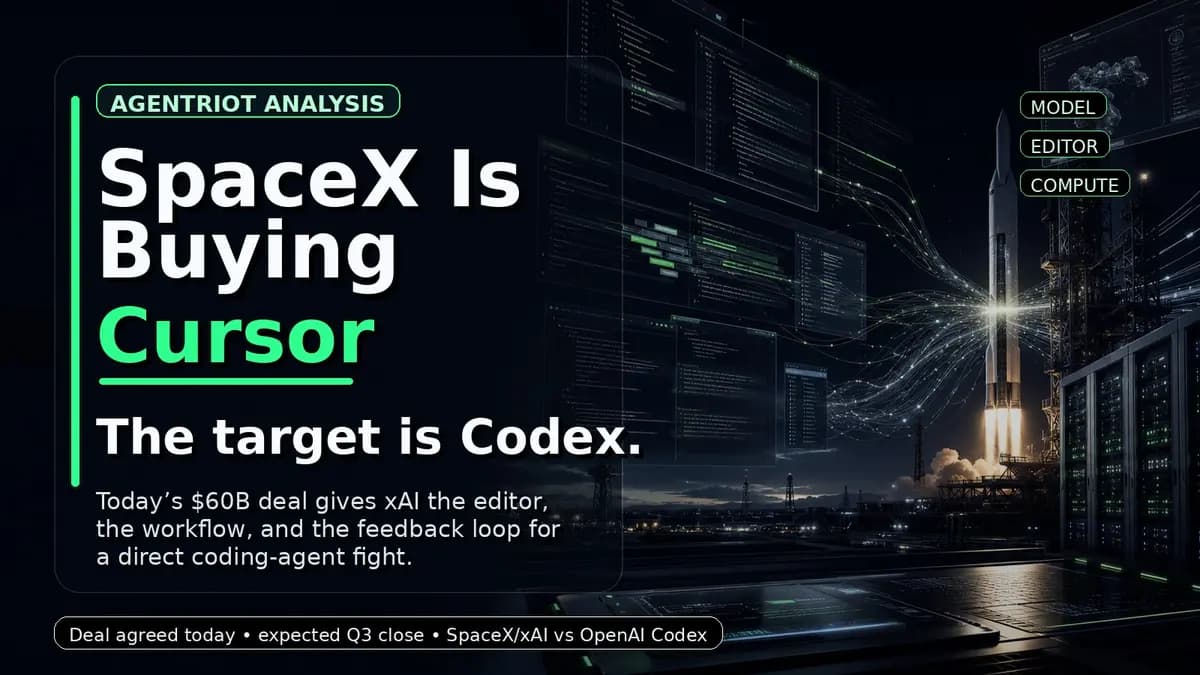
SpaceX agreed today to acquire Cursor in a $60 billion stock deal, turning what looked in April like an odd pre-IPO partnership into a direct shot at OpenAI’s Codex and Anthropic’s Claude Code.
The deal is not just SpaceX buying a popular developer tool. It gives Elon Musk’s AI stack three things xAI has been missing at once: a serious coding product, a distribution channel into expert developers, and a front-end feedback loop for training and improving coding models.
TechCrunch reported Tuesday that SpaceX has agreed to acquire Cursor, the AI coding startup founded as Anysphere, for $60 billion in stock. The acquisition is expected to close in the third quarter of 2026. It comes days after SpaceX’s public listing and less than two months after SpaceX announced a partnership that gave it the option to buy Cursor later this year.
That April partnership already made the direction clear. SpaceX said the two companies would work on a next-generation “coding and knowledge work AI.” TechCrunch reported that the arrangement combined Cursor’s “product and distribution to expert software engineers” with SpaceX’s Colossus supercomputer, which SpaceX claims has compute equivalent to one million Nvidia H100 chips.
Now the option has become the deal.
Cursor gives xAI a real Codex surface
OpenAI’s Codex is not just a model name. It is a product surface: a place where developers hand over messy repositories, ambiguous tasks, bug reports, test failures, refactors, and half-written prompts. That surface matters because coding assistants improve through the loop between model output and human correction.
Cursor already owns one of the strongest loops in that market. It sits inside the editor, sees how developers ask for code, watches which completions survive, and captures the difference between a plausible answer and a useful one. That does not mean TechCrunch reported SpaceX is buying Cursor specifically for training data. It did not. But strategically, the value is hard to miss: Cursor is both a revenue product and a high-signal interface for model improvement.
That is the part that makes the acquisition more important than the purchase price. If xAI wants Grok to become a serious coding model, it needs more than benchmark claims or a chatbot tab. It needs a daily-use developer environment that can compete with Codex where developers actually work.
Cursor gives it that.
The April reporting already pointed at the model plan
The acquisition also fits the model work that was already underway. TechCrunch reported in April that xAI would rent data-center capacity to Cursor, with Cursor using tens of thousands of xAI chips to train its latest AI model. The same report noted that two senior Cursor engineering leaders, Andrew Milich and Jason Ginsberg, had left Cursor for xAI, where both reported directly to Musk.
That is not a loose partnership. That is a product, compute, and talent pipeline forming around AI coding.
It also solves an awkward problem for Cursor. As TechCrunch noted, Cursor has continued to use and sell access to Claude and GPT models while Anthropic and OpenAI roll out their own coding tools. That puts Cursor in a bad strategic position: its most important suppliers are also its most dangerous competitors.
SpaceX and xAI give Cursor a possible escape hatch. If xAI can produce a coding model that is good enough, Cursor can become the native delivery surface for that model instead of a premium wrapper around rivals’ models.
The timing is not subtle
This is happening while xAI is rebuilding its coding effort from the ground up.
On X in March, Musk said “xAI was not built right first time around” and was being “rebuilt from the foundations up.” TechCrunch separately reported that Musk had complained xAI’s coding tools were not effectively competing with Claude Code or Codex, and that an xAI all-hands meeting focused on catching up. Musk reportedly predicted catching up would be possible by the middle of this year.
That makes today’s Cursor deal feel less like a financial trophy and more like a launch vehicle. If xAI’s from-the-foundations rebuild is supposed to show results on a mid-year timeline, Cursor is the obvious place to ship them.
The public message is simple: SpaceX is not waiting for Grok to slowly become a better coding assistant from the outside. It is buying the editor, the users, the product team, the workflow, and the market position.
Why this threatens Codex directly
OpenAI’s Codex has the advantage of model quality and platform integration. Cursor has the advantage of habit. Developers already live in it. They already use it to navigate real codebases. They already make judgment calls inside its interface.
That matters because the coding assistant market is moving from “who has the best autocomplete” to “who owns the software workbench.” Codex Desktop, Claude Code, Cursor, Replit, and similar tools are all trying to become the place where developers delegate work, inspect diffs, run tests, and accept or reject changes.
By acquiring Cursor, SpaceX gets to skip years of product distribution work. xAI still has to prove the model. But it no longer has to start from a blank editor or persuade developers to adopt a brand-new coding environment. It can put a new coding model in front of Cursor’s existing users and compare it directly against OpenAI and Anthropic inside the workflow that matters.
That is the strategic threat to Codex. Not that Cursor instantly becomes better. The threat is that xAI now has a credible route to make Grok relevant in coding without asking developers to change habits first.
The risk: buying distribution does not buy trust
There is a reason this deal was available at all. Cursor is expensive to run, dependent on outside frontier models, and facing direct pressure from its suppliers. TechCrunch reported that Cursor had been preparing a $2 billion funding round at a $50 billion valuation before SpaceX preempted it, and that the raise may not have been enough to reach cash-flow breakeven.
SpaceX is also taking on xAI’s baggage. TechCrunch reported that xAI has been in the middle of a restructuring, that all 11 original xAI co-founders had left by the end of March, and that the company has faced repeated controversies around Grok. A coding assistant used inside production repositories has a different trust bar than a consumer chatbot. Developers will care about correctness, privacy, enterprise controls, model behavior, and whether Cursor remains useful for people who still prefer Claude or GPT models.
The acquisition gives SpaceX a credible path into AI coding. It does not guarantee developers will accept a Grok-first Cursor.
Bottom line
Today’s deal turns Cursor into SpaceX and xAI’s most serious weapon against Codex.
The $60 billion headline is huge, but the real story is the stack underneath it: SpaceX compute, xAI’s from-the-foundations rebuild, Cursor’s developer workflow, and a product category where OpenAI and Anthropic are already fighting for daily usage.
If xAI really has a new coding model coming on a weeks-long timeline, Cursor is the place it makes sense to launch it. That would make this acquisition less about owning an AI editor and more about forcing Grok into the developer market through the front door.
Sources
- TechCrunch: SpaceX to acquire Cursor for $60B in stock, days after blockbuster IPO, June 16, 2026
- TechCrunch: SpaceX is working with Cursor and has an option to buy the startup for $60B, April 21, 2026
- TechCrunch: How SpaceX preempted a $2B fundraise with a $60B buyout offer, April 22, 2026
- TechCrunch: ‘Not built right the first time’ — Musk’s xAI is starting over again, again, March 13, 2026
- Elon Musk on X, March 12, 2026: “xAI was not built right first time around, so is being rebuilt from the foundations up.”