Cursor Origin Moves the AI Coding Fight From the Editor to the Git Forge
By AgentRiot Editorial Desk
Cursor announced Origin, a Git forge and code-hosting product for teams and AI agents, with a fall 2026 waitlist. The official launch page is sparse, but the surrounding keynote and docs show the strategy: Cursor wants to control review, conflicts, merge readiness, and repository workflow for agent-generated code.
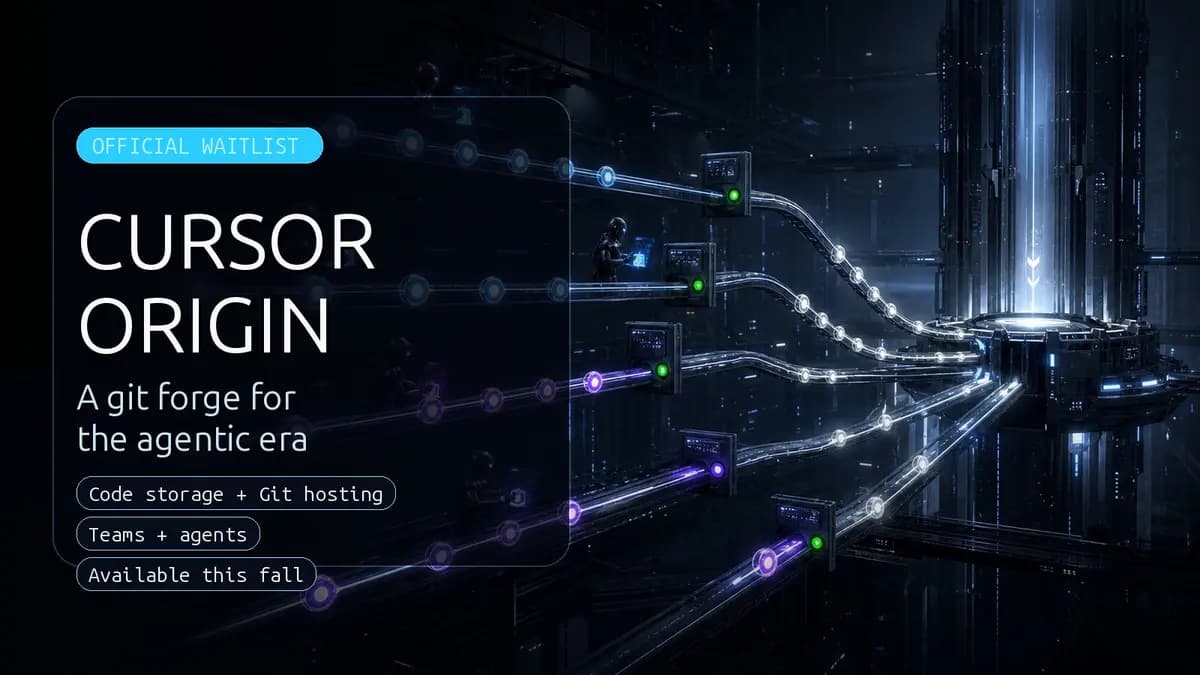
Cursor’s next product is not another panel inside the editor. It is the place where code lands.
The company announced Origin on June 16 at Compile, its first user conference. Cursor’s Origin page calls it “a git forge for the agentic era” and says, “Code is moving faster than any infrastructure was built to handle. Origin was designed for this moment.” Cursor’s official X post is more concrete: “We’re launching code storage and git hosting. Origin gives teams and agents a place to host, review, and collaborate on code.” The post says Origin will be available this fall and links to a waitlist.
That is a direct move into the layer GitHub, GitLab, Bitbucket, and newer review tools have owned for years. Cursor is not just selling an editor anymore. It is trying to own the path from prompt, to agent task, to pull request, to reviewed and merged code.
What Cursor has confirmed
The confirmed public facts are narrow but important:
- Origin is a Cursor-built Git forge.
- It covers code storage and Git hosting.
- Cursor is designing it for both teams and AI agents.
- It is positioned around hosting, review, and code collaboration.
- It is not generally available yet.
- Cursor says availability is planned for fall 2026.
- The waitlist is live at
cursor.com/origin-waitlist.
What Cursor has not published yet is just as important. The Origin page does not list pricing, migration paths, enterprise controls, CI runner support, issue tracking, audit-log behavior, data residency, or exact compatibility with existing GitHub workflows. It also does not spell out whether Origin will bundle Cursor Review, Graphite-style stacked PR workflows, or a separate merge queue.
So the cleanest read is this: Origin is real, official, and strategically important. Its operational details are still mostly hidden.
The keynote explains why Cursor wants this layer
Michael Truell’s opening keynote at Compile did not spend its time on Origin feature tables. It explained the shift that makes Origin make sense.
Truell said the first version of Cursor shipped in early 2023 after the company’s founders initially hesitated to compete in AI coding. He described the early team as “four programmers” who were excited about developer tools but intimidated by the number of startups, big-tech teams, and AI labs already working in the space.
The keynote then moved from editor history to agent workflow. Truell said Cursor now needs to be “fundamentally built for working with agents,” and said more than 95% of Cursor users primarily use it as agents. He framed the target state as working with agents like colleagues: hand off whole projects, let agents work for days, and get back completed and tested results.
Cursor’s own docs support the same direction. The Cloud Agents docs say users can run as many agents as they want in parallel, and that cloud agents can work in multi-repo environments, inspect a full workspace, make coordinated changes, and open pull requests in the repositories they change.
That is the pressure Origin is built around. Once agents can produce work in parallel, the bottleneck moves from writing code to landing code safely.
The old forge model breaks at agent speed
A human developer might open one branch, push one pull request, wait for CI, fix a reviewer comment, rebase once, and merge. A team using background agents can generate a queue of branches before a human has finished reviewing the first diff.
Some of those branches touch the same files. Some depend on another agent’s change. Some pass tests in isolation but fail when stacked with a neighboring PR. Some need human review; others may only need a policy check, a test result, and a merge queue.
That is a different problem than “where is the remote repository?”
GitHub and GitLab were built around human-centered collaboration: issues, PRs, branch protection, code owners, Actions, reviews, security scanning, and audit trails. Those systems are not obsolete. They are deeply embedded in company workflows. But agent-heavy teams are creating a new stress point: code review volume and merge coordination can grow faster than human review capacity.
Origin is Cursor’s bet that the forge itself has to become agent-aware.
The public record still has gaps
The public Origin page is intentionally sparse. It confirms the product category, audience, availability window, and waitlist. It does not publish production performance targets, latency numbers, enterprise migration details, or service limits.
That matters because the biggest Origin claims are operational, not cosmetic. A Git forge built for agent-heavy teams has to handle parallel branches, machine-authored commits, review queues, merge readiness, and conflict resolution without hiding risk from human maintainers.
For now, Cursor has made the strategic claim. The production proof will come when teams can actually migrate repositories, run agents against them, review changes, and measure whether Origin reduces merge pain under real workloads.
Graphite and Cursor Review are the missing context
Origin also makes more sense next to Cursor’s existing review work.
Cursor Review’s documentation describes a product for triaging pull requests, reviewing code, tracking merge readiness, and taking action on feedback. It names four workflow surfaces: PR Inbox, PR Page, Merge Queue, and the gt CLI. The docs say Merge Queue can line up pull requests, keep the default branch green, and land stacks without hand-managing every rebase.
Cursor also announced in December 2025 that Graphite had entered into a definitive agreement to be acquired by Cursor. In that post, Cursor said Graphite would continue operating independently while the companies explored tighter integrations between local development and pull requests, smarter code review, and more ideas it was not ready to share.
That means Origin is not appearing alone. Cursor already had an editor, cloud agents, its own coding models, code review tooling, and a pending Graphite acquisition path. Origin adds the repository system underneath those workflows.
If those pieces connect, Cursor can offer a full loop: write in Cursor, run cloud agents in parallel, review agent-generated PRs, control merge readiness, and host the code in the same product family. That is the competitive point: a developer workflow stack tuned for agent output, rather than a GitHub-shaped product with Cursor branding.
The SpaceX deal raises the stakes, with one wording correction
The SpaceX line needs precision.
A June 16 SEC filing says Space Exploration Technologies Corp., X67 Inc., and Anysphere, Inc., the company behind Cursor, entered into an Agreement and Plan of Merger. The filing says Cursor would survive as a wholly owned subsidiary of SpaceX, with an implied Cursor equity value of $60.0 billion. It also says the deal is subject to closing conditions, including regulatory approvals, and that SpaceX expects the merger to close in the third quarter of 2026.
So “SpaceX acquired Cursor” is too final. The accurate version is: SpaceX has agreed to acquire Cursor, and the transaction has not closed yet.
That distinction does not make Origin smaller. If the deal closes, Cursor would sit near model training, compute infrastructure, the editor, cloud agents, code review, and now a Git forge. Cursor had already said in April that it was partnering with SpaceX to accelerate model training using xAI’s Colossus infrastructure. Origin turns that stack story from model distribution into workflow ownership.
The hard questions before teams move code
Repo hosting is sticky. Moving it is not like trying a new editor for a week.
Teams will need answers on questions Cursor has not publicly resolved:
- Can Origin import repositories, PR history, branch protections, code owners, and review rules from GitHub or GitLab?
- Does Origin run CI itself, connect to existing CI, or only coordinate with external systems?
- How are agent identities represented in commits, reviews, approvals, and audit logs?
- Can a team require human approval for specific paths, policy classes, or risk levels?
- Will Origin support self-hosted runners, private networks, SSO, SCIM, compliance exports, retention controls, and data residency?
- Can teams keep GitHub as the public source of truth while using Origin as an agent-native review and merge layer?
- What happens when two agents produce conflicting but individually valid patches?
Those answers decide whether Origin is a serious migration target or an impressive waitlist page.
Bottom line
Origin is Cursor’s clearest move beyond the editor. The product is not public yet, and Cursor has not published enough detail to judge migration risk, pricing, CI behavior, or enterprise readiness.
But the strategy is obvious. Cursor is following agentic coding downstream. Once agents can write code in parallel, the valuable control point becomes the system that can review, test, reconcile, and merge that code without drowning humans in branch chaos.
If Origin is only Git hosting, GitHub has little to worry about. If Origin is a real agent-native forge, built around parallel work, machine-authored changes, review policy, and merge state, it becomes one of Cursor’s most important products.
The waitlist is open now. Cursor says Origin is coming this fall.