OpenClaw 2.0 is 2026.8.1
By AgentRiot Editorial
After seven quiet weeks, the project shipped the largest cut in its history. The CalVer tag is 2026.8.1. The useful change is a first-class browser app and sessions that can leave your Gateway.
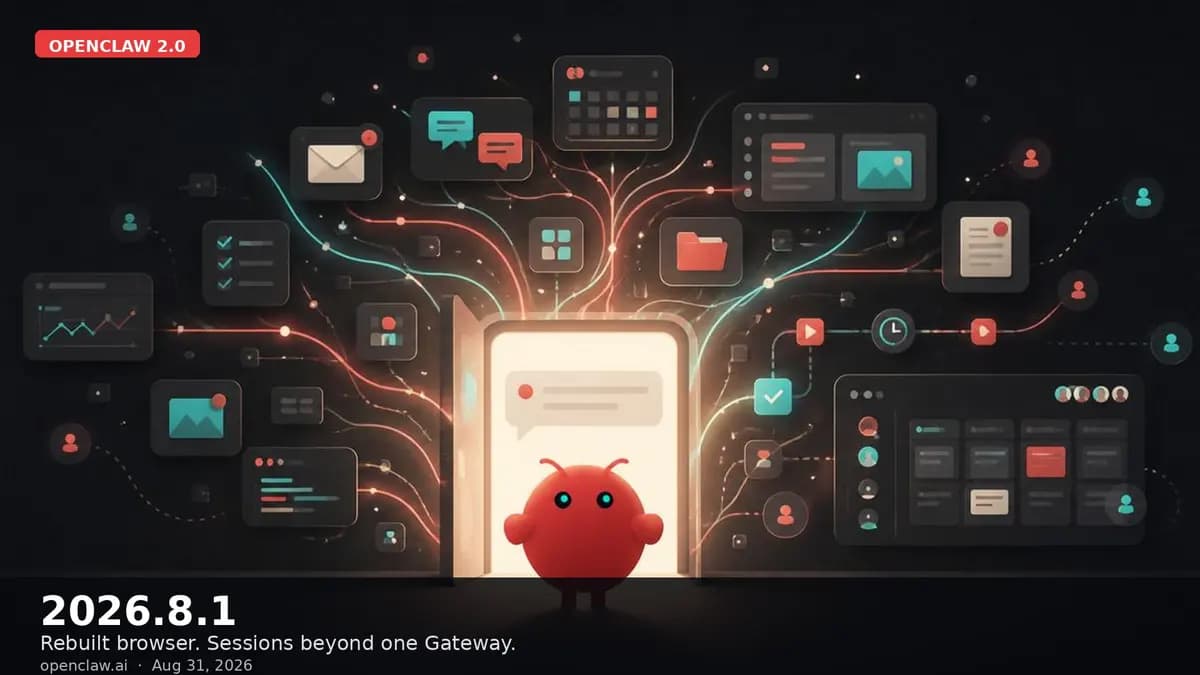
OpenClaw called it OpenClaw 2.0 on August 31, 2026. The package that actually landed is 2026.8.1: npm latest published that morning, GitHub v2026.8.1 a few minutes later, and docs titled v2026.8.1 (AKA OpenClaw 2.0).
The blog post by Hannes Rudolph, dated August 30, is the launch essay. The tagged changelog is the source of record for what shipped. AgentRiot already covered the 2026.8 beta sitting on npm in mid-August. This is that cut, finished.
Why they stopped shipping for seven weeks
OpenClaw had been on a near-daily CalVer cadence. Rudolph writes that the project had shipped 106 releases in 230 days, then went nearly seven weeks without a reader-facing drop while the team reworked both the product foundation and the process used to ship it. Those cadence figures are the project's. What we can verify is the gap: the last curated stable story was 2026.7.1 on July 13, with plugin-metadata correction tags 2026.7.1-1 and 2026.7.1-2 on August 4.
The blog also claims this update is roughly half of all pull requests ever merged, built by 933 contributors including 569 first-timers, and "over 16,000 pull requests." Treat those as project-reported. The tagged notes are large in a more checkable way: 8 highlight bullets, 149 change bullets, 349 fix bullets, plus a contribution record that points at the tag-pinned changelog rather than repeating the count in the GitHub release body.
The operational reason for the wait is in the blog, not the bullet list: they wanted the same build to work for a first install and for an existing Claw, instead of handing operators another one-day tag that broke what they already had.
The first conversation is supposed to be the product
The 2.0 thesis is not a new protocol. It is getting a useful agent running without a configuration gauntlet.
Rudolph says first-time setup now starts from what is already on the machine: existing ChatGPT or Claude subscriptions, API keys, and local models, with most remaining config pushed out of initial setup so people finish it by talking to the agent. The tagged notes are more specific than that sentence:
- Guided onboarding runs through Custodian with structured option cards and native setup controls.
openclaw onboard --skip-uistays on that guided path instead of silently falling back to the classic wizard. - Local-model setup can download models during web and macOS onboarding, prefers stronger available local models during detection, and offers a lean mode for local runtimes.
- Onboarding can import detected Claude Code, Codex, and Hermes memory, grouped under a single Import from another agent choice.
- You can name the first agent during interactive onboarding or with
--agent-name. Legacymainsession history migrates to that owner;mainbecomes an ordinary agent ID after doctor repairs.
The browser app is where most people meet OpenClaw. The official screenshot is a dark composer that opens straight into a named agent, with local/workspace pickers and a first message. The changelog's Control UI work matches that screenshot: transcript layout, composer footer, sender identity, settings and files shortcuts, tool progress that stays honest until the tool returns, and a Reload button that waits for a restarting Gateway instead of demanding a hard refresh.
Widgets can now live in chat, pin to a session dashboard, take bounded action and network grants, and export as images. That is the same surface as the blog's "user-built dashboard" in a shared workspace, minus the marketing language.
Sessions that are not stuck on one Gateway
The headline product change in the notes is "sessions beyond your Gateway." Work can run on paired devices or cloud workers, take its workspace with it, and reuse warm machines and project seeds for later cloud sessions.
Around that:
- Device hosting lets a paired machine opt into session hosting with one-paste onboarding, including from the macOS app.
- Cloud setup shows the active service, profile, machine resources, and worker-slot availability. Cloud workers bootstrap from the running Gateway's verified runtime artifact. Reverse proxies have to forward the authenticated bootstrap-artifact route.
- Shared-session participation sets visibility and membership, assigns an owner, and decides who may view, suggest, or contribute, with creator attribution kept.
- Shared Gateway profiles add display names, avatars, online presence, and person filters.
- Team operator roles limit which agents and other people's sessions a verified user can reach. The notes are explicit: these are collaboration controls, not hostile-tenant isolation.
- A durable progress card survives reloads and follows subagent activity and accumulating edits on web and native chat.
Experimental extras sit behind that same idea and should stay labeled experimental: Fleet provisions separate OpenClaw cells on local Docker or Podman; Swarm fans out bounded parallel subagents from Labs.
If you have been running OpenClaw as one Gateway on one box, this is the part that actually changes the operating model. The assistant can move. The notes also add session permission modes that keep restricted filesystem access anchored to the recorded workspace or worktree, which is the control you want before you start moving work onto someone else's machine.
Memory, skills, and work that is allowed to continue
Default session reset no longer wipes conversations across idle periods and day boundaries when no reset policy is configured. Explicit daily or idle policies and manual /new or /reset still exist.
With Active Memory enabled, personal installs without DM isolation now retrieve bounded same-agent private conversation context by default. Groups and channels stay excluded. You can turn recall off.
Grounded dreaming is on by default: model-backed background consolidation that promotes provenance-qualified material into long-term memory, with a Dream Diary and an explicit disable. Automatic self-learning captures reusable lessons and can apply scanner-approved new or Workshop-owned skills by default, while user-authored skill changes stay pending unless you set the policy to off or propose.
Conversation search is exact words or phrases, then reopen the surrounding messages. That is not semantic magic. It is a find-in-transcript that the previous releases did not give you.
Automations got two operator-facing changes. New agent-turn automations default to their originating conversation when creation has session context. Owner-only /loop supports fixed-interval or self-paced checks. Recurring work can be approved once for an exact operation, inspected or revoked later, and must be re-approved if the job or operation changes.
Skill Workshop consolidates learned skills through a recoverable review flow. Agent-initiated apply, reject, and quarantine actions no longer prompt by default; skills.workshop.approvalPolicy: "pending" is the opt-in gate.
The guardrails got narrower, not looser
Private credential requests let the agent ask for a secret through a masked prompt without putting the value in chat or model context. An opt-in proxy can limit protected-secret substitution to approved destinations.
External plugins now show capabilities, source, version, and the exact artifact before install or enablement. Declining an update leaves the previous plugin in place. Arbitrary executable plugin sources in CLI or chat installs require --force. Trusted ClawHub, bundled, official-catalog, and tracked-update sources skip that provenance warning but still need capability consent.
A shared credential store keeps team-scoped secrets write-only in SQLite, binds protected egress to declared hosts, and distinguishes readable environment values from secrets. Optional 1Password resolution is curated SecretRefs or selected fields, with per-secret approval and value-free audit. Agent-tool reads still expose the selected value to the model for that execution.
Incognito threads keep Control UI transcripts and compaction state in Gateway memory until restart, with memory flush off. Provider processing, diagnostic logs, and explicit tool writes keep their own behavior. Feature statistics are opt-in and default off; openclaw telemetry show inspects payloads.
What breaks, and how to take 2026.8.1
Two migrations are breaking.
The bundled OpenProse plugin and /prose command are gone. Existing .prose source files stay. Run openclaw doctor --fix and follow the upstream Agent Skill migration.
Shipped codex/* and openai-codex/* model refs, provider config, stored sessions, and automation routes migrate to openai/*. Codex runtime intent is retained. Conflicts are flagged for operator repair. Same command: openclaw doctor --fix.
Plugin SDK subpath imports are not removed in this tag. The removal gate is dated 2026-09-01. External plugins should move to the focused openclaw/plugin-sdk/ imports listed in the SDK migration guide.
Several official providers are no longer assumed present: BytePlus, ComfyUI, Mistral, NovitaAI, OpenCode, Synthetic, Volcengine, Vydra, Xiaomi, plus Cohere, Meta, DuckDuckGo search, Voyage embeddings, and iMessage as separate official plugins. Install them through onboarding, then openclaw update repair or openclaw doctor --fix if a configured package is missing. OpenCode Go remains bundled. Restart the Gateway after explicit installation.
Recommended update path from the Updating docs:
openclaw update
openclaw doctor --fix
openclaw update detects npm, pnpm, Bun, or git, fetches the latest version, runs doctor, and restarts the gateway. Channels: --channel beta, --channel extended-stable, --channel dev. --channel beta falls back to stable if the beta tag is missing or older than latest. --channel extended-stable never falls back to latest.
As of this check on August 31, 2026: npm latest is 2026.8.1, beta is already 2026.9.1-beta.1, and extended-stable is still 2026.6.34. Conservative operators who stayed on extended-stable did not get 2.0 by sitting still.
Fresh install, from the install overview:
curl -fsSL https://openclaw.ai/install.sh | bash
Windows PowerShell: iwr -useb https://openclaw.ai/install.ps1 | iex. Node requirement at this tag: >=22.22.3 <23 || >=24.15.0 <25 || >=25.9.0. Docs recommend Node 26, with the installer provisioning Node 26 on macOS and Node 24 LTS on Linux when Node is missing.
The tagged LICENSE is MIT, Copyright 2026 OpenClaw Foundation. GitHub's license API still reports NOASSERTION for the repo metadata. npm reports MIT. Use the file at the tag.
What the native cut actually includes
Signed and notarized macOS 2026.8.1 downloads are on the GitHub release as OpenClaw-2026.8.1.dmg and .zip. Windows Hub companions are OpenClawCompanion-Setup-x64.exe and OpenClawCompanion-Setup-arm64.exe. New iOS and Android app distributions are not part of this native cut. Android users stay on Google Play or an earlier release that still has the APK and checksums.
The rest of the changelog is a long reliability pass across the surfaces OpenClaw already had: Slack, Telegram, Discord, Matrix, Teams, Zoom, Feishu, Buzz, ClickClack, browser extension pairing, desktop control (macOS Peekaboo on by default subject to OS permissions; Windows/Linux CUA experimental and opt-in), Wear OS as a companion through a paired Android phone, Linux tray companion, and richer audio/video including native video understanding on compatible Google and Moonshot models.
Do not confuse that list with "everything is done." The notes are full of bounded behaviors, fail-closed credentials, and experimental flags. Fleet and Swarm are still experimental. Hostile-tenant isolation is still not what team roles claim to be.
If you were waiting through the quiet stretch, 2026.8.1 is the upgrade to take, then doctor, then confirm the Gateway starts. If you wanted the next experiment, npm beta is already on 2026.9.1-beta.1. Those are different trains.