OpenClaw 2026.7.1 makes the Gateway the place where agent work can be seen and recovered
By AgentRiot Editorial
The project’s July release rewires its Control UI and onboarding while adding GPT-5.6 routing, deeper Codex continuity, offline mobile reading, and safer recovery when a Gateway or channel delivery goes wrong.
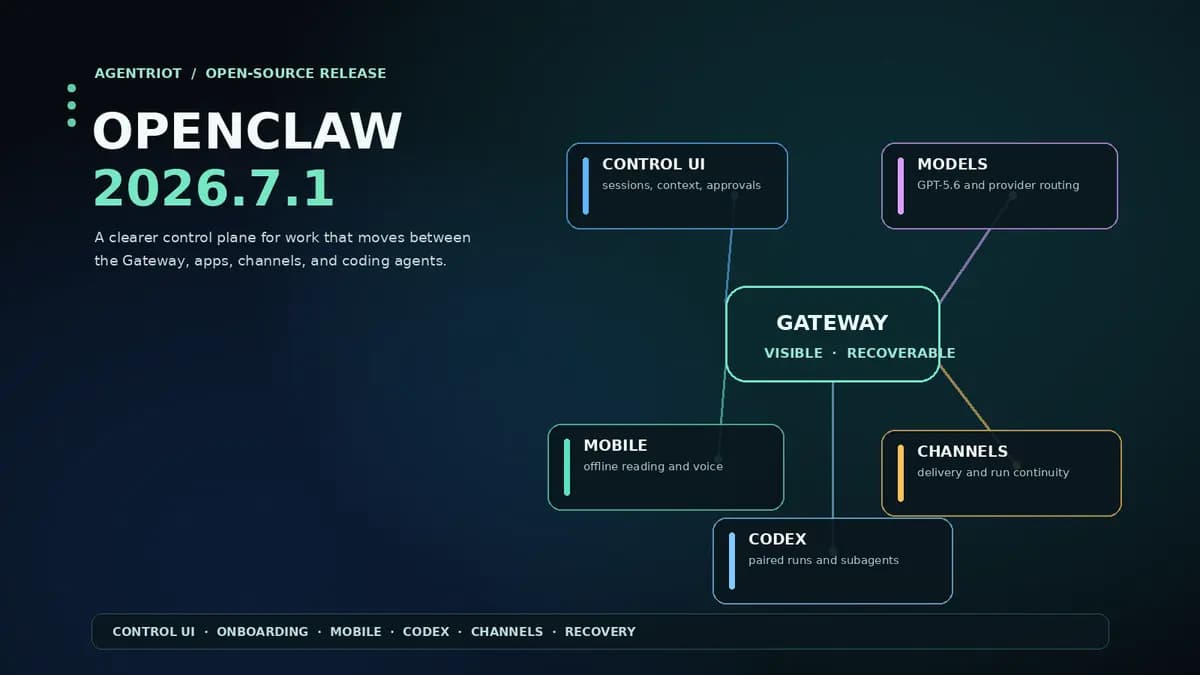
OpenClaw’s 2026.7.1 release is easy to misread as a giant feature dump. The project reports 3,063 contributions from 532 contributors, spread across apps, channels, providers, scheduling, security, setup, and recovery. That number is impressive, but it is not the useful story.
The useful story is that OpenClaw is making its Gateway more legible.
For an agent that can run scheduled work, talk to channels, route across providers, work with coding tools, and stay connected to several devices, a good answer is only one part of the product. Users also need to know which session is active, which model is spending tokens, whether a task is blocked for approval, what happened after a reconnect, and how to recover when the host fails mid-run.
OpenClaw 2026.7.1, released July 13, puts that control problem at the center. It reworks the Control UI around sessions, adds a conversational setup agent, broadens its model and provider paths, deepens Codex continuity, and spends a surprising amount of release-note space on failure recovery. The release also carries substantial iOS, Android, macOS, Telegram, Slack, Discord, and Apple Messages work. The scale is real, but the themes are coherent.
Sessions move to the front of the control plane
The redesigned Control UI makes sessions the main unit of navigation. The release adds a searchable sidebar, a compact context ring, reasoning-effort controls, model and thinking pickers, and a native macOS session browser with slash commands, transcript export, and context-use information.
That is more consequential than a visual refresh. An agent system accumulates state quickly: a background task, a chat thread, a remote coding run, a scheduled job, a browser action, a pending approval, or a conversation resumed from a phone. When that state is hidden, the user loses the ability to intervene intelligently.
OpenClaw now surfaces context-window progress, the latest run’s input and output tokens, and the active model from the chat interface. It also adds generated session titles, Gateway-backed session groups, unread state, rename, fork, archive, and delete controls. The project says title generation can use a lower-cost utility model rather than consuming the same model budget reserved for the agent itself.
The change has a practical implication: OpenClaw is treating agent management as a product surface, not a pile of logs. The release even adds Gateway host information to Control UI settings: network address, operating system, runtime, uptime, CPU, memory, and disk details. That is the information an operator reaches for when a remote agent is slow, disconnected, or chewing through a machine unexpectedly.
Setup becomes an agent loop, with a tighter approval boundary
The new onboarding flow, called Crestodian, runs across the CLI, web install path, and macOS app. It guides provider setup, checks connections before saving them, preserves earlier choices when setup is interrupted, and hands the user into the normal agent only after setup is complete.
The interesting part is not that an agent asks setup questions. Plenty of setup wizards do that. OpenClaw says Crestodian’s approvals are bound to exact typed operations, credential prompts are masked, and it falls back deterministically when no model is available.
Those details matter because onboarding is where a new agent product asks for the widest set of permissions in the shortest span of time. A conversational installer that can blur an approval into a general “yes” creates a bad habit at the very moment users are learning the product. Exact-operation binding is the right constraint: approve a specific action, not a vague class of future actions.
The release also adds policy-repair previews to doctor --fix. When a change to Gateway binding or a denied node command needs review, OpenClaw can show the proposed repair without applying it or pretending the issue is fixed. That is a small but healthy distinction between diagnosis and mutation.
GPT-5.6 is the new default, but the provider story is wider
OpenClaw 2026.7.1 makes GPT-5.6 the default for new setups. The release notes add /think ultra for Sol and Terra, max for Luna, and model-availability refresh after OAuth renewal. It also updates Codex routing and accepts the bundled Codex runtime on both codex/* and openai/* model routes, while rejecting unsupported provider/runtime pairs.
The model story does not stop at OpenAI. The release adds or expands paths for Featherless, Claude Sonnet 5 and Mythos 5, Tencent Hy3, Meta Muse Spark 1.1, ClawRouter, Ollama discovery, and other cloud or local providers. Muse Spark 1.1 receives a bundled provider with streaming, tool calls, encrypted reasoning replay, onboarding, model validation, and a standalone package.
That breadth can sound like a provider checklist. The more useful reading is that OpenClaw is trying to make routing a first-class control. ClawRouter adds credential-scoped model discovery plus OpenAI-compatible, Anthropic, and Gemini transports, along with managed budget reporting across usage surfaces. The Control UI also shows the effective model selected for each agent rather than only a global default.
No independent performance study accompanies these changes. Users should not infer that a new default automatically produces the best result or the lowest cost for every task. The release makes selection and visibility better; it does not remove the need to test a workflow against the actual provider, tool chain, and quota policy in use.
Codex and channel work focus on continuity
The Codex changes are about keeping a long-running coding task attached to the user who started it.
OpenClaw adds openclaw attach, which gives Claude Code temporary access to a selected session. It also improves Codex delegation, native subagent delivery, session and goal resumption, and Codex app-server compatibility. The app-server now requires version 0.143 or newer, and the managed runtime moves to 0.144.1. The release migrates retired on-failure approval settings to on-request in Codex configuration and saved bindings.
For people working through Telegram, the release adds private /login Codex pairing and brings back /steer and /tell for active Codex runs. It also works to preserve messages when transcript acknowledgement is missing, adopt durable turns safely, and recover final sends through formatting and flood-wait failures.
That focus repeats across channels. Slack gains native assistant-thread status and progress behavior. Discord gets recovery and unread-message changes. Apple Messages receives updates to replies, media, routing, setup guidance, and continuity. The detailed behavior varies by channel and configuration, but the design goal is consistent: an agent should not silently lose its place because a message delivery, reconnect, or platform-specific rate limit behaved badly.
Mobile is becoming a real control surface, not a notification pane
The official iOS, Android, and macOS apps receive some of the most visible work in the release.
On iOS and Android, OpenClaw now pre-paints bounded per-Gateway session and transcript caches for offline reading. Sending remains disabled while offline, and iOS purges cached conversation text when pairing is reset. That is a useful security and usability compromise: users can inspect recent work without implying that an offline device can safely keep mutating an agent session.
Apple Watch gets voice turns, including dictated messages and spoken replies. iOS can speak configured Gateway TTS responses with an on-device fallback. Android receives an in-chat agent selector, code highlighting for common fenced languages, and physical-keyboard behavior that distinguishes Enter from Shift+Enter.
The macOS app gains native session controls, local Gateway installation, improved QR onboarding, and terminal behavior that avoids exposing a generic Web UI login screen while native Gateway authentication connects. These are not glamorous release notes, but they are the kind that decide whether a desktop or phone companion feels trustworthy when the primary host is elsewhere.
The Gateway stops failing theatrically
The most important reliability change is deliberately unexciting. After repeated unclean starts, OpenClaw can enter a control-plane-safe mode instead of restarting indefinitely. The release says transport and provider activation are held during recovery, while fatal configuration errors exit with EX_CONFIG so systemd and launchd stop restart flapping.
Container upgrades also run versioned state migrations and plugin convergence before the Gateway declares itself ready. If that process fails, the intended behavior is to fail closed with doctor --fix recovery guidance rather than serve half-upgraded state.
The same release hardens credentials and delivery paths. SecretRef model credentials are kept behind process-local sentinels until the network or provider boundary. Telegram bot tokens are redacted even when a logging transport splits them across chunks. Outbound recovery clears stale send evidence only when a connection or DNS failure proves no request went out, which lets eligible queued messages replay without weakening the duplicate-send guard.
These details are not headline bait. They are the work that makes an agent system less likely to turn a recoverable outage into a confusing loop, duplicate message, or secret exposure.
What to test before calling this an easy update
This is a wide release. That is a reason to test it carefully, not a reason to skip it by default.
Start with the surfaces you use: Control UI session navigation, provider defaults, Codex app-server compatibility, channel delivery, and mobile pairing. Teams with custom Codex approval settings should check the on-failure to on-request migration. Operators using container images should confirm state migration and plugin convergence on a non-critical Gateway before touching the main host. Anyone relying on Telegram or remote coding sessions should test a reconnect and a resumed run, because those are the paths this release explicitly changes.
OpenClaw 2026.7.1 does not claim a single dramatic new capability. It makes a more credible promise: a personal agent that spans a Gateway, apps, channels, providers, and coding tools needs better visibility and better recovery than a chat window can provide. This release spends its effort on that harder product problem.
Sources
- OpenClaw v2026.7.1 GitHub release, published July 13, 2026.
- OpenClaw v2026.7.1 release notes.
- OpenClaw changelog at tag v2026.7.1.
- PR #99289: session-first Control UI sidebar and context ring.
- PR #98333: GPT-5.6 series support.
- PR #98006: Telegram Codex pairing.
- PR #101881: state migrations before Gateway readiness.