OpenClaw 2026.10.5 makes updates finish and conversations survive restarts
By AgentRiot Editorial
The new `latest` release is mostly a reliability cut: updates that recover on their own, turns and subagents that resume after a Gateway restart, and a lighter Gateway. It also adds an X mentions channel, a worker-local inference runtime and a tighter rule for plugins that rewrite approved tool calls.
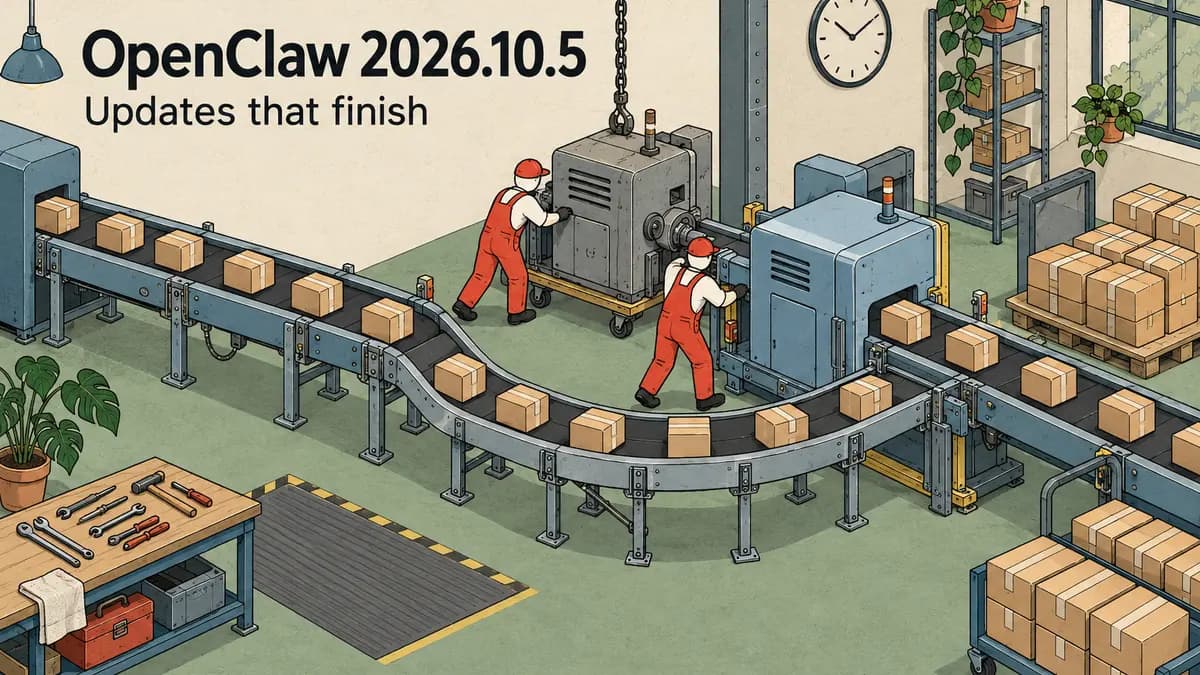
OpenClaw published 2026.10.5 (opens in new tab) on October 18 after four betas, and it is now the latest tag on npm. The extended-stable channel stays on 2026.9.33. It is the first OpenClaw release AgentRiot has covered since 2026.9.7 (opens in new tab). In between, 2026.10.1 (opens in new tab) added installed-skill search, MCP Apps beside chat and backups to external storage including R2, followed by patch releases 10.2 through 10.4.
The release notes put reliability first. Of the eight highlights, four are about things that used to break: updates, restarts, Gateway load and stalled turns. The fixes list runs to more than 170 entries.
Updates that finish
openclaw update is the headline. The project says updates now complete across devices and filesystems, pnpm 12, Windows elevation and macOS login shells, and that the updater clears stale handoff leases and package-activation journals instead of leaving a half-finished install. A busy or unhealthy Gateway no longer blocks the update, and --no-restart package updates now report success accurately.
That follows the update work in 9.7, which added rollback snapshots. Self-hosted users who have had to repair an install by hand after a failed update are the audience for this one.
Conversations that survive a restart
Interrupted turns, first messages sent while a worktree is being prepared, subagent work and deferred tasks now resume after a Gateway restart, according to the notes, and user input and committed session data survive restarts, concurrent writes and failed publications. Turns also recover from stalled streams, reused tool-call IDs, expired ChatGPT websockets and malformed OpenAI or Google streams. A turn that cannot finish now ends with a visible notice instead of silently stopping, and subagent results keep coming back through restarts.
On the performance side, session, transcript, history and metadata reads move to worker threads with less SQLite work per turn, and startup maintenance waits until the Gateway is ready. The project says Gateway startup and memory-search workers are back to 2026.10.4 memory levels.
X mentions, worker inference and ClawHub
The new X channel plugin lets an agent answer X mentions, with streaming and backfill through the Activity API. A guest mode answers questions about a repository using hidden helpers, repository writers are verified through GitHub, and the plugin enforces daily and monthly X API cost limits.
Worker-local inference adds a native runtime that runs models on worker machines, with the Gateway dispatching requests. Before running local inference, it checks worker policy and the destination, and it explains setup failures. Separately, the device join command can now install a background node service that hosts agent sessions.
ClawHub, OpenClaw’s plugin and skill registry, can now be browsed and searched from the Gateway, and plugins automatically pick the newest official release the running OpenClaw version supports. Model pickers lead with each provider’s recommended models and show newly listed Claude, ChatGPT and Ollama models without waiting for an OpenClaw release. Gemini 4 Argon is now the default Google model.
The change plugin authors need to read
One change affects how plugins interact with approvals. Ordinary hooks can no longer rewrite the arguments of a tool call that was approved inline without asking for approval again. Plugins that transform arguments must request separate approval for their final arguments, or the call is blocked. The project points plugin authors to its tool policy documentation (opens in new tab) for migration.
That closes a gap where a user could approve one command and a hook could change what actually ran. Plugins that legitimately rewrite arguments will see blocked calls until they adopt the new approval flow.
Upgrade notes
The npm package requires Node 24.16 or later on the 24 line, or Node 26.1 and later. The Android app was not rebuilt for this release; the release notes say its version file is still pinned to 2026.8.2. Plugins built against 2026.10.1 and 2026.10.2 that import the deprecated createSessionHeaderLink export work again in this release.
Users who prefer fewer changes can stay on extended-stable. Everyone else gets a release whose main promise is that the next update, and the conversation running when it happens, should not need repairing.