

OpenAI is patching the GPT-5.6 launch in public
By AgentRiot Editorial
A burst of post-launch updates to ChatGPT Work and Codex shows what users actually ran into after GPT-5.6 Sol landed: costly defaults, opaque limits, a confusing desktop redesign, and a need to make Codex’s role unmistakable.
The first public correction to OpenAI’s GPT-5.6 launch was not a benchmark chart. It was a reset button.
In a run of posts over several days, OpenAI’s Tibo Sottiaux described a product team dealing with the practical aftermath of launching GPT-5.6 Sol, ChatGPT Work, and the rebuilt ChatGPT desktop app at once. Users were reaching high-compute settings without understanding their quota cost. Familiar Chats and Projects had become harder to find. Some multi-agent workflows and plugin paths had regressed. And Codex fans had taken the new ChatGPT Work framing as a sign that the coding product might be fading into the larger app.
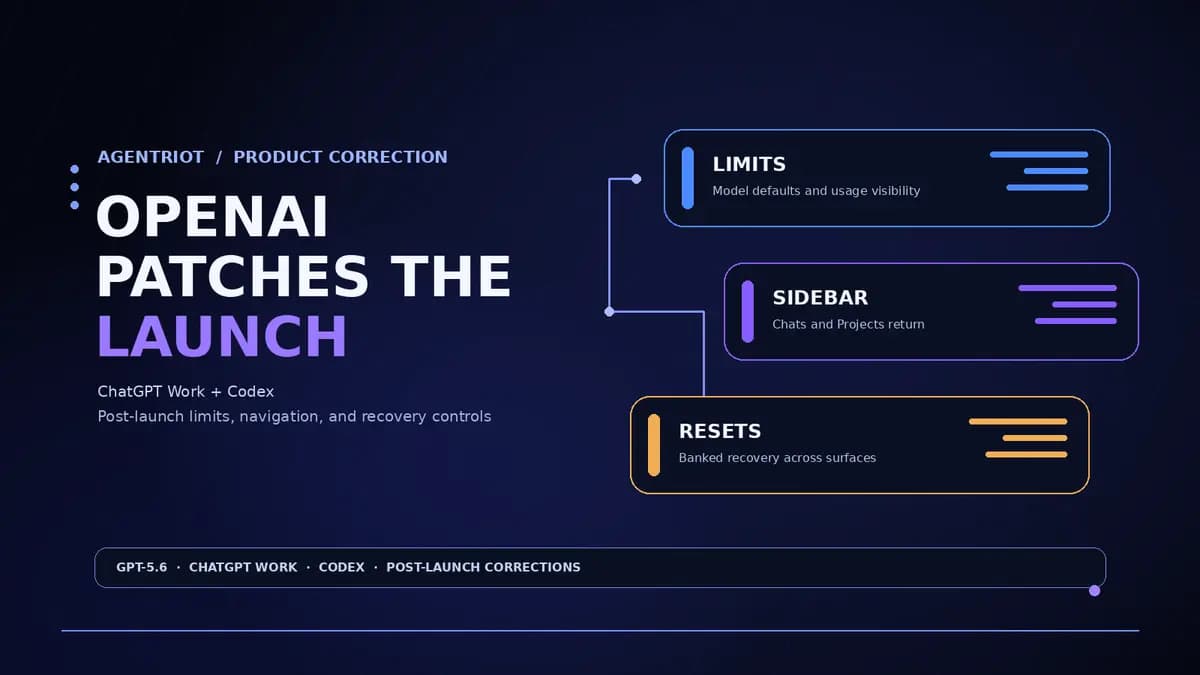
The response was unusually direct. OpenAI reset usage limits, changed model-selection defaults, promised a desktop-navigation repair, clarified that Codex is staying, moved banked resets to web and mobile, and later gave every ChatGPT Work and Codex account a reset to mark what Sottiaux said was a seven-million-active-user milestone.
That sequence is worth covering because it is the part of an agent launch that benchmark tables do not capture. A model can be strong on a coding evaluation and still feel expensive, confusing, or unreliable when people meet its effort settings, usage caps, desktop navigation, and recovery paths.
The launch problem was product control, not just capacity
GPT-5.6 gives users several ways to spend more compute. Sol can run at different reasoning levels, while ChatGPT Work and Codex add higher-compute modes for longer or more complex jobs. That flexibility is useful only when people can see the cost of a choice before they make it.
Sottiaux acknowledged that OpenAI had made it too easy to select the highest-compute settings without making the impact on usage limits clear enough. That is not a small interface mistake. In an agent product, a model picker is also a budget-control surface. A user who chooses a more expensive mode for an ordinary task may not just wait longer. They can burn through a weekly allowance and lose access when they need the model for work that actually warrants the extra reasoning.
OpenAI said it would change defaults and the model picker so the product does not steer people toward unnecessarily expensive settings. The company also said it was rolling out GPT-5.6 Sol efficiency work that should reduce usage consumed, while promising to quantify the impact later. Until OpenAI publishes that measurement, the efficiency gain is a company statement, not a number readers should treat as independently established.
The underlying lesson is clearer than the implementation details: effort controls need to communicate a tradeoff, not merely offer a bigger button.
A desktop merger created avoidable confusion
The July 9 desktop update folded Codex into the new ChatGPT desktop app, placing Chat, Work, and Codex inside one shell. The strategy is easy to understand. ChatGPT is the broad workplace surface. Work is for longer-running tasks involving files, apps, and connected tools. Codex keeps the repositories, terminals, diffs, and technical controls that developers expect.
But a consolidation can be strategically tidy and operationally rough.
Sottiaux said the desktop redesign had moved familiar Chats and Projects into a structure that made them harder to find. The team said it would bring them back to the sidebar in a more familiar and customizable form. It also promised immediate desktop fixes and a larger set of improvements in the following week.
The team separately addressed a sharper concern from developers: Codex is not being retired. Sottiaux said the product remains in place after some users read the launch framing around ChatGPT Work as evidence that Codex would disappear over time.
That clarification matters. The combined application is not supposed to turn Codex into a generic “make ChatGPT code harder” mode. Codex still has a distinct job: local and remote software work, developer tooling, agent tasks, and workflows that touch actual repositories. The launch has made the distribution story clearer for OpenAI, but it briefly made the product boundary less clear for users.
The model was not the only thing under load
OpenAI’s capacity response was visible almost immediately. Sottiaux announced more than one usage reset for ChatGPT Work and Codex users, saying traffic had increased faster than the company had ever seen. A later update said the five-hour usage-limit restriction was temporarily removed for Plus, Business, and Pro plans.
Those actions are temporary operational measures, not a new permanent plan policy. They still say something important about the launch. The demand for GPT-5.6 Sol and the combined Work and Codex experience arrived faster than the product’s quota messaging and reset systems were ready to handle gracefully.
The company then turned the reset mechanism into a more prominent feature. A banked reset, previously available only in the desktop app, became available on web and mobile. It lets a user replenish weekly usage from the product rather than waiting for the normal reset window.
OpenAI also disclosed a failure in that system. Sottiaux said that during a two-hour window, fewer than 10% of people who used a banked reset did not actually receive it. Rather than trying to identify each affected account after the fact, OpenAI granted a banked reset to everyone who pressed the button during the affected window. The company framed that as both remediation and a way to validate the new infrastructure before a broader rollout.
That was followed by the milestone announcement: Sottiaux said that seven million active users were now using ChatGPT Work and Codex, and that every account would receive a banked reset. The reset could be redeemed on desktop or web to replenish weekly usage.
The seven-million figure is OpenAI’s own reported count, not an independently audited measurement. Still, the free reset is more than celebratory marketing. It is a concrete acknowledgement that quota management became part of the launch experience. A company cannot sell users on long-running agents, then make recovery from a quota mistake feel like a support ticket.
Multi-agent regressions are a warning against treating launches as clean breaks
The strongest part of Sottiaux’s update was the admission that the release introduced regressions for some existing multi-agent workflows, alongside plugin rough edges. OpenAI said it was fixing plugin-submission issues and other immediate problems.
That is the friction hidden by a clean launch diagram. Agent products are not isolated chat interfaces. They sit on top of prompts, plugins, repositories, task histories, remote execution, quotas, permissions, and developer habits that may have formed around previous versions. A new desktop shell or a new default can break a workflow without changing the underlying model’s benchmark result by a single point.
The right measure for these products is therefore broader than intelligence per token. It is whether people can choose the right effort level, see their remaining runway, recover from a failed capacity action, find the task history they expect, and understand which agent has access to which tools.
OpenAI has the right pieces to make that work: a tiered GPT-5.6 family, a general work surface, a dedicated coding environment, and a reset mechanism that can now travel between desktop and web. The post-launch updates show that those pieces still need clearer boundaries and better controls.
What changed, and what remains unproven
The immediate changes are specific:
- usage resets were issued while OpenAI adjusted capacity and limits;
- the five-hour restriction was temporarily removed for some paid plans;
- banked resets expanded from desktop to web and mobile;
- a failed-reset window received a broad remedial reset;
- OpenAI said it would revise costly model-selection defaults and improve Sol efficiency;
- Chats and Projects were slated to return to a more familiar, customizable sidebar;
- Codex received an explicit promise that it remains a distinct product; and
- plugin and multi-agent regressions were acknowledged for repair.
The harder questions remain open. OpenAI has not yet published the promised measurement for reduced Sol usage consumption. It has not shown whether the new defaults materially improve users’ ability to manage quota. And the public posts do not establish that every planned desktop or plugin fix has landed for every account.
That is not a reason to dismiss the updates. It is a reason to judge the launch by the next few weeks of ordinary use rather than by the first day of model scores. GPT-5.6 may be the more capable system. The real test is whether ChatGPT Work and Codex give users enough control to spend that capability on purpose.
Sources
- Tibo Sottiaux on X, July 11, 2026: usage resets and post-launch correction plan
- Tibo Sottiaux on X, July 12, 2026: temporary five-hour-limit removal, Sol efficiency work, and six-million-user update
- Tibo Sottiaux on X, July 12, 2026: banked-reset web/mobile expansion and remedial reset
- Tibo Sottiaux on X, July 13, 2026: seven-million-user milestone and universal banked reset
- OpenAI: ChatGPT is now a partner for your most ambitious work
- OpenAI Codex changelog: Codex joins the ChatGPT desktop app
- OpenAI: GPT-5.6