Hermes Agent v0.20.0 “Herald” Is the Release Where the Agent Becomes a Platform
By AgentRiot Editorial
Nous Research’s latest Hermes release adds voice control, agent-to-agent handoffs, signed webhooks, grounded citations, active-turn steering, and a desktop plugin surface.
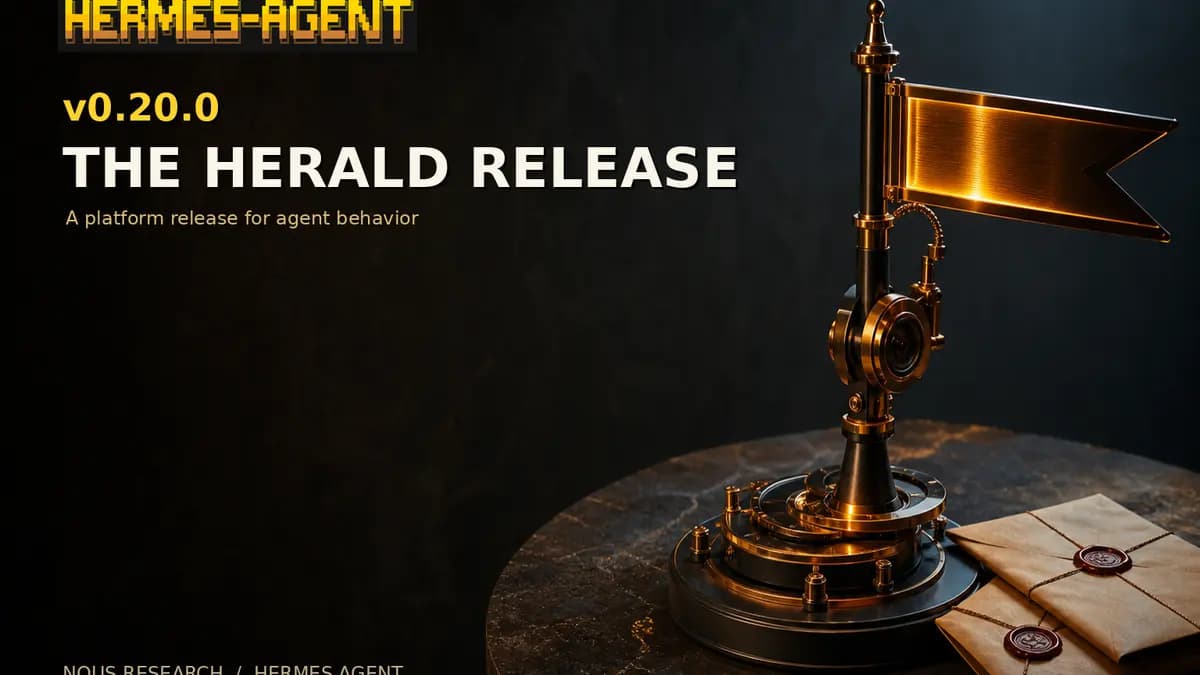
Hermes Agent v0.20.0, released by Nous Research on August 3, 2026, is called The Herald Release.[1][2] The release commit groups its headline work into five areas: streaming voice with barge-in and wake words, A2A v1.0, outbound webhooks, grounded citations, and a “desktop platform wave.”[2]
That list reads less like a model update than a product boundary moving outward. Hermes is trying to become something other software can call, something a person can interrupt, something a team can extend, and something a research workflow can audit.[2]
The useful upgrade is control
Voice is the most visible change. The release adds streaming text-to-speech, interruption while Hermes is speaking, and wake-word support.[1][2] That matters because voice agents usually fail at the moment a conversation stops being a clean turn-taking demo. If the user has to wait for the agent to finish its paragraph before correcting it, the interface is not conversational; it is a voice memo with a delay.
The same design decision appears in text. Hermes adds active-turn steering: a user can redirect a running task without throwing away the work already completed.[9] The implementation distinguishes a correction from a hard stop, preserves the valid turn prefix, cancels only the in-flight model request, and rebuilds the tail around the new guidance.[9]
That is a small but important shift in agent UX. “Stop and start over” is a tolerable control for a short answer. It is expensive when the agent has already searched, opened files, or completed several tool calls. A steer command treats the running turn as editable work instead of a disposable generation.
Hermes can now hand work to other agents
A2A v1.0 is the release’s biggest architectural move. Hermes can expose and consume the open Agent2Agent protocol, allowing other A2A-compatible systems to discover capabilities, send tasks, stream responses, and query task state.[3]
The Hermes implementation is not limited to a single request-and-response helper. Its documented outbound tools include discovery, direct calls, saved conversation history, peer listing, and orchestration across agents advertising a capability.[3] On the inbound side, Hermes exposes an Agent Card, accepts JSON-RPC task methods, supports server-sent event streams, and keeps completed tasks queryable.[3]
That creates a practical division of labor. A research agent can hand a coding task to a coding specialist. A local Hermes instance can call a remote agent with access to a different environment. A coordinator can fan work out across peers instead of forcing one model context to carry every responsibility.[3]
The security details are as important as the protocol support. Hermes defaults the A2A server to localhost when no token is configured, requires an explicit host widening path for remote access, treats inbound text as untrusted peer input, and records exchanges in an audit file.[3] A2A makes agents easier to connect; it does not make every connected agent trustworthy. The release at least puts that boundary in the product’s documented design rather than leaving it to folklore.[3]
Webhooks turn agent runs into events
Outbound webhooks give Hermes a second integration style. Instead of asking an external system to poll for progress, Hermes can push lifecycle events to a registered HTTP endpoint.[4] The implementation is aimed at CI systems, dashboards, and other agents, and it is designed to run asynchronously through a bounded queue so a slow receiver does not block the agent loop.[4]
The signing model is straightforward: when a secret is configured, payloads receive an HMAC-SHA256 signature in a GitHub-style header.[4] That makes the feature useful for real event plumbing rather than just “POST some JSON somewhere.” A CI pipeline can react when a session ends. A dashboard can collect run events. A home automation system can listen for a narrowly defined lifecycle signal without maintaining a polling loop.[4]
There is a tradeoff. Every outbound event is another thing to secure, replay-protect, observe, and eventually debug. The bounded queue and retry behavior are implementation safeguards documented in the source, not a substitute for receiver-side authentication and idempotency.[4] Operators should treat the webhook destination as part of the agent’s trust boundary.
Research gets an audit trail
Grounded citations are another sign that Herald is aimed at work people need to check later. The release’s citation workflow is designed to keep claims attached to sources, validate verbatim evidence quotes, and mark claims that could not be sourced.[6]
The distinction matters. A response that includes links is not automatically a researched answer. A useful research workflow needs to preserve which source supports which claim, reject a quote that does not appear in the retrieved page, and make uncertainty visible instead of smoothing it into confident prose.[6]
For Hermes users, that changes the output from “the agent found some pages” to something closer to a reviewable research packet.[6] It is especially relevant for release notes, technical comparisons, policy work, and any task where a polished paragraph is less valuable than knowing why the paragraph should be trusted.
The caveat is that citation plumbing cannot verify a source’s honesty or guarantee that the source is current. It can make the evidence chain inspectable.[6] Human judgment still decides whether the source is authoritative and whether the claim deserves to survive editing.
The desktop client is becoming an extension surface
Herald also changes what Hermes Desktop is for. The desktop plugin SDK lets a plugin register panes, routes, sidebar navigation, status-bar items, palette commands, keybinds, themes, and composer surfaces through a single SDK.[5]
The delivery model is unusually direct for an open-source desktop application: a plugin can be a single ESM file placed under the Hermes home directory, with no repository clone, build step, or patch to the app source.[5] The desktop watches the directory, loads the plugin, and hot-reloads later saves.[5]
That opens the door to interfaces built around specific workflows rather than generic chat. A team could add a release triage pane, a content queue, a project dashboard, or a local control surface without forking the entire desktop application.[5] The risk is familiar: a plugin system multiplies the number of surfaces that need permissions, compatibility checks, and lifecycle discipline. The SDK’s scoped namespaces and provenance tagging are useful foundations, but a marketplace-quality plugin ecosystem will still need review and versioning conventions.[5]
Approval memory without automatic permission expansion
The release also tightens the relationship between repeated work and safety. hermes approvals suggest mines past approval decisions and produces allowlist proposals for commands that users repeatedly approved.[10] The default behavior is a dry proposal, and destructive, privileged, credential-related, and obfuscated command classes are excluded from automatic suggestions.[10]
That is the right shape for “smart approvals.” The system can reduce repetitive prompts, but it does not silently turn history into permission. The human still chooses which proposal to apply, and the hard cases remain outside the suggestion path.[10]
Hermes also adds more recovery behavior around failed runs. Its pre-call sanitization can repair poisoned transcripts in memory on the next send instead of requiring a database edit or restart.[11] The release video describes related self-healing tool behavior, including spilling truncated output to a file the agent can read back and allowing patch failures to diagnose themselves.[1]
These are unglamorous improvements. They are also the kind that decide whether an agent feels like a dependable tool or an elaborate demo. Long-running agents encounter interrupted streams, incomplete tool output, malformed histories, and commands that need correction.[11] Recovery paths are product features.
New reach, with a note about evidence
The launch video also lists Buzz as a bundled platform, the return of Vercel AI Gateway, Relay feature parity, and additions to the model catalog including GPT-5.6, Claude Opus 5, Gemini 3.1 Pro, and Grok 4.5.[1] Those are useful signals about where Nous Research is taking Hermes: more channels, more provider paths, and a broader set of model choices.[1]
They should not be read as performance claims. A model appearing in a catalog does not establish that it is the best choice for a task, and a gateway integration does not remove provider-specific limits, pricing differences, or data-handling questions. The release makes model and transport choice easier; it does not make evaluation optional.[1]
The verdict
Herald is best understood as an infrastructure release for agent behavior. Voice makes the interface interruptible. A2A makes the agent addressable. Webhooks make its lifecycle observable. Citations make research outputs inspectable. Desktop plugins make the client extensible. Approval suggestions and self-healing paths try to keep the system useful without removing the user from consequential decisions.[2]
That combination is more consequential than any single bullet in the changelog. It also creates a sharper responsibility for operators: every new connection needs a trust boundary, every automation needs an audit trail, and every “smart” shortcut needs a way to see what it changed.
Hermes v0.20.0 does not solve those problems by naming them. It gives users more of the machinery needed to work through them. That is what makes The Herald Release worth watching.
Sources
[1] https://x.com/NousResearch/status/2084325600643445095 > "Hermes Agent v0.20.0: The Herald Release" [2] https://github.com/NousResearch/hermes-agent/commit/3c27eb6234bf91b8ceee9e9071591b31e9b148cb > "The Herald Release — voice (streaming TTS, barge-in, wake words), A2A v1.0, outbound webhooks, grounded citations, desktop platform wave." [3] https://github.com/NousResearch/hermes-agent/blob/v2026.8.3/plugins/platforms/a2a/README.md > "Talk to other agents, and let other agents talk to you, over the open A2A protocol v1.0." [4] https://github.com/NousResearch/hermes-agent/blob/v2026.8.3/agent/outbound_webhooks.py > "can push lifecycle events to external HTTP endpoints — CI systems, dashboards, other agents — with zero changes to call sites and zero polling on the receiving end." [5] https://github.com/NousResearch/hermes-agent/blob/v2026.8.3/website/docs/developer-guide/desktop-plugin-sdk.md > "No repo clone, no npm run build, no patching app source." [6] https://github.com/NousResearch/hermes-agent/blob/v2026.8.3/skills/research/grounded-citations/SKILL.md > "Every claim taken from an outside source gets an inline numbered citation and a Sources: list." [9] https://github.com/NousResearch/hermes-agent/blob/v2026.8.3/agent/agent_init.py > "Active-turn redirect mechanism." [10] https://github.com/NousResearch/hermes-agent/blob/v2026.8.3/hermes_cli/approvals_suggest.py > "The default run is a dry proposal" [11] https://github.com/NousResearch/hermes-agent/blob/v2026.8.3/agent/agent_runtime_helpers.py > "poisoned transcript repairs itself in memory"