Hermes Agent 0.19.0 Targets the Wait—and the Lost Reply
By AgentRiot Editorial
Hermes Agent 0.19.0 adds a vendor-reported ~80% first-turn latency cut, durable final-response delivery, smart approvals, and profile-based gateway routing.
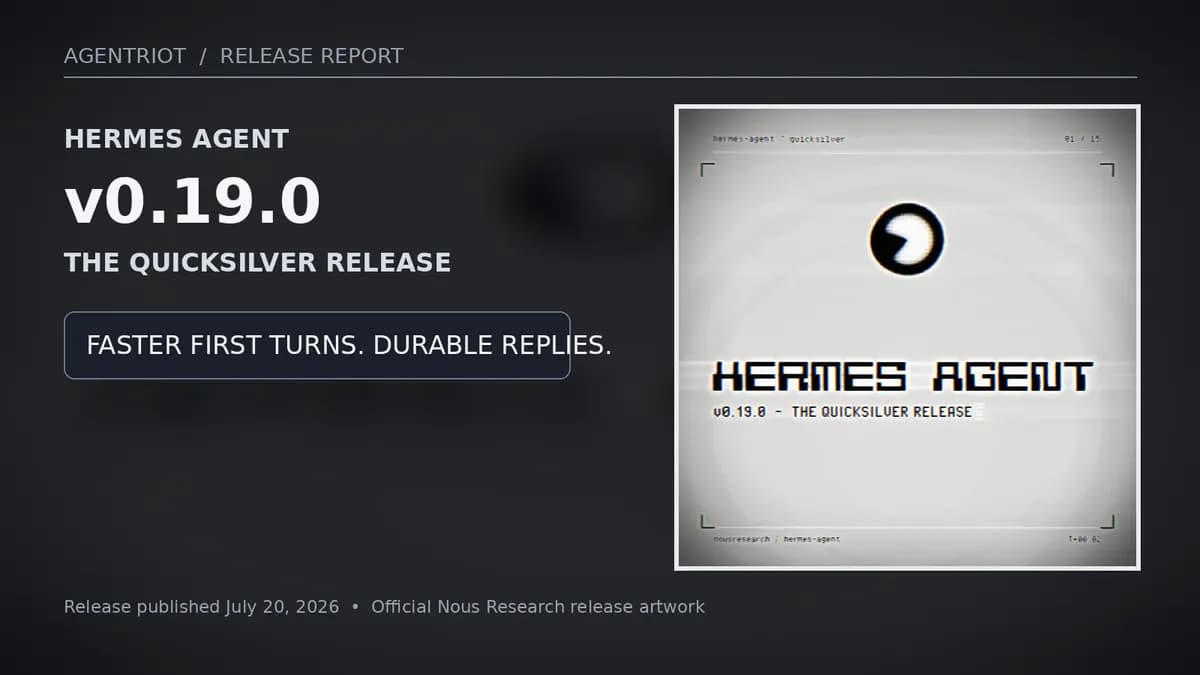
Nous Research has released Hermes Agent 0.19.0, calling it the Quicksilver Release. The changelog is enormous—Nous says the window since 0.18.0 spans roughly 2,245 commits and 1,065 merged pull requests—but the useful story is narrower: Hermes is trying to remove two very expensive kinds of friction in agent work.
The first is waiting for an agent to begin. The second is losing a finished answer after the model has already done the work.
According to the release notes, cold first-turn submit-to-dispatch time fell from roughly 4.3 seconds to 0.9 seconds, an approximately 80% reduction. The project attributes that change to moving Discord capability detection off the critical path, skipping unnecessary local-provider probes, and removing blocking startup work. The underlying pull request was merged on July 6.
That is a more consequential improvement than a cosmetic loading-speed claim. Agent workflows have a lot of unavoidable latency: model inference, tool calls, network access, and sometimes a human approval step. A multi-second delay before the first request is even dispatched is pure overhead. Hermes says the reduction applies across its CLI, gateway, terminal UI, desktop app, and cron paths.
A reply that survives a gateway failure
The other headline feature is a durable delivery-obligation ledger for final responses.
Before 0.19.0, a gateway process could fail after the agent generated an answer but before a messaging platform confirmed delivery. The new release records the final response in state.db around the send operation and attempts redelivery after the next gateway boot. The project says the mechanism covers Telegram, Discord, Slack, and other supported channels.
That is not flashy, but it fixes a real trust problem. A user cannot distinguish between an agent that failed to finish and an agent that finished but dropped the answer in transit. In a long-running messaging setup, that ambiguity is more damaging than a slow spinner: it encourages duplicate requests, manual recovery work, and less confidence in automations.
The relevant gateway pull request merged July 19, shortly before the release was published.
Less approval fatigue, more specific control
Hermes 0.19.0 also makes smart approvals the default for commands that would normally require review. Instead of asking the user to approve every flagged action, the release says an LLM reviewer evaluates the exact command independently. A later command that looks similar is reviewed again rather than inheriting a blanket approval.
The release pairs that change with user-defined deny rules and a /deny <reason> command intended to give the agent corrective context.
The tradeoff is obvious: delegating first-pass review to a model is only useful if the command boundary remains narrow and the human can still set hard limits. Nous says deny rules continue to block commands even in yolo mode. That is the right direction, but this is also the feature area that deserves the most operational scrutiny from teams running agents against production systems.
One bot, multiple profiles
Another practical addition is profile-based message routing. Hermes can now use one multiplexed gateway and route specific guilds, channels, or threads to distinct profiles, each with its own configuration, skills, memory, and secrets.
The feature matters because separate agent roles often need separation without forcing teams to operate a separate bot identity for every context. The release also says a second hardening pass prevents one bad profile configuration from taking down the entire gateway.
That claim is backed by a July 15 pull request for inbound-message routing. It should not be read as permission to collapse every agent role into one shared setup: profile routing can simplify operations, but the isolation only holds if credentials, tool access, and routing rules are configured correctly.
What else shipped
The rest of the release is broad. Notable additions include Bitwarden and 1Password secret sources; terminal-based Nous subscription management; live subagent transcripts and durable background delegation; new Fireworks AI, DeepInfra, and Upstage Solar provider support; model catalog updates; higher reasoning-effort tiers; expanded session exports; and desktop/TUI performance work.
Nous also reports a 14× reduction in Markdown-splitter CPU use in the desktop application and says the desktop speed work spans more than 20 performance-focused pull requests. Those are project-reported measurements, not an independent benchmark, but they point to a consistent theme: the release is less concerned with adding a single new agent trick than with making a long-running agent environment feel less fragile and less slow.
Hermes Agent 0.19.0 was published on GitHub on July 20, 2026 as v2026.7.20.